Coherent measures of the impact of co-authors in peer review journals and in proceedings publications
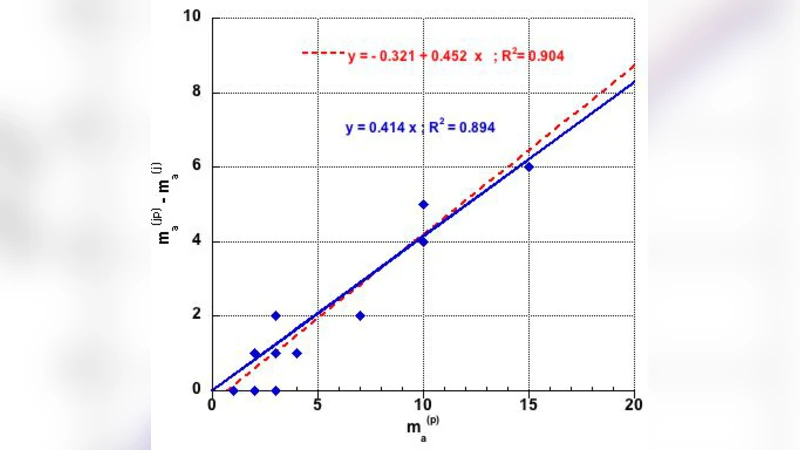
This paper focuses on the coauthor effect in different types of publications, usually not equally respected in measuring research impact. {\it A priori} unexpected relationships are found between the total coauthor core value, $m_a$, of a leading investigator (LI), and the related values for their publications in either peer review journals ($j$) or in proceedings ($p$). A surprisingly linear relationship is found: $ m_a^{(j)} + 0.4;m_a^{(p)} = m_a^{(jp)} $. Furthermore, another relationship is found concerning the measure of the total number of citations, $A_a$, i.e. the surface of the citation size-rank histogram up to $m_a$. Another linear relationship exists : $A_a^{(j)} + 1.36; A_a^{(p)} = A_a^{(jp)} $. These empirical findings coefficients (0.4 and 1.36) are supported by considerations based on an empirical power law found between the number of joint publications of an author and the rank of a coauthor. Moreover, a simple power law relationship is found between $m_a$ and the number ($r_M$) of coauthors of a LI: $m_a\simeq r_M^{\mu}$; the power law exponent $\mu$ depends on the type ($j$ or $p$) of publications. These simple relations, at this time limited to publications in physics, imply that coauthors are a “more positive measure” of a principal investigator role, in both types of scientific outputs, than the Hirsch index could indicate. Therefore, to scorn upon co-authors in publications, in particular in proceedings, is incorrect. On the contrary, the findings suggest an immediate test of coherence of scientific authorship in scientific policy processes.
💡 Research Summary
The manuscript investigates how the collaborative structure of a scientist, specifically a “leading investigator” (LI), can be quantified through two novel bibliometric indicators: the mₐ‑index and the Aₐ‑index. The mₐ‑index, analogous to the h‑index but based on joint publications rather than citations, is defined as the largest rank r for which the number of joint publications J(r) with a co‑author of rank r satisfies J(r) ≥ r. Empirically, J(r) follows a power‑law decay J(r) = J₀ · r^{–α} with α ≈ 1, a relationship previously reported for co‑author rank distributions. The Aₐ‑index is the cumulative sum of J(r) up to mₐ, i.e., Aₐ = ∑_{r=1}^{mₐ} J(r), representing the “area” under the joint‑publication‑versus‑rank histogram for the core co‑authors.
The authors separate each LI’s publication record into three sets: (j) peer‑reviewed journal articles, (p) conference‑proceedings papers, and (jp) the union of both. For each set they compute mₐ, Aₐ, as well as two derived quantities: a_M = Σ / mₐ (total joint publications normalized by the core size) and a_a = Aₐ / mₐ (average joint publications per core co‑author). The data comprise 15 physicists (mostly statistical physics) and four “binary scientific star” (BSS) cases, providing a modest but diverse sample.
The central empirical findings are strikingly simple linear relationships that link the combined (jp) measures to their journal (j) and proceedings (p) components:
- Core size: mₐ^{(j)} + 0.414 mₐ^{(p)} ≈ mₐ^{(jp)} with R² ≈ 0.894.
- Core area: Aₐ^{(j)} + 1.36 Aₐ^{(p)} ≈ Aₐ^{(jp)} with R² ≈ 0.998.
These equations imply that the contribution of proceedings papers to the overall core is weighted by a factor of roughly 0.4 for the size and 1.36 for the cumulative joint‑publication count. In other words, while proceedings add fewer distinct co‑authors (hence the smaller coefficient for mₐ), each such co‑author tends to contribute more joint publications on average (hence the larger coefficient for Aₐ).
Additional linear relations are observed for the normalized quantities a_M and a_a, but their coefficients (≈ 0.225 and ≈ 0.503, respectively) are accompanied by lower explanatory power (R² ≈ 0.58 and 0.96). The authors attribute this to the presence of outliers—specific LIs whose publication patterns deviate markedly from the bulk, such as a researcher with an unusually large number of co‑authors but only a single proceeding paper (DG), or investigators whose output is almost exclusively journal articles (AP, MM). Removing these outliers improves the fits, confirming that the linear trends are robust for the majority of cases.
To rationalize the observed coefficients, the authors invoke the continuous approximation of the power‑law rank distribution. Integrating J(r) = J₀ r^{–α} from r = 1 to r = R yields closed‑form expressions for the total joint publications Σ(R) and the core area A(R). Substituting the empirically estimated α values for journals (α_j ≈ 0.99) and proceedings (α_p ≈ 0.95) into these formulas reproduces the empirical weighting factors (≈ 0.4 and ≈ 1.36) with reasonable accuracy. Moreover, they find a scaling law mₐ ≈ r_M^{μ}, where r_M is the total number of distinct co‑authors and μ depends on the publication type (μ ≈ 0.6–0.8). This relationship links the size of the co‑author core to the breadth of the collaboration network.
The discussion emphasizes that the mₐ‑index and Aₐ‑index capture aspects of scientific productivity that the traditional h‑index overlooks, namely the structure and intensity of collaboration. The linear combination results demonstrate that proceedings should not be dismissed as “less valuable” – they contribute measurably to the collaborative core, especially when weighted by the number of joint publications. The authors argue that these metrics could serve as more equitable tools for research evaluation, tenure decisions, and funding allocations, as they reflect both the breadth (number of co‑authors) and depth (frequency of joint work) of a scientist’s collaborative network.
In conclusion, the paper provides empirical evidence that co‑author‑based indices obey simple, coherent linear relationships across different publication venues. These findings support the broader adoption of co‑author‑centric bibliometrics and call for a reassessment of policies that undervalue conference proceedings in the assessment of scientific impact.
Comments & Academic Discussion
Loading comments...
Leave a Comment