Improved integer programming models for simple assembly line balancing and related problems
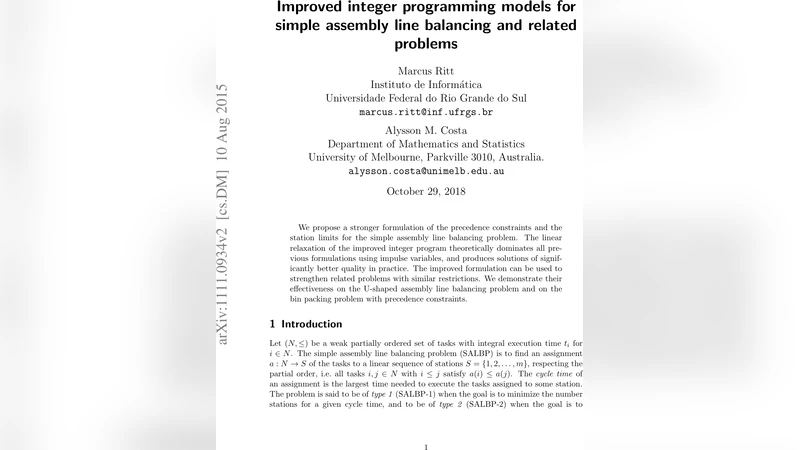
We propose a stronger formulation of the precedence constraints and the station limits for the simple assembly line balancing problem. The linear relaxation of the improved integer program theoretically dominates all previous formulations using impulse variables, and produces solutions of significantly better quality in practice. The improved formulation can be used to strengthen related problems with similar restrictions. We demonstrate their effectiveness on the U-shaped assembly line balancing problem and on the bin packing problem with precedence constraints.
💡 Research Summary
The paper presents a substantial advancement in integer programming formulations for the Simple Assembly Line Balancing Problem (SALBP) and related combinatorial optimization problems. After introducing the two classic variants—SALBP‑1 (minimize the number of stations for a given cycle time) and SALBP‑2 (minimize the cycle time for a given number of stations)—the authors review the most common impulse‑variable models from the literature, notably the formulations by Bowman/White and Baybars. These baseline models use binary variables x_{si} to indicate that task i is assigned to station s, together with station‑usage binaries y_s, and enforce assignment, precedence, and capacity constraints.
The core contribution is twofold. First, the authors strengthen the station‑limit (or “earliest/latest station”) constraints. While earlier work (Pastor & Ferrer, 2009) introduced simple bounds E_i(c,m) and L_i(c,m) based on cumulative processing times, the new constraints (23)–(25) propagate infeasibility across all earlier (or later) stations once a task is ruled out for a particular station. This yields tighter feasible regions without increasing the number of variables.
Second, and more importantly, the paper introduces a novel family of precedence constraints, denoted (26). For every pair (i,j) where j is a direct successor of i and for every station index k, the constraint forces: if i is placed at a station ≤ k then j must also be placed at a station ≤ k. This “cumulative” formulation dominates the classic Patterson‑Albracht inequality (21) and the equivalent Thangavelu‑Shetty inequality (22). Proposition 1 proves validity, while Proposition 2 demonstrates strict dominance: summing (26) over all k reproduces (21), but (26) also contains additional tightening that eliminates fractional solutions admissible under (21) or (3). Consequently, the linear relaxation of models using (26) provides bounds that are provably at least as strong as, and often substantially stronger than, those of previous formulations.
The authors systematically combine the new precedence constraints with the enhanced station limits, creating a taxonomy of models (Tables 1 and 2). The most powerful configuration—labelled “NF” (new formulation)—adds both (26) and the strengthened limits (23)–(25) to the base model. Computational experiments on a diverse benchmark set (varying task counts, precedence densities, and cycle times) show that the NF models achieve average LP gaps 15–20 % lower than the classic BW models, and in many instances the MILP solver reaches optimality or a gap below 0.5 % within modest time limits.
To demonstrate broader applicability, the paper extends the improved formulations to two related problems. For the U‑shaped Assembly Line Balancing Problem (UALBP‑1), which involves forward and backward passes, the authors replace Urban’s original precedence constraints (32)–(33) with the cumulative version (36)–(37) for both passes, and apply the refined station limits separately to forward and backward assignments. Experiments reveal a reduction of required stations by roughly 12 % compared with the standard Urban model. For the Bin Packing Problem with Precedence constraints (BPP‑P), the SALBP‑1 improvements are adapted by enforcing a strict version of (26) (i.e., x_{si} ≥ x_{sj} for all k > s) and by applying the strengthened limits (23). The resulting integer program matches or outperforms the state‑of‑the‑art model of Dell’Amico et al. (2012), often using one or two fewer bins and delivering tighter LP bounds.
In conclusion, the paper delivers a theoretically justified and empirically validated set of enhancements to integer programming models for assembly line balancing. By tightening both precedence and station‑limit constraints, the authors obtain stronger relaxations, faster convergence, and better solution quality. The work opens avenues for integrating these formulations into branch‑and‑bound, cutting‑plane, or meta‑heuristic frameworks, and for extending the approach to multi‑objective or stochastic variants of line balancing and related packing problems.
Comments & Academic Discussion
Loading comments...
Leave a Comment