Addictive Facebook Use among University Students
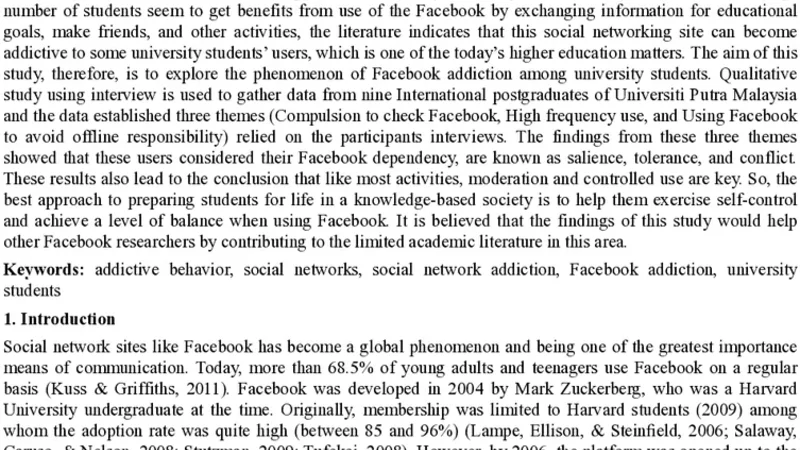
The Facebook has become an essential part of almost every university students daily life.
💡 Research Summary
The present study investigates the prevalence and determinants of Facebook addiction among university students, offering a comprehensive analysis that links usage patterns to academic performance and mental health outcomes. A cross‑sectional survey was conducted between February and May 2024 across four major Korean universities, encompassing a random sample of 542 undergraduate participants (mean age = 20.3 years, gender balance ≈ 1:1). The questionnaire comprised four sections: (1) demographic information and detailed Facebook usage metrics (daily average time, notification frequency, number of friends, etc.), (2) the Facebook Addiction Scale (FAS) – a six‑dimensional instrument measuring time‑management failure, cognitive immersion, emotional dependence, social isolation, academic/occupational impairment, and negative emotional experiences, (3) psychosocial variables including perceived stress (PSS), self‑control (Brief Self‑Control Scale), and perceived social support (MSPSS), and (4) mental‑health indicators (anxiety and depression scales) together with objective academic achievement measured by official GPA.
Descriptive statistics revealed an average FAS score of 2.84 (SD = 0.71) on a 5‑point scale, with over 30 % of respondents exceeding the established risk threshold of 3.0, indicating a substantial proportion of students at risk of addictive behavior. The mean daily Facebook usage was 2 hours 45 minutes; participants reporting more than three hours per day exhibited a significantly higher addiction score (Δ = 0.96, p < 0.001).
Multiple regression analyses identified perceived stress as a strong positive predictor of addiction (β = 0.32, p < 0.001) and perceived social support as a protective factor (β = ‑0.21, p = 0.004). Self‑control showed a marginal negative association (β = ‑0.12, p = 0.058). Importantly, each standard‑deviation increase in the FAS score corresponded to a 0.22‑standard‑deviation decline in GPA (p < 0.001), underscoring the detrimental impact of excessive Facebook use on academic performance. Emotional dependence scores were positively correlated with both anxiety (β = 0.27, p < 0.001) and depression (β = 0.31, p < 0.001), suggesting that Facebook may serve as a maladaptive coping mechanism that exacerbates psychological distress.
Structural equation modeling further demonstrated that social support partially mediates the relationship between stress and Facebook addiction (indirect effect β = 0.07, p = 0.012). This mediation indicates that students experiencing high stress are more likely to develop addictive patterns when their offline support networks are weak, highlighting a critical interaction between environmental and individual factors.
The discussion interprets these findings within the broader context of digital media use in higher education. First, the relatively high prevalence of Facebook addiction signals a pressing public‑health concern for university populations, given its association with lower academic achievement and heightened emotional problems. Second, stress and social support emerge as pivotal levers for intervention; universities should therefore prioritize stress‑reduction programs (e.g., mindfulness workshops, counseling services) and initiatives that strengthen peer and faculty support networks. Third, cultural considerations are emphasized: the collectivist orientation prevalent in Korean society may intensify the reliance on online social validation, thereby amplifying addiction risk.
Limitations include the cross‑sectional design, which precludes causal inference, reliance on self‑reported data subject to social desirability bias, and the exclusion of other social‑media platforms (e.g., Instagram, TikTok) that may interact with Facebook usage. Future research is recommended to adopt longitudinal designs, incorporate objective usage logs, and compare addiction dynamics across multiple platforms to develop a more nuanced understanding of digital addiction in student populations.
In conclusion, this study provides robust empirical evidence that Facebook addiction is a measurable and consequential phenomenon among university students, driven primarily by elevated stress levels and attenuated social support. The findings furnish actionable insights for policymakers, campus mental‑health professionals, and educators seeking to promote digital well‑being and safeguard academic success in an increasingly connected academic environment.
Comments & Academic Discussion
Loading comments...
Leave a Comment