Noise Addition for Individual Records to Preserve Privacy and Statistical Characteristics: Case Study of Real Estate Transaction Data
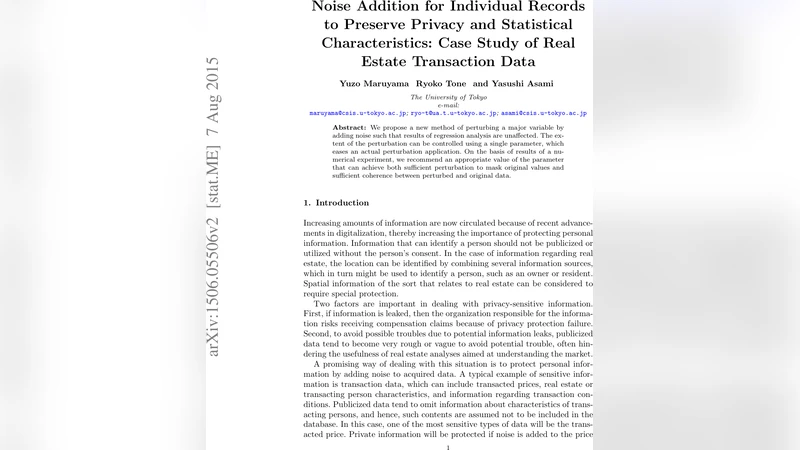
We propose a new method of perturbing a major variable by adding noise such that results of regression analysis are unaffected. The extent of the perturbation can be controlled using a single parameter, which eases an actual perturbation application. On the basis of results of a numerical experiment, we recommend an appropriate value of the parameter that can achieve both sufficient perturbation to mask original values and sufficient coherence between perturbed and original data.
💡 Research Summary
The paper addresses the tension between privacy protection and data utility in the context of real‑estate transaction data, where the sale price is a highly sensitive attribute. The authors propose a novel noise‑addition mechanism that perturbs the response variable (price) while leaving ordinary least‑squares (OLS) regression results—specifically the coefficient of determination (R²) and t‑statistics for each regression coefficient—unchanged.
The methodological core starts with a standard linear regression model y = Xβ + ε, where X is an n × (p + 1) design matrix (including an intercept) and y is the n‑dimensional vector of observed prices. Let e = y − Xβ̂ denote the residual vector from the OLS fit. The proposed noise vector η is constructed as a linear combination of e and an orthogonal component u derived from a random vector v that is projected onto the orthogonal complement of the column space of X and e. Formally,
η = a·‖e‖₁ + b·(e/‖e‖) + √b·(u/‖u‖),
with scalar parameters a (non‑zero) and b ≥ 0. The key theoretical results (Theorem 2.1) show that for any a and b: (1) the sample mean of y + η equals the original mean; (2) the OLS estimator computed on y + η is identical to that computed on y; (3) the t‑values are scaled by a factor that depends on a and b; (4) R² is transformed by a similar factor; and (5) the correlation between y and y + η can be expressed analytically.
Crucially, when a is set to –2, the scaling factors become unity for any b > 0. Thus, with a = –2 the OLS coefficients, t‑statistics, and R² remain exactly the same regardless of the random component v. The correlation between the original and perturbed responses simplifies to
r(y, y + η) = 1 − 2(1 − R²)/(1 + b).
Hence, the practitioner can control the trade‑off between privacy (larger b yields lower correlation, i.e., more distortion) and utility (the regression results are preserved for any b).
The authors validate the approach with a real data set from a Japanese real‑estate portal, comprising 1,320 newly built detached houses in Setagaya Ward, Tokyo. Variables include price, travel times to major stations, land area, floor area, building‑coverage ratio, and several dummy indicators. An OLS hedonic price model is fitted to the original data. Then, for three values of b (0.5, 1.0, 2.0) and a = –2, synthetic noise vectors are generated and added to the price variable. The empirical findings confirm the theory: regression coefficients, t‑values, and R² are identical across original and perturbed data sets.
Beyond regression, the authors examine multivariate analyses not covered by the theory, such as principal component analysis (PCA) and hierarchical clustering. As b increases, the perturbed data deviate more from the original in these secondary analyses, but the overall structure remains recognizable. The correlation values observed (≈0.85 for b = 0.5, ≈0.73 for b = 1.0, ≈0.55 for b = 2.0) suggest that a moderate b (0.5–1.0) offers a practical balance: sufficient distortion to impede re‑identification while retaining enough similarity for most exploratory analyses.
The discussion acknowledges limitations. The method guarantees invariance only for linear OLS models; logistic regression, non‑linear models, or variable‑selection procedures may be affected. The orthogonal component u requires a high‑dimensional random vector v to ensure true orthogonality, which may be computationally demanding for very large data sets. Moreover, the choice of b is context‑dependent: too small a b yields inadequate privacy, while too large a b reduces data usefulness.
Future work proposed includes extending the technique to generalized linear models, exploring simultaneous perturbation of multiple covariates, and developing automated procedures for selecting b based on formal disclosure‑risk metrics.
In summary, the paper delivers a mathematically elegant and practically simple solution for releasing sensitive real‑estate transaction data: by adding a specially crafted noise vector with a fixed a = –2 and a tunable b, data custodians can preserve exact OLS regression outcomes while providing a quantifiable privacy shield. This contribution bridges a gap between statistical disclosure limitation and the need for high‑quality public data, offering a valuable tool for government agencies, researchers, and commercial data providers.
Comments & Academic Discussion
Loading comments...
Leave a Comment