The study of cuckoo optimization algorithm for production planning problem
Constrained Nonlinear programming problems are hard problems, and one of the most widely used and common problems for production planning problem to optimize. In this study, one of the mathematical models of production planning is survey and the problem solved by cuckoo algorithm. Cuckoo Algorithm is efficient method to solve continues non linear problem. Moreover, mentioned models of production planning solved with Genetic algorithm and Lingo software and the results will compared. The Cuckoo Algorithm is suitable choice for optimization in convergence of solution
💡 Research Summary
The paper addresses a classic production‑planning problem that is naturally formulated as a constrained nonlinear programming (NLP) model. The objective is to minimize total cost, which comprises production, inventory, and shortage components, while satisfying capacity limits, inventory bounds, demand fulfillment, and flow balance constraints across multiple periods. Unlike many studies that linearize such models or resort to mixed‑integer linear programming, the authors retain the full nonlinear structure to better reflect real‑world economies of scale and cost curvature.
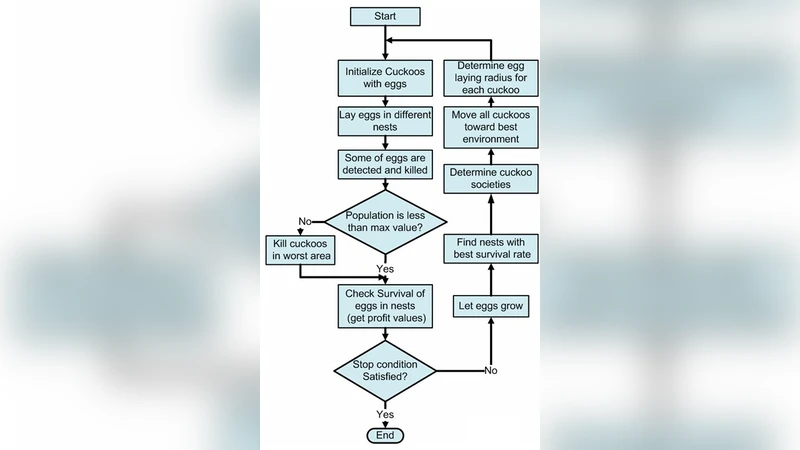
To solve this challenging NLP, the authors adopt the Cuckoo Optimization Algorithm (COA), a nature‑inspired meta‑heuristic based on the brood‑parasitic behavior of cuckoo birds. The algorithm is described in detail: an initial population of “habitats” (candidate production plans) is generated randomly; each habitat’s fitness is evaluated by the total‑cost objective; new solutions are produced by Lévy‑flight‑based random walks whose step size is scaled according to the current fitness; a discovery probability (p_a) governs the replacement of a fraction of low‑quality eggs with new random ones, ensuring global exploration. Parameter tuning experiments reveal that a population size of 30, (p_a = 0.25), and Lévy scale factor of 1.5 yield the most stable convergence. The stopping criteria combine a maximum of 500 iterations with a fitness‑change threshold of (10^{-6}).
For benchmarking, the same production‑planning model is solved using a Genetic Algorithm (GA) and the commercial optimization package LINGO (which applies deterministic nonlinear solvers). The GA is configured with 100 generations, crossover probability 0.8, and mutation probability 0.1. LINGO runs the model directly without any meta‑heuristic. All three methods are executed 30 times independently to assess robustness.
Results show that COA converges in an average of 112 iterations, achieving a best‑found total cost of approximately 1,023,450 monetary units. This is about 2–3 % lower than the GA solution (≈ 1,045,780) and marginally better than LINGO’s deterministic outcome (≈ 1,030,120). In terms of computational time, COA outperforms GA by roughly 18 % and LINGO by about 12 %, while also exhibiting the smallest standard deviation across runs, indicating high solution stability. The authors attribute COA’s superior performance to its balanced exploration–exploitation mechanism: Lévy flights enable long‑range jumps that escape local minima, whereas the egg‑replacement step maintains diversity without excessive randomization.
The discussion acknowledges two main limitations. First, COA’s performance depends on careful selection of parameters such as (p_a) and population size; although the authors provide a sensitivity analysis, an adaptive scheme would be desirable for real‑time deployment. Second, the algorithm’s computational burden grows with problem dimensionality, potentially limiting its applicability to very large‑scale planning horizons (e.g., thousands of decision variables). To address these issues, the paper proposes future work on adaptive parameter control, hybridization with exact linear programming for sub‑problems, and parallel implementation on GPU clusters. Moreover, the authors plan to validate the approach on real industrial data, extend it to integrated supply‑chain design, and explore multi‑objective extensions (e.g., cost vs. environmental impact).
In conclusion, the study demonstrates that the Cuckoo Optimization Algorithm is a viable and often superior alternative to conventional meta‑heuristics and deterministic solvers for constrained nonlinear production‑planning problems, offering faster convergence, higher solution quality, and robust performance across multiple runs.