Symmetries of matrix multiplication algorithms. I
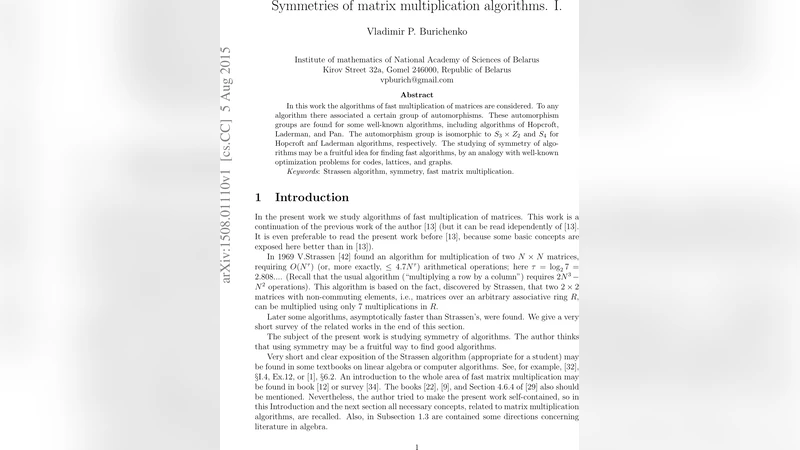
In this work the algorithms of fast multiplication of matrices are considered. To any algorithm there associated a certain group of automorphisms. These automorphism groups are found for some well-known algorithms, including algorithms of Hopcroft, Laderman, and Pan. The automorphism group is isomorphic to $S_3\times Z_2$ and $S_4$ for Hopcroft anf Laderman algorithms, respectively. The studying of symmetry of algorithms may be a fruitful idea for finding fast algorithms, by an analogy with well-known optimization problems for codes, lattices, and graphs. {\em Keywords}: Strassen algorithm, symmetry, fast matrix multiplication.
💡 Research Summary
The paper investigates the hidden symmetry structures of fast matrix‑multiplication algorithms by formalising the notion of an automorphism group attached to any bilinear algorithm. Starting from the classical viewpoint that a bilinear algorithm for multiplying an m×n matrix by an n×p matrix can be represented as a decomposition of the structure tensor
(h_{m,n,p}= \sum_{i,j,k} e_{ij}\otimes e_{jk}\otimes e_{ki})
into a sum of rank‑one tensors, the author defines an automorphism of an algorithm as a triple of invertible linear maps ((g_1,g_2,g_3)) acting respectively on the left‑input, right‑input and output spaces and preserving the whole set of algorithmic triples ({(a_\ell,b_\ell,c_\ell)}_{\ell=1}^r). Such a triple belongs to the isotropy (or stabiliser) subgroup of the structure tensor, and the collection of all such triples forms the automorphism group Aut(A) of the algorithm A.
The main technical contribution is the explicit determination of Aut(A) for three well‑known algorithms:
-
Hopcroft’s 3×2 by 2×3 algorithm (15 multiplications).
The algorithm can be written as six rank‑one triples derived from the 2×2 Strassen pattern. By analysing how permutations of the three basic triples and a global sign change act on the set, the author shows that Aut(H) is isomorphic to the direct product (S_3\times \mathbb Z_2). The symmetric group (S_3) corresponds to the six possible permutations of the three underlying Strassen‑type components, while the (\mathbb Z_2) factor reflects the possibility of simultaneously multiplying all three components by –1. -
Laderman’s 3×3 algorithm (23 multiplications).
Laderman’s construction consists of 23 rank‑one triples, but essentially only four independent triples generate the whole set under permutation. The author proves that any automorphism must permute these four triples arbitrarily, yielding the full symmetric group (S_4) as the automorphism group. No extra sign‑flip symmetry appears because the coefficients of the four core triples are not all simultaneously scalable. -
Pan’s trilinear‑aggregation family (P_{2^m}) (n=2^m).
This family recursively embeds m copies of the 2×2 Strassen algorithm into a larger matrix multiplication scheme. The automorphism group is shown to be (S_m\times \mathbb Z_2\times S_3). The factor (S_m) permutes the m independent Strassen blocks; the (\mathbb Z_2) factor corresponds to a global sign inversion of all blocks; and the final (S_3) reflects the three internal symmetries of each 2×2 Strassen block (row/column swaps and transposition). The paper provides explicit matrix representations for each of these actions.
To obtain these results, the author first determines the isotropy group of the structure tensor (h_{m,n,p}). This group is essentially (GL_m\times GL_n\times GL_p) together with the involution that transposes the three tensor factors. By intersecting this isotropy group with the stabiliser of the specific set of triples defining an algorithm, the automorphism group is isolated. The analysis involves checking which permutations and sign changes leave the system of equations (the bilinear identities) invariant.
The paper argues that large automorphism groups are indicative of highly symmetric algorithmic structures, which may be advantageous for algorithm discovery. Symmetric algorithms tend to have fewer essentially different configurations, making exhaustive or heuristic searches more tractable. Moreover, the presence of a rich symmetry group may correlate with optimality (minimal multiplication count) because symmetry often forces the algorithm into a tightly constrained form.
In the concluding section, the author suggests several future directions: (i) developing automated tools that exploit symmetry to search for new low‑rank tensor decompositions; (ii) extending the symmetry analysis to higher‑dimensional analogues of Strassen’s method, possibly revealing new families of fast algorithms; (iii) investigating whether the size of Aut(A) can serve as a heuristic predictor of an algorithm’s asymptotic exponent ω. The work thus bridges algebraic group theory, tensor decomposition, and computational complexity, providing a fresh perspective on the longstanding problem of fast matrix multiplication.
Comments & Academic Discussion
Loading comments...
Leave a Comment