Light-Emitting Diodes in the Solid-State Lighting Systems
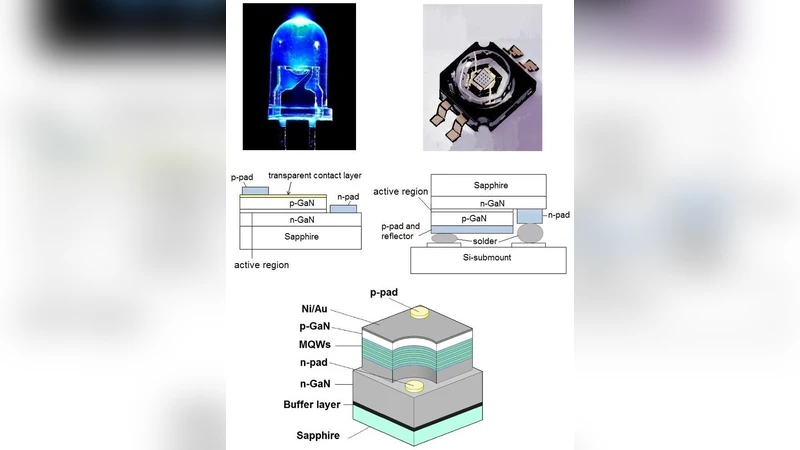
Red and green light-emitting diodes (LEDs) had been produced for several decades before blue emitting diodes, suitable for lighting applications, were widely available. Today, we have the possibility of combining the three fundamental colours to have a bright white light. And therefore, a new form of lighting, the solid-state lighting, has now become a reality. Here we discuss LEDs and some of their applications in displays and lamps.
💡 Research Summary
The paper provides a comprehensive overview of light‑emitting diodes (LEDs) as the cornerstone of solid‑state lighting (SSL) systems, tracing their historical development, underlying physics, material science, device engineering, and practical applications in both display and illumination technologies. It begins by highlighting the inefficiencies and environmental drawbacks of conventional incandescent and fluorescent lighting, establishing the need for a more energy‑conserving alternative. The authors then recount the evolution of LED technology: red and green devices based on AlGaAs and InGaN emerged in the 1960s, while the breakthrough for blue LEDs arrived in the late 1990s with the maturation of high‑quality gallium nitride (GaN) substrates, p‑type doping techniques, and metal‑organic chemical vapor deposition (MOCVD) processes.
Fundamentally, LED operation is explained through semiconductor band‑gap physics: when forward bias drives electrons and holes across a p‑n junction, their radiative recombination emits photons whose energy matches the material’s band‑gap. Consequently, the choice of semiconductor determines the emission wavelength. Blue LEDs, requiring a wide band‑gap (~2.8 eV), demand higher operating voltages and suffer from the well‑known “efficiency droop” at high current densities. The paper identifies Auger recombination, carrier overflow, and thermal losses as primary contributors to this droop, and discusses mitigation strategies such as thin quantum‑well designs, high‑conductivity contacts, and thermally conductive substrates like silicon carbide (SiC) or aluminum nitride (AlN).
Two principal routes to white light generation are examined. The first, an RGB approach, combines separate red, green, and blue LEDs, offering excellent color rendering index (CRI) and tunable correlated color temperature (CCT) but requiring complex driver circuitry and careful color‑balance control. The second, a phosphor‑converted single‑chip method, coats a blue LED with a yellow cerium‑doped yttrium aluminum garnet (YAG:Ce) phosphor, converting part of the blue emission into yellow to produce white light. This method simplifies manufacturing and reduces cost, yet its spectral quality depends on phosphor stability, thermal quenching, and limits CCT adjustability. Emerging alternatives, such as multi‑layer phosphor stacks or AlGaN‑based UV/blue LEDs that directly excite red and green phosphors, are also discussed.
Optical engineering techniques aimed at maximizing light extraction efficiency (LEE) are detailed. Surface texturing (micro‑ and nano‑structures), high‑reflectivity reflectors, dome lenses, and diffuser designs are shown to reduce total internal reflection and raise LEE to 70‑80 %. The authors present experimental data confirming that patterned pyramidal surfaces can significantly improve photon out‑coupling without compromising device reliability.
Application domains are divided into displays and illumination. In display technology, LEDs serve as backlights for liquid‑crystal displays (LCDs), excitation sources for organic LEDs (OLEDs), and as the emissive elements in emerging micro‑LED panels, delivering high brightness, rapid response, and wide color gamut while consuming far less power than traditional backlights. In illumination, the paper surveys residential bulbs, office lighting, automotive headlamps, and street lighting, emphasizing that LED fixtures achieve over 80 % energy savings relative to incandescent sources and typically exceed 50 000 hours of operational life. Integration with smart‑lighting platforms enables wireless dimming, dynamic CCT adjustment, and human‑centric lighting schemes that align artificial illumination with circadian rhythms.
The final section addresses remaining challenges and future research directions. Long‑term reliability under thermal cycling, humidity, and high‑current stress remains a critical concern, prompting advances in package design and heat‑sink engineering. Cost reduction for high‑efficiency blue LEDs hinges on scaling GaN wafer production and optimizing large‑area MOCVD processes. The pursuit of phosphor‑free white light—through high‑efficiency multi‑color LED arrays or novel Al‑rich AlGaN alloys—represents a key frontier. The authors conclude that LED technology epitomizes a multidisciplinary convergence of materials science, electrical engineering, and optical design, and that continued innovation will solidify solid‑state lighting as the dominant, environmentally sustainable illumination paradigm worldwide.