Revolutionaries and spies: Spy-good and spy-bad graphs
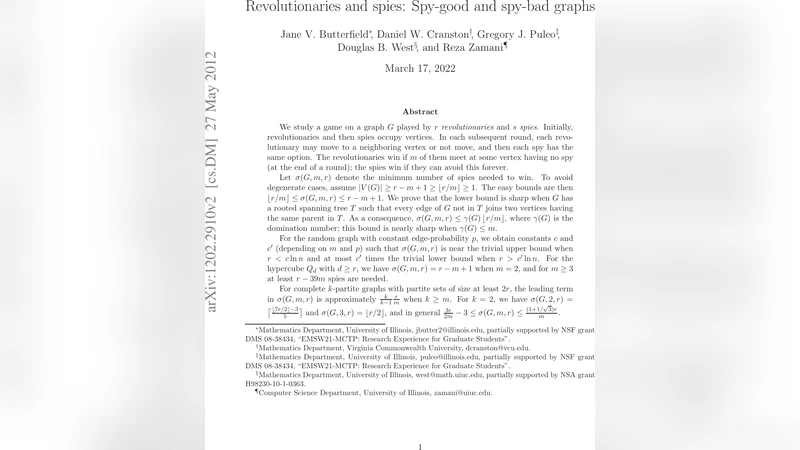
We study a game on a graph $G$ played by $r$ {\it revolutionaries} and $s$ {\it spies}. Initially, revolutionaries and then spies occupy vertices. In each subsequent round, each revolutionary may move to a neighboring vertex or not move, and then each spy has the same option. The revolutionaries win if $m$ of them meet at some vertex having no spy (at the end of a round); the spies win if they can avoid this forever. Let $\sigma(G,m,r)$ denote the minimum number of spies needed to win. To avoid degenerate cases, assume $|V(G)|\ge r-m+1\ge\floor{r/m}\ge 1$. The easy bounds are then $\floor{r/m}\le \sigma(G,m,r)\le r-m+1$. We prove that the lower bound is sharp when $G$ has a rooted spanning tree $T$ such that every edge of $G$ not in $T$ joins two vertices having the same parent in $T$. As a consequence, $\sigma(G,m,r)\le\gamma(G)\floor{r/m}$, where $\gamma(G)$ is the domination number; this bound is nearly sharp when $\gamma(G)\le m$. For the random graph with constant edge-probability $p$, we obtain constants $c$ and $c’$ (depending on $m$ and $p$) such that $\sigma(G,m,r)$ is near the trivial upper bound when $r<c\ln n$ and at most $c’$ times the trivial lower bound when $r>c’\ln n$. For the hypercube $Q_d$ with $d\ge r$, we have $\sigma(G,m,r)=r-m+1$ when $m=2$, and for $m\ge 3$ at least $r-39m$ spies are needed. For complete $k$-partite graphs with partite sets of size at least $2r$, the leading term in $\sigma(G,m,r)$ is approximately $\frac{k}{k-1}\frac{r}{m}$ when $k\ge m$. For $k=2$, we have $\sigma(G,2,r)=\bigl\lceil{\frac{\floor{7r/2}-3}5}\bigr\rceil$ and $\sigma(G,3,r)=\floor{r/2}$, and in general $\frac{3r}{2m}-3\le \sigma(G,m,r)\le\frac{(1+1/\sqrt3)r}{m}$.
💡 Research Summary
The paper introduces a pursuit–evasion game played on a finite graph G involving r revolutionaries and s spies. After an initial placement, each round proceeds in two phases: first every revolutionary may either stay put or move to an adjacent vertex, then each spy makes the same choice. The revolutionaries win as soon as at least m of them occupy a vertex that contains no spy at the end of a round; the spies win by preventing this situation indefinitely. The central parameter is σ(G,m,r), the smallest number of spies that guarantees a perpetual win for the spies. Under the natural size condition |V(G)| ≥ r‑m+1 ≥ ⌊r/m⌋ ≥ 1, the trivial bounds are ⌊r/m⌋ ≤ σ(G,m,r) ≤ r‑m+1.
The authors first identify a broad class of “tree‑good” graphs for which the lower bound is tight. If G contains a rooted spanning tree T such that every edge not in T joins two vertices sharing the same parent in T, then σ(G,m,r)=⌊r/m⌋. This structural condition captures many hierarchical graphs and shows that a simple tree decomposition can be exploited by the spies. From this they derive the general inequality σ(G,m,r) ≤ γ(G)·⌊r/m⌋, where γ(G) is the domination number. When γ(G) ≤ m the bound is essentially optimal, indicating that domination number is a natural measure of a graph’s “spy‑friendliness.”
For random graphs G(n,p) with constant edge‑probability p, the paper establishes a phase transition around logarithmic values of r. There exist constants c(p,m) and c′(p,m) such that if r < c ln n then σ(G,m,r) is close to the trivial upper bound r‑m+1, whereas if r > c′ ln n then σ(G,m,r) is at most a constant factor above the trivial lower bound ⌊r/m⌋. Thus, a modest number of revolutionaries (sub‑logarithmic) can be easily contained, while a super‑logarithmic number forces the spies to allocate roughly r/m agents.
The hypercube Q_d (dimension d ≥ r) is examined next. For m = 2 the exact value σ(Q_d,2,r)=r‑1 holds, matching the trivial upper bound. For m ≥ 3 the authors prove a linear lower bound σ(Q_d,m,r) ≥ r‑39m, showing that even in a highly symmetric, high‑dimensional graph a substantial spy force is required when the meeting size grows.
Finally, the paper treats complete k‑partite graphs with each part of size at least 2r. When k ≥ m the leading term of σ is approximately (k/(k‑1))·(r/m). In the bipartite case (k = 2) they obtain exact formulas: σ(G,2,r)=⌈(⌊7r/2⌋‑3)/5⌉ and σ(G,3,r)=⌊r/2⌋. For general m they prove the bounds (3r)/(2m)‑3 ≤ σ(G,m,r) ≤ (1+1/√3)·r/m.
Overall, the work provides a comprehensive analysis of the spy‑revolutionary game across several fundamental graph families. By linking σ(G,m,r) to structural parameters such as spanning‑tree hierarchies, domination number, and partite size, the authors illuminate how graph topology governs the balance of power between pursuers and evaders. The results have potential implications for network security, information‑flow control, and any domain where coordinated attacks must be thwarted by limited defensive resources.
Comments & Academic Discussion
Loading comments...
Leave a Comment