Numerical Study of K{alpha} X-ray Emission from Multi-layered Cold and Compressed Targets Irradiated by Ultrashort Laser Pulses
In this paper the generation of K{ alpha} X-ray produced by interaction of ultrashort laser pulses with metal targets has been studied numerically. Several targets were assumed to be irradiated by hig
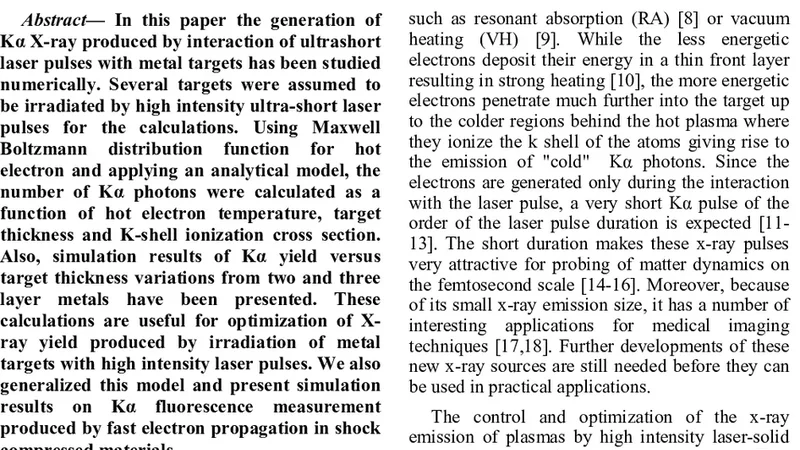
In this paper the generation of K{\alpha} X-ray produced by interaction of ultrashort laser pulses with metal targets has been studied numerically. Several targets were assumed to be irradiated by high intensity ultra-short laser pulses for the calculations. Using Maxwell Boltzmann distribution function for hot electron and applying an analytical model, the number of K{\alpha} photons were calculated as a function of hot electron temperature, target thickness and K-shell ionization cross section. Also, simulation results of K{\alpha} yield versus target thickness variations from two and three layer metals have been presented. These calculations are useful for optimization of X-ray yield produced by irradiation of metal targets with high intensity laser pulses. We also generalized this model and present simulation results on K{\alpha} fluorescence measurement produced by fast electron propagation in shock compressed materials.
💡 Research Summary
This paper presents a comprehensive numerical investigation of K‑alpha X‑ray generation when ultra‑short, high‑intensity laser pulses interact with metallic targets. The authors adopt a Maxwell‑Boltzmann distribution to describe the hot‑electron population produced at the laser‑irradiated surface and develop an analytical framework that links the number of emitted K‑alpha photons to three principal parameters: hot‑electron temperature (T_h), target thickness (d), and the K‑shell ionization cross‑section (σ_K).
The hot‑electron temperature is assumed to scale with the laser intensity (I) and wavelength (λ) according to the well‑known I·λ² ∝ T_h² law, allowing the authors to express the electron flux as Φ_e(E) = n_0 exp(−E/kT_h). Electron transport through the target is modeled with a continuous slowing‑down approximation that incorporates energy loss (dE/dx) and angular scattering. At each depth x, the probability of K‑shell ionization is given by σ_K(E), which is interpolated from standard atomic data (e.g., Scofield). The emitted K‑alpha photon then experiences exponential attenuation governed by the material‑specific linear attenuation coefficient μ_Kα. The total photon yield is obtained by integrating over electron energy and depth:
N_Kα = ∫0^d ∫{E_min}^{∞} Φ_e(E) σ_K(E) exp
📜 Original Paper Content
🚀 Synchronizing high-quality layout from 1TB storage...