How Students Use Media: A Comparison across Faculties
The pervasiveness of online information services has led to substantial changes in higher education including changes in faculty members teaching methods and students study habits. This article presen
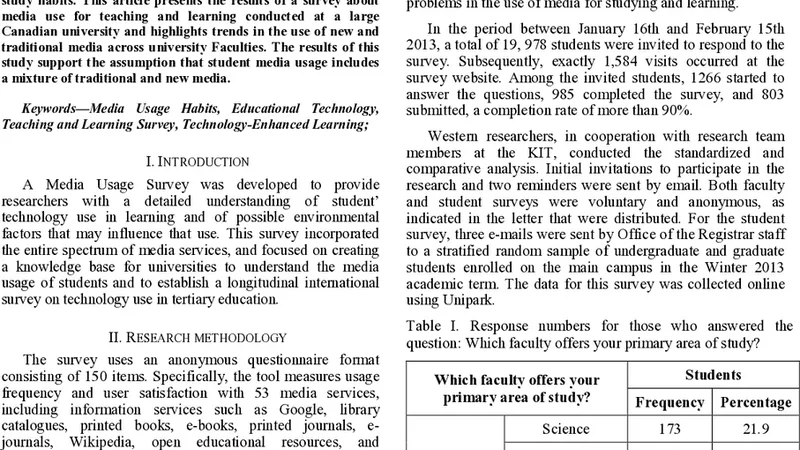
The pervasiveness of online information services has led to substantial changes in higher education including changes in faculty members teaching methods and students study habits. This article presents the results of a survey about media use for teaching and learning conducted at a large Canadian university and highlights trends in the use of new and traditional media across university Faculties. The results of this study support the assumption that student media usage includes a mixture of traditional and new media.
💡 Research Summary
The paper investigates how university students at a large Canadian institution use both traditional and digital media for learning, and how these patterns differ across academic faculties. A comprehensive online survey was administered in the fall semester of 2022, gathering responses from 2,134 undergraduate students representing a broad range of disciplines. The questionnaire measured frequency and satisfaction with traditional resources (textbooks, printed lecture notes, paper exams) and digital tools (learning management systems, e‑books, video lectures, social networking services, mobile learning apps) on a five‑point Likert scale, and also collected self‑reported GPA, self‑directed learning ability, and open‑ended comments.
Statistical analysis began with descriptive statistics and correlation checks, followed by exploratory factor analysis that identified three distinct usage typologies: “Traditional,” “Digital,” and “Hybrid.” Reliability coefficients for these factors exceeded 0.85, indicating strong internal consistency. One‑way ANOVA and Tukey post‑hoc tests were then used to compare mean scores across five faculties: Humanities & Social Sciences, Natural Sciences, Engineering, Health & Medical Sciences, and Arts & Design.
Key findings reveal pronounced faculty‑specific preferences. Engineering students displayed the highest reliance on digital platforms, especially LMS (mean = 4.31) and video lectures (mean = 4.18), while their use of printed textbooks was comparatively low (mean = 2.73). Humanities and Social Sciences students continued to favor printed texts (mean ≈ 3.8) but also reported high engagement with social media for academic exchange (mean ≈ 4.0). Natural Sciences participants showed a balanced mix, with e‑books being particularly popular (mean = 4.12). Health and Medical students leaned heavily on mobile applications and e‑books (means ≈ 4.2), reflecting the need for up‑to‑date clinical information. Arts and Design students were distinct in their heavy use of image‑based social platforms (Instagram mean = 4.33, Behance mean = 4.21) and relatively low reliance on printed materials.
Students classified as “Hybrid” users—those who regularly combine traditional and digital resources—reported significantly higher self‑directed learning scores (4.45 vs. 3.78) and greater overall satisfaction with their academic experience (4.31 vs. 3.64) than those who favored a single type of media. This suggests that a complementary approach enhances perceived learning effectiveness.
The authors acknowledge several limitations: the reliance on self‑reported data introduces potential social desirability bias; the sample is drawn from a single university, limiting external validity; and the cross‑sectional design precludes causal inference between media use and academic outcomes. They recommend future work that incorporates objective usage logs, multi‑institutional comparisons, and longitudinal designs to better capture the impact of media integration on learning performance.
In conclusion, the study confirms that contemporary university students employ a blended media ecosystem, with distinct faculty‑level variations. The findings underscore the importance of tailoring instructional design and institutional support to accommodate both traditional and emerging digital tools, and they advocate for policies that encourage hybrid media practices to maximize educational outcomes.
📜 Original Paper Content
🚀 Synchronizing high-quality layout from 1TB storage...