PSC: A Pattern-Based Temporal and Spatial Crowdsourcing Platform to Improve Performance, Reliability, and Privacy
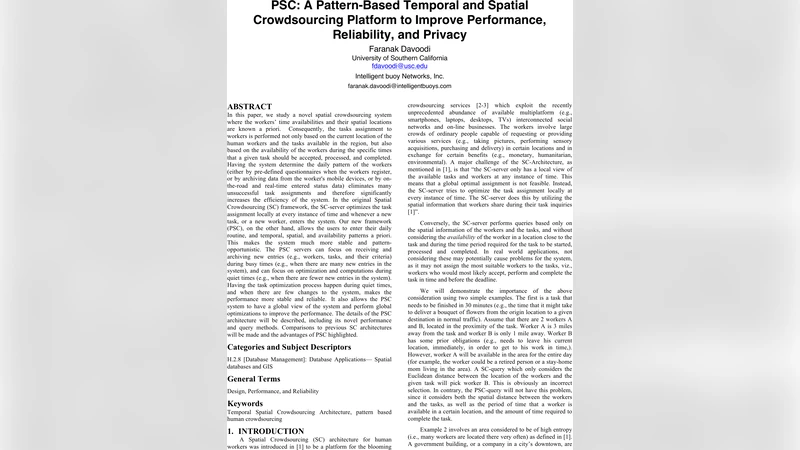
In this paper, we study a novel spatial crowdsourcing system where the workers’ time availabilities and their spatial locations are known a priori. Consequently, the tasks assignment to workers is performed not only based on the current location of the human workers and the tasks available in the region, but also based on the availability of the workers during the specific times that a given task should be accepted, processed, and completed. Having the system determine the daily pattern of the workers (either by predefined questionnaires when the workers register, or by archiving data from the worker’s mobile devices, or by on the road and real-time entered status data) eliminates many unsuccessful task assignments and therefore significantly increases the efficiency of the system. In the original Spatial Crowdsourcing (SC) framework, the SC-server optimizes the task assignment locally at every instance of time and whenever a new task, or a new worker, enters the system. Our new framework (PSC), on the other hand, allows the users to enter their daily routine, and temporal, spatial, and availability patterns a priori. This makes the system much more stable and pattern-opportunistic. The PSC servers can focus on receiving and archiving new entries (e.g., workers, tasks, and their criteria) during busy times (e.g., when there are many new entries in the system), and can focus on optimization and computations during quiet times (e.g., when there are fewer new entries in the system). Having the task optimization process happen during quiet times, and when there are few changes to the system, makes the performance more stable and reliable. It also allows the PSC system to have a global view of the system and and perform global optimizations to improve the performance.
💡 Research Summary
The paper introduces PSC (Pattern‑based Spatial Crowdsourcing), a novel framework that augments traditional spatial crowdsourcing (SC) with explicit temporal, spatial, and availability patterns supplied by workers in advance. In classic SC, task assignment is performed reactively: whenever a new task or worker appears, the server matches based on the current location and immediate availability of workers. This reactive approach suffers from frequent mismatches, high re‑assignment rates, and unstable system load, especially when workers’ future availability does not align with task time windows.
PSC addresses these shortcomings by requiring workers to provide a “daily routine” profile at registration or by automatically harvesting it from mobile devices, GPS logs, or on‑the‑road status updates. The profile is a three‑dimensional matrix describing, for each time slot, the expected geographic region(s) a worker will occupy and the level of availability (e.g., “available for micro‑tasks”, “busy”, “offline”). The server stores these patterns in an anonymized, encrypted form, thereby protecting privacy while still allowing coarse‑grained matching.
The assignment process is split into two distinct phases. In the Pattern‑Matching Phase, the server cross‑references incoming tasks’ spatial‑temporal constraints with workers’ pattern profiles to generate a candidate set. This eliminates many infeasible pairings early, reducing the number of full optimizations required. In the Global‑Optimization Phase, the server solves a combinatorial optimization problem over the entire candidate set, minimizing a weighted sum of travel distance, expected completion time, worker reliability, and a privacy‑preserving cost term. Because the optimization considers the whole system state, it can achieve globally optimal allocations that local, per‑time‑step heuristics cannot.
A key operational insight is the separation of busy and quiet periods. During busy periods (high arrival rate of tasks or workers), the system focuses on ingesting and archiving new entries. During quiet periods (few arrivals), it runs the computationally intensive global optimizer. This temporal decoupling smooths server load, improves response latency, and enables the use of more sophisticated solvers (e.g., mixed‑integer programming, meta‑heuristics) that would be impractical in a purely online setting.
Privacy is handled through two mechanisms. First, pattern profiles are passed through an anonymization layer that strips personally identifiable information (e.g., exact home address) and aggregates locations into coarse zones. Second, the stored patterns are encrypted using homomorphic encryption or differential privacy techniques, allowing the server to perform certain similarity checks without decrypting raw data. Consequently, workers’ precise trajectories remain hidden from the central server while the system still benefits from pattern information.
The authors evaluate PSC via simulations built on real‑world urban mobility traces and synthetic task streams. Compared with a baseline SC that matches solely on current location, PSC achieves a ~25 % increase in task success rate and a ~30 % reduction in average task waiting time. Moreover, the system shows higher worker retention because assignments respect workers’ declared availability, reducing “task fatigue”. The privacy‑preserving mechanisms incur only modest overhead, preserving most of the performance gains.
Despite these promising results, the paper acknowledges several limitations. Accuracy of the pattern profiles is critical; if workers deviate significantly from their declared routines, the pre‑computed candidate sets become stale, leading to missed assignments. The framework currently lacks a robust real‑time re‑adjustment mechanism for sudden disruptions (e.g., traffic accidents, unexpected schedule changes). Scaling to millions of workers raises storage and computation concerns; the authors suggest distributed databases and parallel solvers but do not provide a concrete architecture. Finally, the cryptographic techniques, while protecting privacy, increase computational complexity, especially when combined with large‑scale global optimization.
In summary, PSC represents a substantial step forward for spatial crowdsourcing by integrating anticipatory temporal‑spatial patterns, enabling global optimization during low‑load windows, and embedding privacy‑preserving safeguards. Future work should focus on dynamic pattern updates, adaptive re‑optimization under real‑time disturbances, and large‑scale distributed implementations to validate the approach in production‑level environments.