Viral marketing as epidemiological model
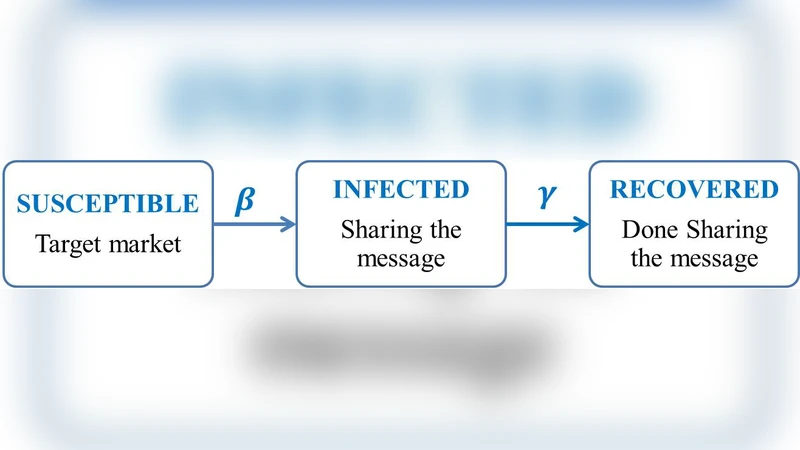
In epidemiology, an epidemic is defined as the spread of an infectious disease to a large number of people in a given population within a short period of time. In the marketing context, a message is viral when it is broadly sent and received by the target market through person-to-person transmission. This specific marketing communication strategy is commonly referred as viral marketing. Due to this similarity between an epidemic and the viral marketing process and because the understanding of the critical factors to this communications strategy effectiveness remain largely unknown, the mathematical models in epidemiology are presented in this marketing specific field. In this paper, an epidemiological model SIR (Susceptible- Infected-Recovered) to study the effects of a viral marketing strategy is presented. It is made a comparison between the disease parameters and the marketing application, and simulations using the Matlab software are performed. Finally, some conclusions are given and their marketing implications are exposed: interactions across the parameters are found that appear to suggest some recommendations to marketers, as the profitability of the investment or the need to improve the targeting criteria of the communications campaigns.
💡 Research Summary
The paper “Viral marketing as epidemiological model” adapts the classic SIR (Susceptible‑Infected‑Recovered) framework from infectious disease epidemiology to study the dynamics of viral marketing campaigns. The authors begin by outlining the rise of digital word‑of‑mouth (WOM) strategies, noting that consumer‑initiated sharing can achieve rapid, large‑scale diffusion at lower cost than traditional mass media. They then map the epidemiological compartments onto marketing concepts: “Susceptible” (S) represents potential customers who have not yet encountered the message, “Infected” (I) denotes individuals who have received the message and are actively forwarding it, and “Recovered” (R) comprises those who have stopped sharing.
Four key parameters are defined: δ (contact rate), τ (probability that a contact leads to transmission), β = δ·τ (overall infectivity), and γ (recovery rate, i.e., the rate at which sharers lose interest or forget). The total population N = S + I + R is assumed constant. The governing differential equations are the standard SIR system: dS/dt = –βSI/N, dI/dt = βSI/N – γI, dR/dt = γI, with initial conditions S(0)=900, I(0)=100, R(0)=0 for a population of 1,000.
Using MATLAB’s ode45 solver, the authors conduct a series of simulations. First, they vary β while keeping γ = 0.1. Higher β values (0.25, 0.5, 0.7) produce earlier and higher infection peaks, and the cumulative recovered population (the total number of people who ever shared the message) rises from roughly 400 to over 800. Next, they keep β = 0.25 and vary γ (0.01, 0.1, 0.2, 0.5). Larger γ values dramatically reduce both the height of the infection curve and the final number of sharers, illustrating that rapid loss of interest curtails campaign reach.
A third set of experiments explores the effect of the initial seed size I(0). Simulations with I(0) = 1, 10, 100, and 200 show that while a larger seed accelerates the time to peak, the marginal benefit diminishes beyond a seed proportion of about 10‑20% of the target audience. In practical terms, investing heavily to seed more than 10% of the market yields little additional reach but incurs higher costs.
The authors conclude that the infectivity parameter β is the most influential lever for marketers: increasing contact opportunities (e.g., through richer social network structures) and enhancing message attractiveness (raising τ) can dramatically expand reach. Conversely, reducing the recovery rate γ—by keeping the message relevant, offering incentives, or minimizing fatigue—extends the sharing lifespan. They advise focusing on network‑building and precise targeting rather than overspending on large seed groups.
Limitations of the study include the assumption of a closed, fixed‑size population, the exclusion of external influences such as competing campaigns or media exposure, and the lack of a “exposed” compartment that would capture individuals who have seen the message but have not yet decided to share. The authors suggest future work could incorporate SEIR models, agent‑based network simulations, and calibration with real‑world campaign data to improve predictive power and practical relevance.
Comments & Academic Discussion
Loading comments...
Leave a Comment