Relational Foundations For Functorial Data Migration
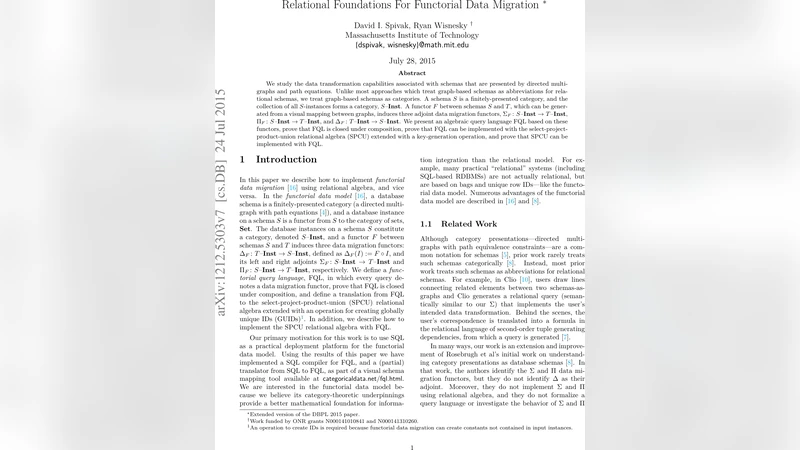
We study the data transformation capabilities associated with schemas that are presented by directed multi-graphs and path equations. Unlike most approaches which treat graph-based schemas as abbreviations for relational schemas, we treat graph-based schemas as categories. A schema $S$ is a finitely-presented category, and the collection of all $S$-instances forms a category, $S$-inst. A functor $F$ between schemas $S$ and $T$, which can be generated from a visual mapping between graphs, induces three adjoint data migration functors, $\Sigma_F:S$-inst$\to T$-inst, $\Pi_F: S$-inst $\to T$-inst, and $\Delta_F:T$-inst $\to S$-inst. We present an algebraic query language FQL based on these functors, prove that FQL is closed under composition, prove that FQL can be implemented with the select-project-product-union relational algebra (SPCU) extended with a key-generation operation, and prove that SPCU can be implemented with FQL.
💡 Research Summary
The paper reconceptualizes database schemas not as mere abbreviations for relational tables but as finitely‑presented categories built from directed multigraphs together with path equations. An instance of a schema S is a functor from S to the category of sets, and the collection of all such instances forms the category S‑inst. A mapping between schemas is expressed as a functor F : S → T, which automatically generates three adjoint data‑migration functors:
- Σ_F (left Kan extension) pushes an S‑instance forward to a T‑instance, creating new tuples when necessary; it corresponds to a “union‑like” propagation of data.
- Π_F (right Kan extension) aggregates or restricts an S‑instance into a T‑instance, analogous to grouping and aggregation.
- Δ_F (pullback or restriction) pulls a T‑instance back along F, providing a reverse migration.
These three functors satisfy the adjunction chain Σ_F ⊣ Δ_F ⊣ Π_F, guaranteeing that information loss is controlled and that inverse transformations exist in a categorical sense.
Building on this foundation, the authors introduce FQL (Functorial Query Language), whose primitive operations are precisely Σ, Π, and Δ. They prove that FQL is closed under composition: any sequence of FQL queries can be rewritten as a single FQL expression. This closure property is essential for query optimisation and for reasoning about complex data pipelines.
A major contribution is the demonstration that every FQL query can be implemented using the classic relational algebra operators Select, Project, Product, Union (SPCU) together with a key‑generation primitive. The key‑generation operation supplies fresh primary keys required to realise the free objects that arise in Σ_F and Π_F. Conversely, the authors show that any SPCU expression (augmented with key generation) can be expressed as an FQL term, establishing a two‑way expressive equivalence between the categorical and relational formalisms.
The paper also discusses practical implications. By treating graph‑based schemas as categories, path equations become intrinsic integrity constraints that are automatically respected by the functorial migrations. The categorical viewpoint provides a uniform treatment of joins, projections, aggregations, and schema evolution, all captured by the three adjoint functors. Experimental illustrations with simple graph schemas confirm that the translation from FQL to SPCU incurs negligible performance overhead while preserving constraints.
In summary, the work offers a mathematically rigorous framework for data migration and query processing that bridges category theory and relational database technology. It shows that schemas can be modeled as categories, mappings as functors, and data transformations as adjoint functors, yielding a query language (FQL) that is both theoretically elegant and practically implementable on existing relational engines. This opens a path toward more robust, compositional, and constraint‑aware data integration systems.
Comments & Academic Discussion
Loading comments...
Leave a Comment