A Business Maturity Model of Software Product Line Engineering
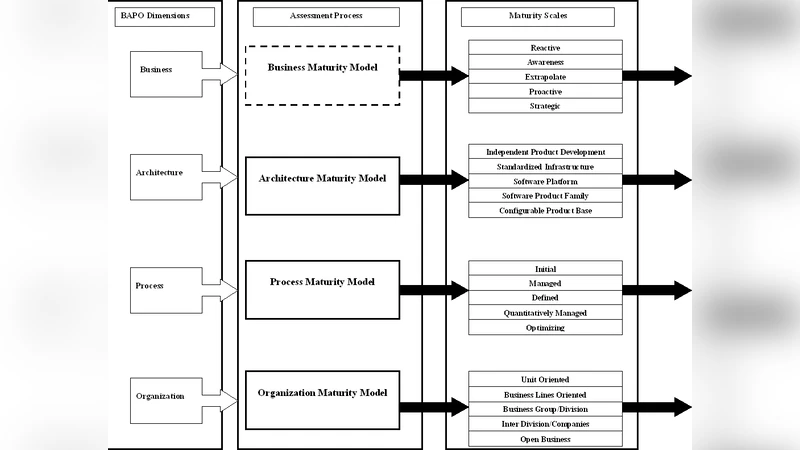
In the recent past, software product line engineering has become one of the most promising practices in software industry with the potential to substantially increase the software development productivity. Software product line engineering approach spans the dimensions of business, architecture, software engineering process and organization. The increasing popularity of software product line engineering in the software industry necessitates a process maturity evaluation methodology. Accordingly, this paper presents a business maturity model of software product line, which is a methodology to evaluate the current maturity of the business dimension of a software product line in an organization. This model examines the coordination between product line engineering and the business aspects of software product line. It evaluates the maturity of the business dimension of software product line as a function of how a set of business practices are aligned with product line engineering in an organization. Using the model presented in this paper, we conducted two case studies and reported the assessment results. This research contributes towards establishing a comprehensive and unified strategy for a process maturity evaluation of software product lines.
💡 Research Summary
Software Product Line Engineering (SPL) has emerged as a powerful approach for creating families of related software products by reusing a common set of core assets. While the technical, process, and organizational aspects of SPL have been extensively studied, the business dimension—how SPL aligns with corporate strategy, market demands, financial objectives, customer relationships, and supply‑chain considerations—has received comparatively little systematic attention. This paper addresses that gap by proposing a Business Maturity Model (BMM) specifically designed to assess the maturity of the business side of SPL within an organization.
The model decomposes the business dimension into five key domains: Strategy, Market, Finance, Customer, and Supply Chain. For each domain, three to five concrete practices are defined, resulting in a total of 22 practices. Examples include “Alignment of product‑line portfolio with corporate vision” (Strategy), “Clear market segmentation and target definition for each line” (Market), and “Establishment of line‑specific financial KPIs” (Finance). Each practice is categorized into three levels—Basic, Intermediate, Advanced—reflecting increasing depth of implementation and integration.
Maturity is expressed through a five‑stage ladder: Initial, Managed, Defined, Measured, and Optimized. The Initial stage corresponds to ad‑hoc SPL awareness with minimal business integration. Managed indicates the presence of basic processes but limited strategic alignment. Defined marks the formalization of business goals, documented roadmaps, and standardized procedures. Measured introduces KPI‑driven performance monitoring and feedback loops, while Optimized represents a fully data‑driven environment where business strategy and product‑line operations are continuously refined in real time. A quantitative scoring algorithm aggregates the practice scores, applies domain‑specific weights, and maps the result to the appropriate maturity stage.
The assessment methodology follows five steps: (1) Scope definition and stakeholder identification, (2) Data collection via interviews, surveys, and document analysis, (3) Scoring of each practice, (4) Determination of the overall maturity stage, and (5) Generation of a tailored improvement roadmap. To mitigate bias, the authors involve multiple stakeholder groups—including senior management, product managers, developers, and sales personnel—during data gathering.
The model was applied in two real‑world case studies. The first organization is a traditional manufacturing firm that had recently begun experimenting with SPL concepts. The assessment revealed a low alignment score (35 %) in the Strategy‑Market domain, while Finance and Customer domains scored 68 % and 72 % respectively, indicating relatively mature cost‑control and customer‑satisfaction mechanisms. The second organization, an IT services company, had already deployed SPL for several product lines but suffered from weak cross‑functional collaboration. Its Strategy and Market scores were 40 % and 45 %, and the Supply Chain domain lagged at 55 %. Both firms were situated at the Defined stage, lacking systematic KPI measurement and continuous improvement loops.
Based on these findings, the authors recommend concrete actions: conduct joint Strategy‑Market workshops, adopt portfolio‑management tools to improve alignment, implement line‑specific KPIs, and deploy real‑time dashboards to transition to the Measured stage. For supply‑chain and customer domains, they suggest automating feedback collection and integrating it into the product‑line decision‑making process.
The contributions of the paper are threefold. First, it introduces the first comprehensive business‑focused SPL maturity framework, filling a notable gap in the SPL literature. Second, it provides a clear mapping between concrete business practices and maturity stages, enabling organizations to pinpoint their current position and chart a realistic path forward. Third, it validates the model through two diverse industry case studies, demonstrating practical applicability and delivering actionable improvement plans.
Limitations include the relatively small sample size, potential subjectivity in practice weighting (derived from expert judgment), and the possibility that the defined practices may not capture industry‑specific nuances. Future research directions involve expanding the empirical base across more sectors, refining weightings through statistical techniques such as Analytic Hierarchy Process (AHP), and developing automated data‑collection tools to streamline the assessment process. Ultimately, integrating this Business Maturity Model with existing technical SPL maturity models could yield a holistic, organization‑wide SPL assessment framework.
Comments & Academic Discussion
Loading comments...
Leave a Comment