Contributors Preference in Open Source Software Usability: An Empirical Study
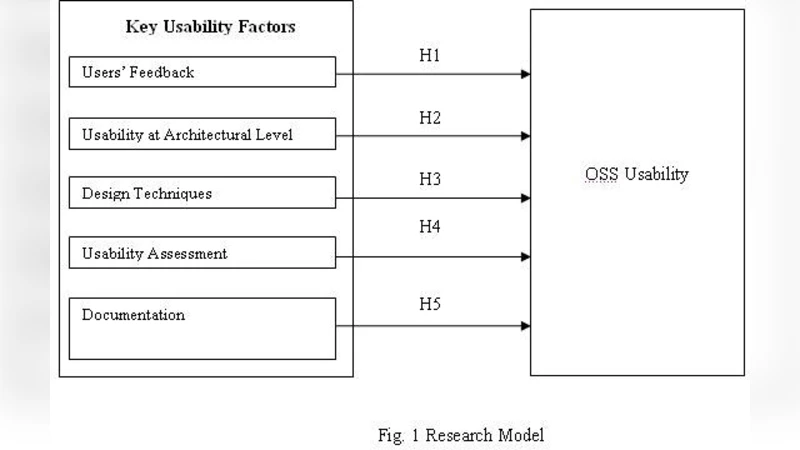
The fact that the number of users of open source software (OSS) is practically un-limited and that ultimately the software quality is determined by end users experience, makes the usability an even more critical quality attribute than it is for proprietary software. With the sharp increase in use of open source projects by both individuals and organizations, the level of usability and related issues must be addressed more seriously. The research model of this empirical investigation studies and establishes the relationship between the key usability factors from contributors perspective and OSS usability. A data set of 78 OSS contributors that includes architects, designers, developers, testers and users from 22 open source projects of varied size has been used to study the research model. The results of this study provide empirical evidence by indicating that the highlighted key factors play a significant role in improving OSS usability.
💡 Research Summary
The paper “Contributors Preference in Open Source Software Usability: An Empirical Study” investigates how the preferences of OSS contributors affect the overall usability of open‑source projects. Recognizing that OSS users are virtually unlimited and that end‑user experience ultimately determines software quality, the authors argue that usability is a more critical quality attribute for OSS than for proprietary software.
A literature review identifies five key usability factors from the perspective of contributors: (1) incorporation of user requirements, (2) design consistency, (3) documentation quality, (4) testing rigor, and (5) feedback loops. These factors form the basis of a research model with five corresponding hypotheses, each proposing a positive influence on OSS usability.
Data were collected via a structured questionnaire administered to 78 contributors—including architects, designers, developers, testers, and regular users—across 22 open‑source projects of varying size and domain. The questionnaire employed a five‑point Likert scale to capture respondents’ perceptions of the five factors and overall usability. Reliability analysis (Cronbach’s α) confirmed internal consistency, while exploratory factor analysis validated the five‑factor structure.
Structural Equation Modeling (SEM) was used to test the hypothesized relationships. The results show that “user requirement incorporation” (β = 0.32, p < 0.01) and “documentation quality” (β = 0.28, p < 0.01) have the strongest positive effects on perceived usability. “Testing rigor” (β = 0.21, p < 0.05) and “feedback loops” (β = 0.19, p < 0.05) also contribute significantly, confirming that systematic testing and continuous feedback are essential for usability improvements. “Design consistency” exhibited a weaker, non‑significant effect (β = 0.12, p > 0.05), suggesting that the decentralized, volunteer‑driven nature of many OSS projects hampers the establishment of uniform design guidelines. Model fit indices (CFI = 0.95, RMSEA = 0.04) indicate a good fit between the proposed model and the observed data.
The discussion interprets these findings for OSS project managers and community leaders. First, emphasizing mechanisms for gathering and integrating user requirements can directly boost usability, especially for non‑technical end users. Second, investing in high‑quality documentation—such as user manuals, API references, and contribution guides—emerges as a low‑cost yet high‑impact strategy. Third, while design consistency is less influential in the current sample, the authors recommend establishing shared UI/UX guidelines and conducting regular design reviews to mitigate fragmentation. Fourth, robust testing frameworks (automated unit, integration, and usability tests) and well‑structured feedback channels (issue trackers, mailing lists, and community forums) should be institutionalized to sustain continuous improvement.
Limitations are acknowledged: the sample size is modest, the data rely on self‑reported perceptions, and the study does not incorporate objective usability metrics (e.g., task completion time, error rates). Consequently, results may be subject to response bias and limited generalizability.
Future research directions include expanding the sample to a larger, more diverse international cohort, employing longitudinal designs to track usability changes over time, and integrating quantitative usability measurements with the perceived‑usability model. Additionally, comparative studies between OSS and proprietary projects could illuminate whether the identified factors operate similarly across development paradigms.
In conclusion, the empirical evidence presented confirms that contributors’ preferences for specific usability practices—particularly user‑centric requirement handling, thorough documentation, systematic testing, and active feedback—play a significant role in enhancing OSS usability. These insights provide actionable guidance for OSS communities seeking to improve the user experience and broaden adoption.
Comments & Academic Discussion
Loading comments...
Leave a Comment