Human diffusion and city influence
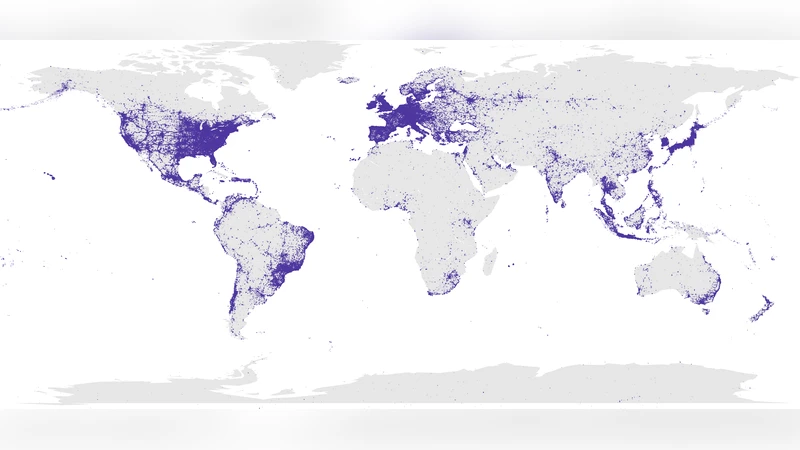
Cities are characterized by concentrating population, economic activity and services. However, not all cities are equal and a natural hierarchy at local, regional or global scales spontaneously emerges. In this work, we introduce a method to quantify city influence using geolocated tweets to characterize human mobility. Rome and Paris appear consistently as the cities attracting most diverse visitors. The ratio between locals and non-local visitors turns out to be fundamental for a city to truly be global. Focusing only on urban residents’ mobility flows, a city to city network can be constructed. This network allows us to analyze centrality measures at different scales. New York and London play a predominant role at the global scale, while urban rankings suffer substantial changes if the focus is set at a regional level.
💡 Research Summary
The paper introduces a data‑driven framework for quantifying the influence of cities by exploiting geolocated Twitter activity as a proxy for human mobility. Using a massive dataset of 21 million tweets posted by over half a million users between October 2010 and June 2013, the authors first filter out non‑human accounts by removing trajectories that imply speeds greater than 750 km h⁻¹. They then focus on 58 of the world’s most populated urban areas, each operationally defined as a 50 km radius circle centered on the city hall, thereby avoiding inconsistencies caused by varying administrative boundaries.
Residence detection is performed by partitioning the globe into 100 km × 100 km equal‑area cells. A user’s home cell is the one from which the majority of his/her tweets originate, provided that at least one‑third of the total tweets are posted from that cell. This criterion yields a robust set of “local” users, while all others are classified as “non‑local” visitors.
Three complementary metrics are proposed to assess a city’s diffusion power:
-
Average radius (R) – For each city, a random sample of u = 300 users is selected, and the Euclidean distance between each subsequent tweet (up to Δt = 350 days after the first visit) and the city centre is computed. The mean of these distances across the sampled users gives R. Temporal analysis shows an initial rapid expansion (faster than √Δt, reminiscent of Lévy‑flight dynamics) lasting about 15–20 days, followed by a markedly slower regime, reflecting the early burst of non‑local visitors and their subsequent return home.
-
Normalized average radius (˜R) – To control for geographic bias (e.g., island cities naturally exhibit larger R because any outbound trip is long), R is divided by the average distance from all Twitter users’ home cells to the city. This normalization highlights cities that truly act as efficient sources of information spread, independent of their spatial isolation.
-
Coverage – The world is tiled into the same 100 km cells; coverage counts how many distinct cells have at least one tweet from the sampled users after they have visited the city. This metric captures the spatial extent of a city’s influence regardless of distance, and complements the radius‑based measures.
When applied to the dataset, raw R ranks Hong Kong at the top, while the bottom is Bandung (West Java). However, after normalization, the leading cities become Rome, Paris, and Lisbon—densely populated European hubs that manage to disperse visitors far beyond their immediate surroundings. Coverage rankings are strongly correlated with R but retain distinct nuances; for example, Moscow and Beijing rank highly in coverage due to their large inbound visitor flows, whereas Hong Kong still leads in normalized radius.
A crucial insight emerges from separating locals from non‑locals. Non‑local visitors generate roughly 260 covered cells on average, more than double the 96 cells contributed by locals. Moreover, the proportion of non‑local users strongly predicts both R and coverage: cities with a high visitor share (e.g., Hong Kong, San Francisco) dominate the diffusion metrics, whereas cities whose activity is driven mainly by residents (e.g., Detroit) rank low. Scatter plots of ˜R versus coverage reveal two clear clusters corresponding to locals (low mobility) and visitors (high mobility).
Beyond individual city metrics, the authors construct a directed, weighted city‑to‑city network where edges represent the flow of non‑local visitors between origin and destination cities. Global centrality analysis (betweenness, closeness) identifies New York and London as the most pivotal nodes, echoing classic world‑city literature that emphasizes their trans‑Atlantic bridging role. When the analysis is restricted to regional sub‑networks, the hierarchy reshapes dramatically: Asian Pacific hubs such as Hong Kong, Singapore, and Sydney emerge as regional authorities, while European cities dominate intra‑European sub‑networks.
The study therefore contributes several methodological and substantive advances. Methodologically, it demonstrates that large‑scale, publicly available ICT traces can be transformed into a robust, multi‑scale measure of urban influence that captures both spatial reach and the composition of visitors. Substantively, it shows that a city’s global prominence is not solely a function of population or GDP but hinges on its ability to attract and disseminate non‑local travelers. The distinction between local and non‑local mobility explains why traditional rankings based on economic indicators sometimes diverge from rankings derived from human movement data.
In summary, by integrating geolocated social‑media data, residence inference, diffusion metrics, and network centrality, the paper offers a comprehensive, data‑driven portrait of the hierarchical structure of world cities. It validates the relevance of Rome, Paris, and Lisbon as European diffusion hubs, confirms the enduring global dominance of New York and London, and highlights the pivotal role of visitor composition in shaping urban influence. This framework can be extended to other digital trace sources (mobile phone records, credit‑card transactions) and applied to policy questions such as infrastructure planning, tourism management, and the design of resilient information‑spreading strategies.
Comments & Academic Discussion
Loading comments...
Leave a Comment