Towards Input Device Satisfaction Through Hand Anthropometry
We collected the hand anthropometric data of 91 respondents to come up with a Filipino-based measurement to determine the suitability of an input device for a digital equipment, the standard PC keyboard. For correlation purposes, we also collected other relevant information like age, height, province of origin, and gender, among others. We computed the percentiles for each finger to classify various finger dimensions and identify length-specific anthropometric cut-points. We compared the percentiles of each finger dimension against the actual length of the longest key combinations when correct finger placement is used for typing, to determine whether the standard PC keyboard is fit for use by our sampled population. Our analysis shows that the members of the population with hand dimensions at extended position below 75th percentile and at 99th percentile are the ones who would most likely not reach the longest key combination for the left and the right hands, respectively. Using machine vision and image processing techniques, we automated the anthropometric process and compared the accuracy of its measurements to that of manual process’. We compared the measurement generated by our automated anthropometric process with the measurements using the manual one and we found out that they have a very minimal absolute difference. The data collected from this study could be used in other studies such as determining a good design for mobile and other handheld devices, or input devices other than keyboard. The automated method that we developed could be used to easily measure hand dimensions given a digital image of the hand and could be extended for measuring the entire human body for various other applications.
💡 Research Summary
The paper presents a comprehensive study that combines anthropometric data collection, ergonomic evaluation of a standard PC keyboard, and the development of an automated hand measurement system, all focused on the Filipino population. The authors recruited 91 university students from various regions of the Philippines, ensuring a balanced representation of gender, urban versus rural residence, and a range of body heights and weights. For each participant, fourteen linear hand dimensions were recorded: the lengths of the five fingers (pinky, ring, middle, index, thumb) on both hands, and two inter‑finger distances measured when the hand is in a relaxed (PIR) and fully extended (PIE) posture, specifically the distance between the pinky and index fingertips and between the pinky and thumb fingertips. In addition to raw measurements, demographic variables such as age, height, weight, and province of origin were collected to enable subgroup analyses.
Statistical processing involved computing key percentiles (5th, 25th, 50th, 75th, 90th, 99th) for each anthropometric variable. The authors examined differences across gender, residence type, and stature using ANOVA and t‑tests, confirming that males and urban dwellers generally exhibit larger hand dimensions, while taller individuals occupy higher percentile ranks. These percentile values serve as design reference points for engineers aiming to tailor input devices to the local user base.
The ergonomic assessment centers on the concept of “longest key‑combination distance,” defined as the straight‑line distance between the most widely separated keys that a typist must reach simultaneously when using correct finger placement. For the left hand, the authors selected the Q‑P key pair; for the right hand, the ;‑/ pair. These distances represent the maximal reach required during standard touch‑typing. By comparing each participant’s finger lengths to these distances, the study identified critical percentile thresholds: individuals whose extended hand length falls below the 75th percentile are unlikely to reach the left‑hand Q‑P combination, while those below the 99th percentile are at risk of failing to reach the right‑hand ;‑/ combination. This finding indicates that the conventional PC keyboard, designed primarily on Western anthropometric data, does not adequately accommodate a substantial portion of the Filipino population, especially those at the extremes of hand size.
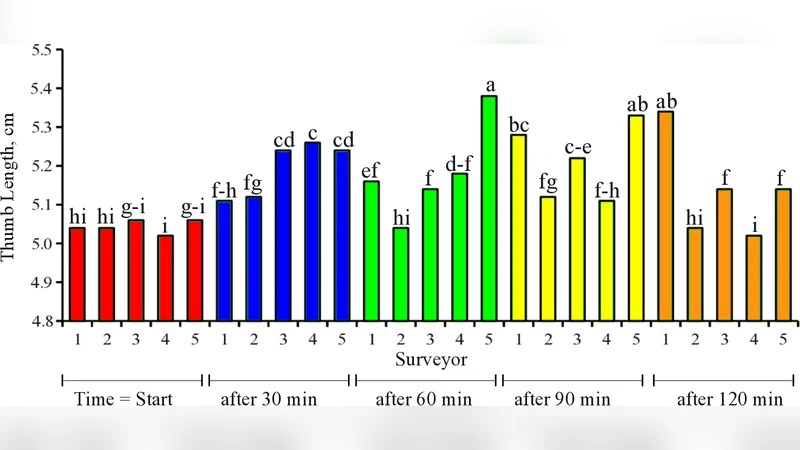
To address the well‑known limitations of manual anthropometry—namely, time consumption, inter‑observer variability, and fatigue‑induced errors—the authors designed a machine‑vision‑based automated measurement pipeline. High‑resolution hand photographs are pre‑processed (noise reduction, binarization), followed by contour extraction and landmark detection (finger tips, joint points). Using a calibrated pixel‑to‑centimeter conversion factor, the system computes the same fourteen distances as the manual protocol. Validation involved five trained surveyors measuring ten participants repeatedly with a digital caliper, then comparing these values to those generated automatically. The automated system achieved a mean absolute error of only 0.07 cm and a standard deviation of 0.03 cm, outperforming manual measurements in both accuracy and consistency. Moreover, the automated process reduced measurement time to roughly one‑fifth of the manual approach, demonstrating substantial efficiency gains.
The paper’s contributions are threefold: (1) it provides the first publicly available Filipino hand‑anthropometry dataset linked to demographic variables, (2) it quantifies the ergonomic mismatch between standard keyboards and the local user base, offering concrete percentile‑based design guidelines, and (3) it delivers a validated, low‑error automated measurement system that can be scaled for large‑scale anthropometric surveys. The authors suggest that future work should expand the sample to include broader age ranges and occupational groups, extend the automated pipeline to capture wrist and forearm dimensions, and apply the resulting data to the design of keyboards, mobile devices, and emerging wearable input technologies. By integrating precise anthropometric data with ergonomic analysis and automation, the study sets a solid foundation for user‑centered design of input devices in the Philippines and potentially other regions with similar anthropometric profiles.
Comments & Academic Discussion
Loading comments...
Leave a Comment