On locating statistics in the world of finding out
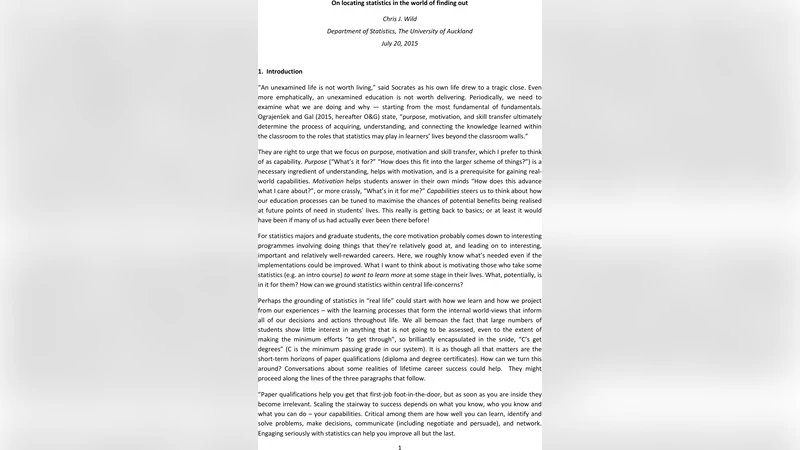
This paper attempts to situate statistics in relation to qualitative research methods and other means of “finding out”. It compares and contrasts aspects of qualitative research methods and statistical inquiry and attempts to answer the question of whether and how elements of qualitative research methods should be included in statistics teaching.
💡 Research Summary
The paper “On locating statistics in the world of finding out” sets out to reposition statistics within the broader epistemic landscape of inquiry, juxtaposing it with qualitative research methods and other modes of “finding out.” The authors begin by acknowledging that both statistical and qualitative approaches share a common goal: to generate knowledge about phenomena. However, they diverge sharply in terms of data type, analytical procedures, and the nature of inference. Statistics traditionally relies on numerical data, hypothesis testing, and probabilistic generalization, whereas qualitative research emphasizes textual or visual data, inductive coding, and context‑specific interpretation.
A comprehensive literature review traces the historical development of each tradition, highlighting how each has cultivated its own methodological canon. The authors note that contemporary mixed‑methods literature already points to points of convergence, but they argue that statistical education has largely ignored these intersections. In most curricula, the focus remains on mathematical derivations, software manipulation, and the mechanical application of tests, with little attention paid to the social, cultural, or situational contexts that give rise to the data.
To address this gap, the paper proposes a three‑dimensional comparative framework: (1) data ontology (numeric vs. narrative), (2) analytic workflow (deductive hypothesis testing vs. inductive theme development), and (3) interpretive stance (objective generalization vs. situated meaning). Using this framework, the authors suggest concrete pedagogical interventions. First, they recommend integrating qualitative exploratory activities—such as brief interviews or field observations—into the early stages of research design. This helps students formulate more nuanced research questions and select variables that are conceptually grounded. Second, they advocate for a “qualitative coding of variables” step, where students use thematic analysis to refine operational definitions before proceeding to quantitative measurement, thereby reducing construct validity threats. Third, they call for a dedicated “interpretive discussion” module in which statistical results (e.g., regression coefficients, confidence intervals) are interpreted alongside qualitative insights that illuminate underlying mechanisms, cultural moderators, or unintended consequences.
The paper illustrates these recommendations with case studies drawn from the social sciences, health sciences, and education. In each case, a mixed‑methods design—combining surveys or experiments with interviews, focus groups, or classroom observations—produced richer, more actionable findings than either method alone. For instance, a public‑policy evaluation that paired a national survey with in‑depth stakeholder interviews revealed not only statistically significant effects but also the narrative of resistance and adaptation that explained why the policy worked in some regions and not others.
In the concluding section, the authors argue that integrating qualitative elements into statistics education cultivates “multidisciplinary thinking,” equipping future analysts to grapple with complex, real‑world problems that cannot be reduced to numbers alone. They acknowledge that their own study is primarily a conceptual and literature‑based argument, lacking large‑scale empirical validation. Consequently, they propose a research agenda that includes controlled classroom experiments to test the efficacy of the proposed curriculum, as well as the development of discipline‑specific integration guidelines. Ultimately, the paper calls for a paradigm shift: statistics should be taught not as an isolated technical skill but as a component of a broader inquiry toolkit that respects both the power of quantification and the richness of qualitative insight.
Comments & Academic Discussion
Loading comments...
Leave a Comment