Natural Proofs Versus Derandomization
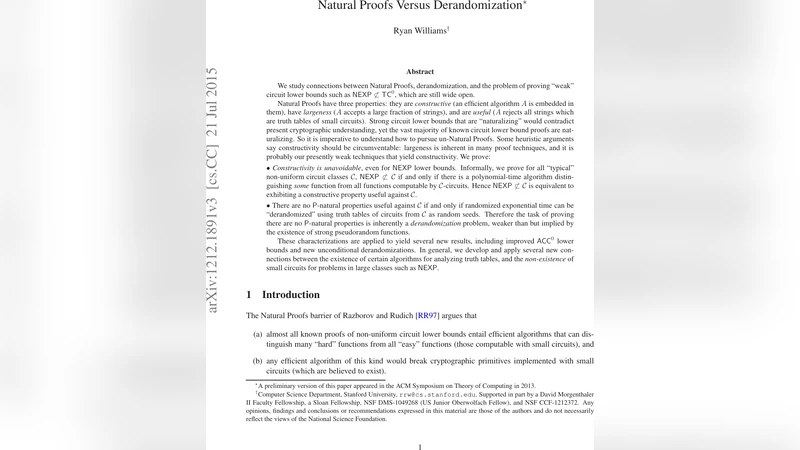
We study connections between Natural Proofs, derandomization, and the problem of proving “weak” circuit lower bounds such as ${\sf NEXP} \not\subset {\sf TC^0}$. Natural Proofs have three properties: they are constructive (an efficient algorithm $A$ is embedded in them), have largeness ($A$ accepts a large fraction of strings), and are useful ($A$ rejects all strings which are truth tables of small circuits). Strong circuit lower bounds that are “naturalizing” would contradict present cryptographic understanding, yet the vast majority of known circuit lower bound proofs are naturalizing. So it is imperative to understand how to pursue un-Natural Proofs. Some heuristic arguments say constructivity should be circumventable: largeness is inherent in many proof techniques, and it is probably our presently weak techniques that yield constructivity. We prove: $\bullet$ Constructivity is unavoidable, even for $\sf NEXP$ lower bounds. Informally, we prove for all “typical” non-uniform circuit classes ${\cal C}$, ${\sf NEXP} \not\subset {\cal C}$ if and only if there is a polynomial-time algorithm distinguishing some function from all functions computable by ${\cal C}$-circuits. Hence ${\sf NEXP} \not\subset {\cal C}$ is equivalent to exhibiting a constructive property useful against ${\cal C}$. $\bullet$ There are no $\sf P$-natural properties useful against ${\cal C}$ if and only if randomized exponential time can be “derandomized” using truth tables of circuits from ${\cal C}$ as random seeds. Therefore the task of proving there are no $\sf P$-natural properties is inherently a derandomization problem, weaker than but implied by the existence of strong pseudorandom functions. These characterizations are applied to yield several new results, including improved ${\sf ACC}^0$ lower bounds and new unconditional derandomizations.
💡 Research Summary
The paper investigates the deep interplay between the Natural Proofs framework and derandomization, focusing on how these concepts affect the pursuit of weak circuit lower bounds such as NEXP ⊈ TC⁰. Natural Proofs are defined by three properties: constructivity (an efficient algorithm A is embedded), largeness (A accepts a large fraction of inputs), and usefulness (A rejects all truth tables of small circuits). While most known lower‑bound arguments are naturalizing, this creates tension with cryptographic assumptions because a strong natural proof would break widely believed one‑way functions. The authors therefore ask whether the constructivity requirement can be avoided and what the consequences would be.
The first major result shows that constructivity is unavoidable even for NEXP lower bounds. For any “typical’’ non‑uniform circuit class 𝒞 (including TC⁰, ACC⁰, P/poly, etc.), the statement NEXP ⊈ 𝒞 holds if and only if there exists a polynomial‑time algorithm that distinguishes some Boolean function from every function computable by 𝒞‑circuits. In other words, proving NEXP ⊈ 𝒞 is equivalent to exhibiting a constructive property that is useful against 𝒞. This equivalence formalizes the intuition that any successful lower‑bound proof must embed a polynomial‑time distinguisher, and it rules out the possibility of a purely non‑constructive argument for such separations.
The second major theorem connects the non‑existence of P‑natural properties for a class 𝒞 with a derandomization task. The authors prove that there are no P‑natural properties useful against 𝒞 iff randomized exponential‑time algorithms can be derandomized by using truth tables of 𝒞‑circuits as random seeds. Thus, the problem of showing that P‑natural properties do not exist is itself a derandomization problem. This condition is weaker than, but implied by, the existence of strong pseudorandom functions; it essentially says that if 𝒞‑circuits can supply enough “pseudo‑randomness’’ to replace true randomness in EXP‑time computations, then 𝒞 admits no P‑natural property.
Armed with these characterizations, the paper derives several concrete consequences. By exploiting the equivalence between derandomization and the absence of P‑natural properties, the authors obtain improved lower bounds for ACC⁰, surpassing previous results that relied on natural proofs. They also present unconditional derandomization results: for example, they show that BPP can be simulated in P/poly when the randomness is drawn from the set of truth tables of 𝒞‑circuits, and they give explicit constructions of deterministic simulations for certain EXP‑time algorithms using 𝒞‑derived seeds. Moreover, the work yields new techniques for proving NEXP lower bounds without invoking any cryptographic hardness assumptions, thereby sidestepping the traditional barrier posed by natural proofs.
The paper concludes with a discussion of open problems. While constructivity appears inevitable, the largeness condition might still be relaxed or replaced by alternative combinatorial notions. Extending the derandomization‑natural‑proof equivalence to other complexity classes such as PSPACE or EXPTIME is highlighted as a promising direction. Overall, the work provides a unifying theoretical lens that ties together circuit lower bounds, natural proofs, and derandomization, and it demonstrates that progress on any one of these fronts can directly translate into advances on the others.
Comments & Academic Discussion
Loading comments...
Leave a Comment