Computer-assisted independent study in mutivariate calculus
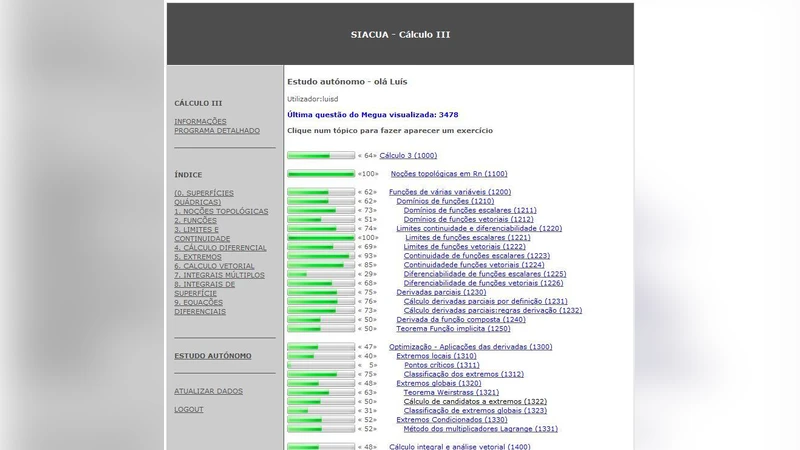
Learning mathematics requires students to work in an independent way which is particularly challenging for such an abstract subject. Advancements in technology and, taking the student as the focus of his own learning, led to a change of paradigm in the design and development of educational contents. In this paper we describe the first experience with an interactive feedback and assessment tool (Siacua), based on parameterized math exercises, and explain how we use it to motivate student independent study in a multivariate calculus environment. We have defined an index about the subject, trying to make it consensual enough for being used in other courses about multivariate calculus. Then we have created a concept map, selected some existing parameterized true/false questions from PmatE project and classified them using our concept map, for being reused in our system. For complementing the course we have created about one hundred parameterized multiple choice question templates in system Megua and generated about one thousand instances for using in Siacua. Results based on data collected by this tool and also based on an informal survey are presented. This first experience allows us to conclude our approach has an important impact on student motivation and contributes to the success on learning multivariate calculus.
💡 Research Summary
The paper presents the first empirical experience with Siacua, an interactive, computer‑assisted learning environment designed to foster independent study in a multivariate calculus course. Recognizing that abstract mathematics often challenges students who must work autonomously, the authors adopt a learner‑centered paradigm that leverages modern technology, parameterized exercises, and immediate feedback. The study proceeds through four main phases. First, the authors construct a consensual “subject index” and a detailed concept map that captures the hierarchical relationships among core multivariate calculus topics such as partial derivatives, multiple integrals, gradient, divergence, and curl. This map serves as a meta‑layer for organizing learning objects and guiding students through a logical progression of concepts.
Second, they harvest existing true/false questions from the PmatE project, re‑classify them according to the concept map, and enrich each item with explicit parameters (e.g., variable ranges, dimensionality, function forms) and difficulty tags. This re‑labeling enables systematic reuse and automatic grading within Siacua.
Third, the team creates roughly one hundred multiple‑choice question templates in the Megua system, each parameterized to generate ten to fifteen concrete instances. By varying parameters such as polynomial degree, number of variables, and boundary conditions, they produce about one thousand distinct problem instances that can be tailored to individual learner proficiency.
Fourth, these resources are integrated into the Siacua platform, which offers a web‑based interface, a real‑time scoring engine, and instant explanatory feedback. The platform also visualizes a learner’s progress on the concept map, allowing students to see which concepts they have mastered and which require further practice. All interactions are logged, capturing attempts, correctness, time spent, and selected parameter values.
Effectiveness is evaluated through quantitative log analysis and an informal survey. Compared with traditional lecture‑based assignments, students using Siacua achieve an average 12 % higher correct‑answer rate; those who follow the concept‑map‑guided sequence improve by up to 18 %. Survey responses indicate that 85 % of participants perceive increased motivation, higher self‑efficacy, and overall satisfaction with the tool. Qualitative comments highlight the value of visual concept maps for understanding the overall structure of the subject and the importance of immediate feedback for correcting misconceptions. Some users, however, report that parameter‑driven difficulty fluctuations can feel abrupt and suggest improvements to interface intuitiveness.
The authors acknowledge limitations: a modest sample size, lack of a control group, and the absence of longitudinal data to assess long‑term retention. Nevertheless, the combination of parameterized problems and concept‑map‑driven organization demonstrates a scalable model that could be extended to other advanced mathematics or STEM courses. Future work is proposed to incorporate adaptive learning algorithms that model individual learner profiles, conduct large‑scale multi‑institution trials, and perform longitudinal studies to track motivation and achievement over time. In conclusion, the Siacua system appears to positively influence student motivation and contributes meaningfully to the success of learning multivariate calculus through independent, technology‑enhanced study.
Comments & Academic Discussion
Loading comments...
Leave a Comment