Support Vector Machine in Prediction of Building Energy Demand Using Pseudo Dynamic Approach
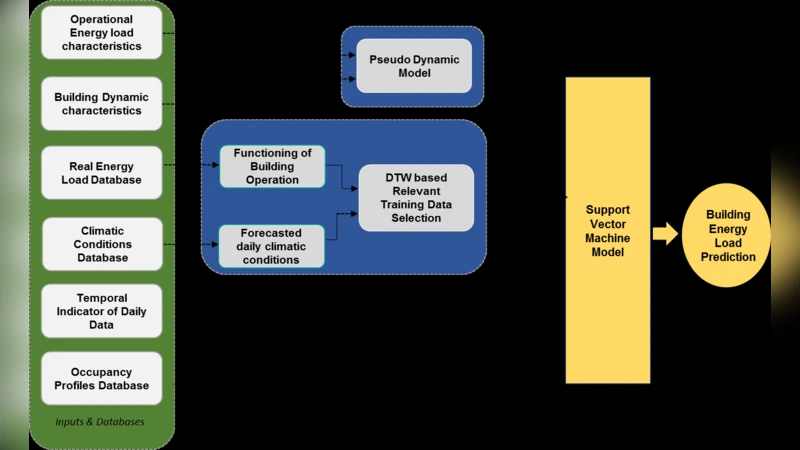
Building’s energy consumption prediction is a major concern in the recent years and many efforts have been achieved in order to improve the energy management of buildings. In particular, the prediction of energy consumption in building is essential for the energy operator to build an optimal operating strategy, which could be integrated to building’s energy management system (BEMS). This paper proposes a prediction model for building energy consumption using support vector machine (SVM). Data-driven model, for instance, SVM is very sensitive to the selection of training data. Thus the relevant days data selection method based on Dynamic Time Warping is used to train SVM model. In addition, to encompass thermal inertia of building, pseudo dynamic model is applied since it takes into account information of transition of energy consumption effects and occupancy profile. Relevant days data selection and whole training data model is applied to the case studies of Ecole des Mines de Nantes, France Office building. The results showed that support vector machine based on relevant data selection method is able to predict the energy consumption of building with a high accuracy in compare to whole data training. In addition, relevant data selection method is computationally cheaper (around 8 minute training time) in contrast to whole data training (around 31 hour for weekend and 116 hour for working days) and reveals realistic control implementation for online system as well.
💡 Research Summary
The paper addresses the challenge of accurately forecasting building energy consumption while keeping the computational burden low enough for real‑time deployment. It proposes a data‑driven prediction framework that combines a Support Vector Machine (SVM) with two novel preprocessing steps: (1) a relevance‑based training‑set selection using Dynamic Time Warping (DTW) and (2) a pseudo‑dynamic feature construction that captures the thermal inertia of the building.
Dynamic Time Warping is employed to compare the historical daily load profiles (including weather and occupancy information) with the target day’s conditions. By measuring the DTW distance, the algorithm automatically extracts a small subset of “relevant days” (typically 5–10) whose patterns are most similar to the day to be predicted. Only these selected days are used for SVM training, dramatically reducing the size of the training set and eliminating unrelated noise that can cause over‑fitting.
To incorporate the building’s thermal mass, the authors augment the input vector with lagged variables: past energy consumption, past outdoor temperature, and past occupancy levels for several preceding time steps. This pseudo‑dynamic representation allows the SVM to learn temporal transition effects without the need for a full physical dynamic model (e.g., differential equations).
The methodology is validated on a real‑world office building at the École des Mines de Nantes, France. The dataset spans one year, with 15‑minute resolution measurements of electricity use, outdoor climate, and occupancy schedules. Two training strategies are compared: (a) conventional SVM trained on the entire dataset, and (b) the proposed DTW‑selected, pseudo‑dynamic SVM. Performance is evaluated using Mean Absolute Error (MAE), Root Mean Square Error (RMSE), and training time.
Results show that the relevance‑based approach reduces training time from 31 hours (weekends) and 116 hours (working days) to roughly 8 minutes, a reduction of over 99 %. Despite the drastic reduction in data volume, prediction accuracy is essentially unchanged; in some cases the relevance‑based model even yields slightly lower MAE and RMSE. The pseudo‑dynamic features improve the model’s ability to react to rapid weather changes and occupancy shifts, further tightening the error distribution.
Key contributions of the work are:
- Introduction of a DTW‑driven data selection pipeline that automatically identifies the most informative historical days for a given forecasting horizon.
- Development of a lightweight pseudo‑dynamic feature set that captures thermal inertia without resorting to complex physics‑based simulations.
- Empirical demonstration that the combined approach achieves comparable or superior forecasting performance while cutting computational cost to a level suitable for online integration into Building Energy Management Systems (BEMS).
The authors argue that the proposed framework can be readily extended to other building typologies (residential, commercial, industrial) and climatic regions, and can incorporate additional sensor streams (e.g., CO₂, humidity) for multi‑modal forecasting. Ultimately, the method enables more responsive demand‑response strategies, optimized HVAC scheduling, and contributes to the broader goal of reducing operational carbon emissions in the built environment.
Comments & Academic Discussion
Loading comments...
Leave a Comment