Bridge the gap between network-based inference method and global ranking method in personal recommendation
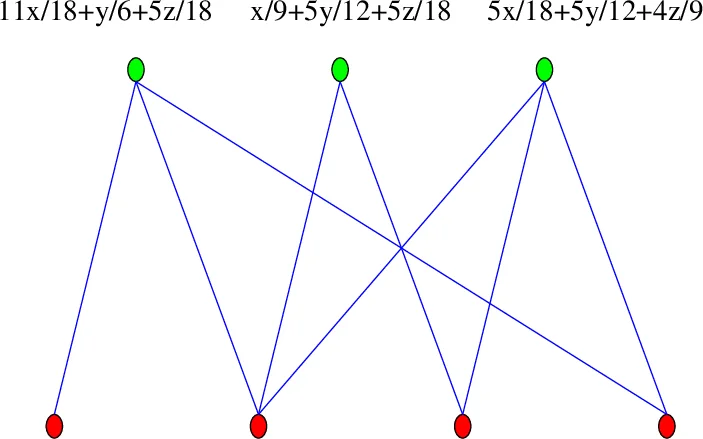
In this paper, we study the relationship between the network-based inference method and global ranking method in personal recommendation. By some theoretical analysis, we prove that the recommendation result under the global ranking method is the limit of applying network-based inference method with infinity times.
💡 Research Summary
The paper investigates the theoretical relationship between two widely used recommendation algorithms: the Network‑Based Inference (NBI) method (also known as mass‑diffusion, ProbS, or probabilistic spreading) and the Global Ranking Method (GRM). The authors model the recommendation problem on a bipartite graph consisting of an object set V₁ and a user set V₂, with a binary adjacency matrix A indicating whether a user has collected an object. NBI works by a two‑step diffusion process: resources initially placed on objects flow to neighboring users (V₁→V₂) and then back to objects (V₂→V₁). This process can be expressed compactly as a linear transformation F^{(1)} = W F, where the transition matrix
W = (A U⁻¹)(O⁻¹ A)ᵀ
with U = diag{k(u₁),…,k(u_m)} and O = diag{k(o₁),…,k(o_n)} being the degree matrices of users and objects respectively. The matrix W is column‑stochastic (each column sums to one) and, under the assumption that the bipartite graph is connected, it is irreducible and non‑negative.
Using Gershgorin’s disc theorem and the Perron‑Frobenius theorem, the authors analyze the spectrum of W. They prove that W possesses a unique dominant eigenvalue λ₁ = 1 with multiplicity one. The corresponding right eigenvector e_r is proportional to the object‑degree vector (k(o₁),…,k(o_n))ᵀ, while the left eigenvector e_l is proportional to the all‑ones vector, normalized by α = 1/∑_{j}k(o_j). All other eigenvalues satisfy |λ_j| < 1. Consequently, for any integer N, the N‑step diffusion result can be written as
F^{(N)} = W^{N} F.
Because the sub‑dominant eigenvalues decay geometrically, the limit as N → ∞ exists and is given by
lim_{N→∞} W^{N} = e_r e_lᵀ.
When the initial resource vector F encodes the items already collected by a target user (i.e., f(o_j) = a_{jl}), the limiting recommendation scores become
f′(o_i) = α k(o_i) ∑{j} a{jl},
which depend only on the object degree k(o_i). This is precisely the ranking produced by GRM, which simply orders items by descending degree. Therefore, the authors demonstrate that GRM is the asymptotic case of repeatedly applying NBI; NBI with a single diffusion step corresponds to the standard NBI algorithm, while infinite diffusion collapses the personalized signal and yields the global ranking.
The paper also proposes a “multiple‑round NBI” algorithm, where the diffusion process V₁→V₂→V₁ is iterated N times. Theoretical analysis shows that as N grows, the recommendation vector converges to the GRM vector, establishing a continuous bridge between fully personalized NBI and the non‑personalized GRM.
While the mathematical derivations are rigorous, the study has several limitations. The proof relies on the graph being connected and W being irreducible; real‑world recommendation data are often highly sparse and may consist of multiple disconnected components, potentially violating these assumptions. The authors provide only a small synthetic example (using MATLAB) to illustrate convergence, without extensive empirical evaluation on benchmark datasets, leaving open questions about convergence speed, numerical stability, and practical computational cost. Moreover, the limiting GRM ignores all user‑specific preferences, which in many commercial scenarios is undesirable; the paper does not discuss how to balance personalization against the global popularity signal in practice. Finally, because W’s structure depends solely on node degrees, higher‑order network features such as clustering, community structure, or edge weights are not captured, suggesting that more sophisticated diffusion kernels could yield richer trade‑offs.
In summary, the paper makes a clear theoretical contribution by proving that the global ranking method is the limit of infinite‑step network‑based inference. This insight clarifies the spectrum of recommendation behaviors obtainable by varying the number of diffusion rounds, offering a principled way to tune between personalized and popularity‑driven recommendations. Future work should extend the analysis to disconnected or weighted bipartite graphs, provide large‑scale experimental validation, and explore hybrid diffusion schemes that retain personalization while still leveraging global popularity cues.
Comments & Academic Discussion
Loading comments...
Leave a Comment