The cc-pV5Z-F12 basis set: reaching the basis set limit in explicitly correlated calculations
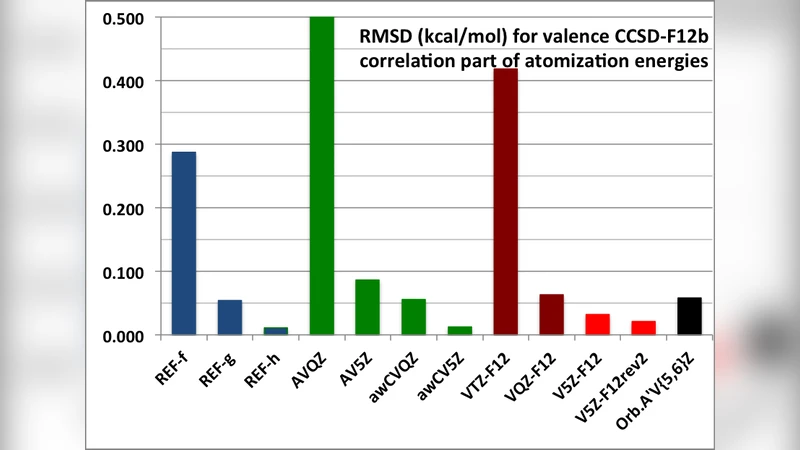
We have developed and benchmarked a new extended basis set for explicitly correlated calculations, namely cc-pV5Z-F12. It is offered in two variants, cc-pV5Z-F12 and cc- pV5Z-F12(rev2), the latter of which has additional basis functions on hydrogen not present in the cc-pVnZ-F12 (n=D,T,Q) sequence.A large uncontracted ‘reference’ basis set is used for benchmarking. cc-pVnZ-F12 (n=D, T, Q, 5) is shown to be a convergent hierarchy. Especially the cc- pV5Z-F12(rev2) basis set can yield the valence CCSD component of total atomization energies (TAEs), without any extrapolation, to an accuracy normally associated with aug-cc-pV{5,6}Z extrapolations. SCF components are functionally at the basis set limit, while the MP2 limit can be approached to as little as 0.01 kcal/mol without extrapolation. The determination of (T) appears to be the most difficult of the three components and cannot presently be accomplished without extrapolation or scaling. (T) extrapolation from cc-pV{T,Q}Z-F12 basis sets, combined with CCSD-F12b/cc-pV5Z-F12 calculations appears to be an accurate combination for explicitly correlated thermochemistry. For accurate work on noncovalent interactions, basis set superposition error with the cc-pV5Z-F12 basis set is shown to be so small that counterpoise corrections can be neglected for all but the most exacting purposes.
💡 Research Summary
The authors present a new explicitly correlated basis set, cc-pV5Z‑F12, designed to bring explicitly correlated (F12) calculations to the practical five‑zeta limit. Two variants are offered: the standard cc-pV5Z‑F12 and a “rev2” version that adds extra functions on hydrogen, addressing the known deficiency of the earlier cc‑pVnZ‑F12 (n = D, T, Q) series for hydrogen‑containing systems.
Benchmarking is performed against a very large uncontracted reference basis set, focusing on the three components that make up total atomization energies (TAEs): the Hartree–Fock (SCF) term, the MP2‑F12 correlation term, and the perturbative triples correction, (T). The results show that the SCF component is essentially at the basis‑set limit already with cc‑pV5Z‑F12, eliminating the need for any extrapolation. MP2‑F12 converges extremely rapidly; the error can be reduced to as little as 0.01 kcal mol⁻¹ without any extrapolation, a level of precision previously attainable only with extrapolations from larger basis sets.
The (T) contribution remains the most challenging. Direct calculation with the 5‑zeta set still yields errors larger than the desired chemical accuracy. However, the authors demonstrate that a two‑point extrapolation using the cc‑pV{T,Q}Z‑F12 sets, combined with a CCSD‑F12b calculation performed with the new 5‑zeta set, provides (T) values that bring the overall TAE within 1 kcal mol⁻¹ of the reference. This hybrid approach is recommended as the most reliable route for high‑accuracy thermochemistry when using explicitly correlated methods.
In non‑covalent interaction studies, the basis‑set superposition error (BSSE) with cc‑pV5Z‑F12 is shown to be negligible. Counterpoise corrections, which are routinely applied to mitigate BSSE, can be omitted for all but the most demanding applications, resulting in a significant reduction of computational overhead.
Overall, the paper establishes cc‑pV5Z‑F12 (especially the rev2 variant) as a convergent, high‑quality hierarchy for F12 calculations. It delivers near‑complete basis‑set limit results for SCF and MP2‑F12, while offering a practical and accurate strategy for handling the (T) term via extrapolation. The work thus provides a new benchmark for explicitly correlated quantum chemistry, enabling routine sub‑kilocalorie accuracy for thermochemical and non‑covalent interaction calculations without the need for large‑scale extrapolations or extensive counterpoise corrections.