Differential orbifold K-Theory
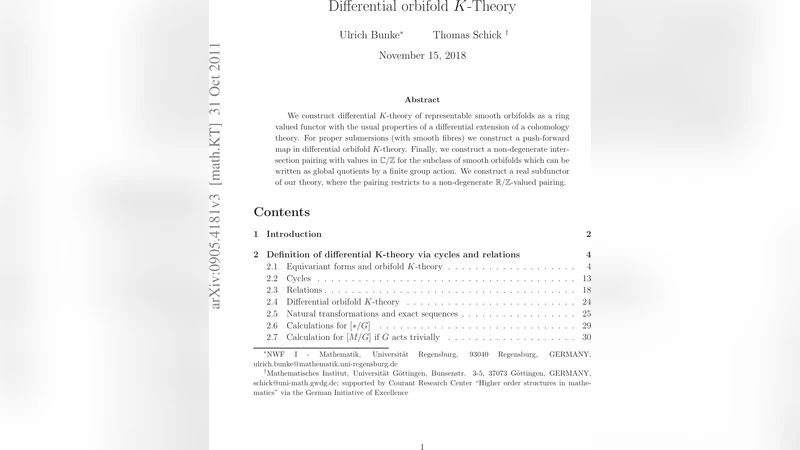
We construct differential equivariant K-theory of representable smooth orbifolds as a ring valued functor with the usual properties of a differential extension of a cohomology theory. For proper submersions (with smooth fibres) we construct a push-forward map in differential equivariant K-theory. Finally, we construct a non-degenerate intersection pairing with values in C/Z for the subclass of smooth orbifolds which can be written as global quotients by a finite group action. We construct a real subfunctor of our theory, where the pairing restricts to a non-degenerate R/Z-valued pairing.
💡 Research Summary
The paper develops a full differential extension of equivariant K‑theory for smooth representable orbifolds, establishing it as a ring‑valued functor that satisfies the standard axioms of a differential cohomology theory. The authors begin by restricting to orbifolds that can be presented as a global quotient (X \cong M/G) where a compact Lie group (G) acts smoothly and locally freely on a manifold (M). This representability condition allows them to lift the ordinary complex K‑theory spectrum (KU) and its differential refinement to a (G)‑equivariant setting, thereby defining groups (\widehat{K}_G^*(X)) together with natural curvature, underlying topological, and characteristic‑form maps. They verify naturality under equivariant smooth maps, exactness relating differential classes to invariant differential forms, and the compatibility of the product structure with the underlying topological K‑theory ring.
A major technical achievement is the construction of a push‑forward (integration) map for proper submersions (f\colon E\to B) whose fibers are smooth (G)‑equivariant manifolds. By adapting the Bismut‑Freed superconnection formalism to the differential equivariant context, they define a map
\
Comments & Academic Discussion
Loading comments...
Leave a Comment