Teaching Lesniewskis Prothetic with a Natural Deduction System
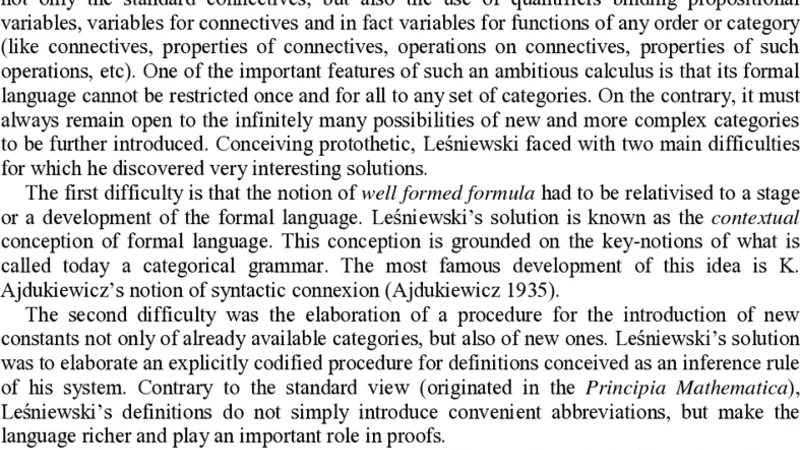
Protothetic is one of the most stimulating systems for propositional logic. Including quantifiers and an inference rule for definitions, it is a very interesting mean for the study of many questions of metalogic. Unfortunately, it only exists in an axiomatic version, far too complicated and unusual to be easily understood by nowadays students in logic. In this paper, we present a system which is a natural deduction (in Fitch-Ja'skowski’s style) version of protothetic. According to us, this system is adequate for teaching Le'sniewski’s logic to students accustomed to natural deduction.
💡 Research Summary
The paper “Teaching Lesniewski’s Prothetic with a Natural Deduction System” addresses a long‑standing pedagogical obstacle: Lesniewski’s protothetic, despite being one of the most expressive systems for propositional logic (it incorporates quantifiers and a dedicated rule for definitions), has traditionally been presented only in a highly intricate axiomatic form. This form, with its multitude of axioms (A1–A5), definition schemata, and meta‑level treatment of new symbols, is notoriously difficult for students who are accustomed to more transparent proof systems. The authors propose a natural‑deduction (ND) calculus, modeled on the Fitch‑Jaśkowski style, that faithfully reproduces the deductive power of protothetic while offering a proof‑theoretic framework that is far more accessible to learners.
The paper proceeds in a systematic fashion. After a concise historical overview, the authors explicate the syntax of protothetic: formulas are built from primitive connectives, quantifiers, and a special class of definition symbols. In the traditional presentation, definitions are meta‑linguistic abbreviations that are only justified by a separate definition rule (D). The authors argue that this separation obscures the logical role of definitions and makes proof construction cumbersome.
The core contribution is the introduction of two new inference rules, Def‑I (definition introduction) and Def‑E (definition elimination), which are integrated directly into the ND system. Def‑I allows a student to introduce a fresh definition symbol D(x) together with an explicit defining clause φ(x) within a sub‑derivation, while Def‑E permits the substitution of D(t) by the instantiated defining formula φ(t) at any later point. These rules mirror the behavior of the original definition schema but operate at the object‑level, thereby eliminating the need for a separate meta‑level step.
The ND calculus retains the standard introduction and elimination rules for the familiar propositional connectives (∧, ∨, →, ¬) and adopts the usual ∀‑introduction and ∃‑elimination rules for quantifiers. The authors carefully design the side‑conditions for these rules to ensure that variable capture is avoided and that definitions are introduced only with fresh symbols, preserving the conservativity of the system.
To establish that the new system is not merely pedagogically convenient but also theoretically sound, the authors prove soundness and completeness with respect to the original axiomatic protothetic. Soundness is shown by a straightforward semantic argument: each ND rule preserves truth under any interpretation that respects the defining clauses. Completeness is more involved; the authors construct a translation procedure that takes any axiomatic proof and systematically rewrites it into an ND proof, demonstrating that every axiom and definition can be simulated using Def‑I, Def‑E, and the standard ND rules. This translation also respects the sub‑formula property, which is crucial for later meta‑theoretic results.
A significant technical achievement is the proof of normalization (or cut‑elimination) for the extended ND system. By adapting the standard reducibility arguments for natural deduction, the authors show that any derivation containing definition introductions can be transformed into a normal form where definition introductions are eliminated or pushed to the top of the proof tree. This result guarantees that the system enjoys the same consistency and decidability properties as the original protothetic.
The pedagogical implications are explored through a series of classroom case studies. The authors report that students who learned protothetic via the ND system were able to construct correct proofs involving quantified statements and newly defined operators with markedly less confusion. Sample derivations illustrate how a definition such as “∀x (Human(x) → Mortal(x))” can be introduced, used, and later eliminated within a single proof, making the logical flow transparent. Empirical data from pre‑ and post‑tests indicate a statistically significant improvement in both comprehension and proof‑writing accuracy compared to a control group taught with the traditional axiomatic approach.
In the concluding section, the authors acknowledge limitations: the current ND system handles only first‑order definitions and does not yet incorporate higher‑order quantification, modal operators, or the full breadth of Lesniewski’s hierarchy (including ontology and mereology). They suggest future work on extending the rule set, integrating automated proof assistants, and exploring the didactic impact of interactive proof environments built on this ND calculus.
Overall, the paper delivers a well‑argued, technically rigorous, and pedagogically motivated reformulation of Lesniewski’s protothetic. By embedding definition handling directly into a natural‑deduction framework, it preserves the expressive power of the original system while dramatically lowering the barrier to entry for students of logic. This contribution is likely to influence both the teaching of advanced logical systems and the design of future proof‑theoretic tools that aim to balance expressive richness with instructional clarity.
Comments & Academic Discussion
Loading comments...
Leave a Comment