Star formation histories of resolved galaxies
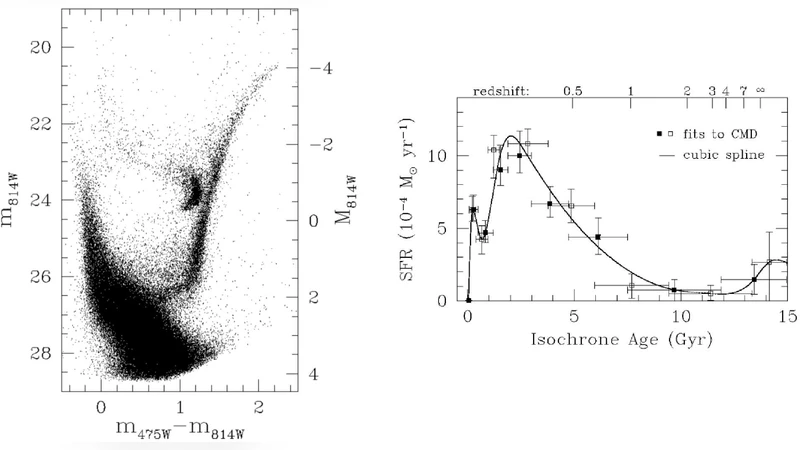
The colour-magnitude diagrams of resolved stellar populations are the best tool to study the star formation histories of the host galactic regions. In this review the method to derive star formation histories by means of synthetic colour-magnitude diagrams is briefly outlined, and the results of its application to resolved galaxies of various morphological types are summarized. It is shown that all the galaxies studied so far were already forming stars at the lookback time reached by the observational data, independently of morphological type and metallicity. Early-type galaxies have formed stars predominantly, but in several cases not exclusively, at the earliest epochs. All the other galaxies appear to have experienced rather continuous star formation activities throughout their lifetimes, although with significant rate variations and, sometimes, short quiescent phases.
💡 Research Summary
The paper reviews the use of colour‑magnitude diagrams (CMDs) of resolved stellar populations as the premier tool for reconstructing the star‑formation histories (SFHs) of nearby galaxies. It begins by outlining the synthetic CMD technique, which generates artificial stellar populations based on assumed initial mass functions (IMFs), time‑dependent star‑formation rates (SFR(t)), and metallicity evolution (Z(t)). These synthetic populations are processed through the same observational pipelines as real data, incorporating photometric errors, incompleteness, and binary‑star effects, allowing a statistically rigorous comparison with observed CMDs. By varying the input parameters and employing maximum‑likelihood or Bayesian fitting, the method yields the most probable SFR(t) and Z(t) histories while quantifying uncertainties.
The review then surveys applications of this method to a broad sample of galaxies spanning the Hubble sequence: dwarf spheroidals, dwarf irregulars, low‑mass spirals, massive spirals, and early‑type (elliptical and S0) systems. Across all morphological classes, the deepest Hubble Space Telescope (HST) observations reach back to look‑back times of 10–13 Gyr, revealing that every galaxy studied already hosted star formation at the earliest epochs accessible to the data. Early‑type galaxies typically display a dominant, early burst of star formation, often concentrated within the first few gigayears, followed by a sharp decline to low or negligible rates. However, several ellipticals also show evidence for low‑level, extended star formation persisting to more recent times, challenging the classic “single‑burst” paradigm.
Late‑type and irregular galaxies, in contrast, exhibit comparatively continuous star formation throughout their lifetimes, punctuated by significant variations in rate. Many display “burst‑quench” cycles: short, intense episodes of star formation separated by brief periods of reduced activity. The dwarf irregulars of the Local Group (e.g., the Large and Small Magellanic Clouds) are archetypal, showing bursts on timescales of a few hundred Myr and metallicity enrichment that proceeds gradually rather than abruptly.
A key insight is that the shape of the SFH appears to be largely independent of present‑day morphology or mean metallicity; instead, it reflects the interplay of gas inflow, internal feedback (supernovae, stellar winds), and environmental interactions (tidal encounters, ram‑pressure stripping). The review emphasizes that the synthetic CMD approach provides robust, observation‑driven constraints on these processes, surpassing integrated‑light techniques that suffer from age‑metallicity degeneracy.
The authors discuss methodological limitations, including the assumption of a universal IMF, potential biases from spatially limited fields (central versus outer regions), and the reliance on photometric metallicity proxies rather than spectroscopic abundances. They advocate for future work that couples deep, high‑resolution imaging (e.g., with JWST and upcoming 30‑m class telescopes) with extensive spectroscopic surveys to refine metallicity histories and to probe fainter, older main‑sequence turn‑offs, thereby extending the look‑back time and improving temporal resolution.
In conclusion, the synthetic CMD method has demonstrated that all nearby resolved galaxies formed stars early, with early‑type systems generally front‑loading their stellar mass and later‑type systems maintaining more prolonged, variable star formation. These empirical SFHs provide essential benchmarks for cosmological galaxy‑formation models, indicating that gas accretion and feedback must be tuned to reproduce both the early, rapid assembly of massive spheroids and the sustained, stochastic star formation seen in low‑mass, gas‑rich systems. The forthcoming generation of telescopes promises to sharpen these constraints, enabling a more detailed reconstruction of the universe’s star‑formation history from the smallest dwarfs to the largest ellipticals.
Comments & Academic Discussion
Loading comments...
Leave a Comment