TOPO: Improving remote homologue recognition via identifying common protein structure framework
Protein structure prediction remains a challenge in the field of computational biology. Traditional protein structure prediction approaches include template-based modelling (say, homology modelling, and threading), and ab initio. A threading algorithm takes a query protein sequence as input, recognizes the most likely fold, and finally reports the alignments of the query sequence to structure-known templates as output. The existing threading approaches mainly utilizes the information of protein sequence profile, solvent accessibility, contact probability, etc., and correctly recognize folds for some proteins. However, the existing threading approaches show poorly performance for remote homology proteins. How to improve the fold recognition for remote homology proteins remains to be a difficult task for protein structure prediction.
💡 Research Summary
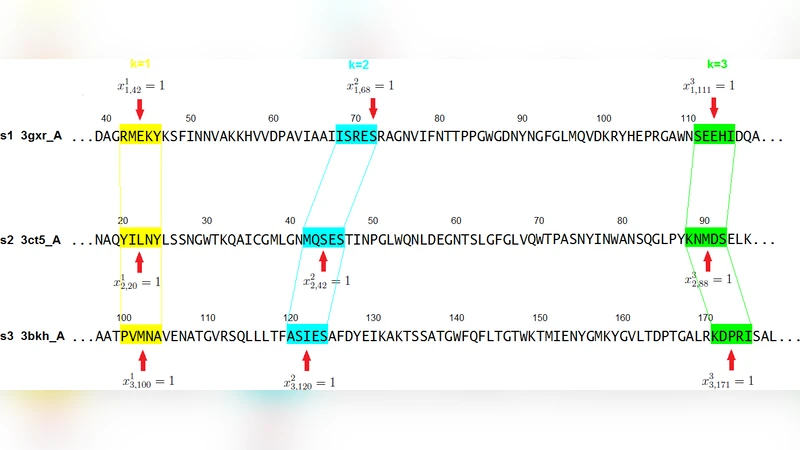
The paper introduces TOPO, a novel threading framework designed to improve remote homology detection by focusing on conserved structural “frameworks” rather than aligning whole protein sequences. Remote homologues often share very weak overall sequence signals, making conventional threading methods— which rely on full‑sequence profiles, solvent accessibility, and contact probabilities—prone to errors, especially in the highly variable regions outside conserved motifs. The authors hypothesize that even in remote homologues, short, dispersed segments of the protein retain both high sequence conservation and structural similarity because they are essential for structural stability. These segments constitute a common structural framework that can be identified across a protein family.
TOPO proceeds in three main steps. First, for each template with known structure, all remote homologues are collected via structural alignment. A linear integer programming (ILP) model is then used to locate a set of m segments (each of length n) that simultaneously maximize structural similarity (measured by Dscore, a distance‑based metric) and satisfy sequence‑conservation constraints (derived from a pre‑computed similarity matrix M). The ILP enforces (i) uniqueness of each segment within a protein, (ii) non‑overlap and ordering of segments, and (iii) a minimum sequence‑similarity threshold T for each segment pair.
Second, instead of aligning the query sequence against the entire template, the query is first aligned to the identified common framework. This reduces the influence of highly variable regions and yields a more reliable seed alignment. The authors employ TreeThreader to generate these framework‑based alignments and rank candidate templates using an E‑value derived from model generation.
Third, the query is re‑aligned to the full‑length candidate templates, and three‑dimensional models are built with MODELLER. The resulting models are evaluated with the dDFIRE statistical potential; the lowest‑energy model is selected as the final prediction.
To validate the approach, the authors constructed a database called TOPO from over 27,000 proteins in the PDB70 (April 2019) release. A benchmark set of 142 protein pairs with high structural similarity but low sequence identity was assembled. Traditional threading tools such as HHpred failed to produce accurate alignments for most of these pairs (TM‑score < 0.4). In contrast, TOPO generated accurate alignments (TM‑score > 0.4) for seven pairs and correctly predicted inter‑residue contacts for 45 pairs. A detailed example is the pair 3dz1A vs. 1twdA: while HHpred yielded a TM‑score of only 0.22, TOPO’s framework‑based alignment achieved a TM‑score of 0.43, reflecting a substantial improvement.
The study demonstrates that even remote homologues retain conserved “framework” regions that carry strong structural signals. By anchoring the threading process on these frameworks, TOPO mitigates the noise introduced by variable regions and markedly improves fold recognition for challenging remote homology cases. The authors acknowledge that ILP‑based framework detection is computationally intensive, but once the TOPO database is built, the subsequent threading steps are efficient. Future work is suggested in optimizing the number and length of frameworks, exploring combinations of multiple frameworks, and integrating deep‑learning‑based sequence‑to‑structure predictors to further enhance remote homology detection.
Comments & Academic Discussion
Loading comments...
Leave a Comment