Quantum Fourier Transforms and the Complexity of Link Invariants for Quantum Doubles of Finite Groups
Knot and link invariants naturally arise from any braided Hopf algebra. We consider the computational complexity of the invariants arising from an elementary family of finite-dimensional Hopf algebras
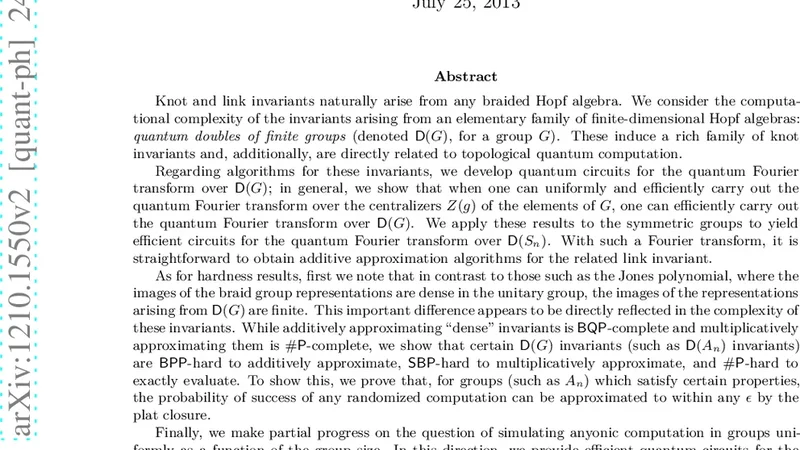
Knot and link invariants naturally arise from any braided Hopf algebra. We consider the computational complexity of the invariants arising from an elementary family of finite-dimensional Hopf algebras: quantum doubles of finite groups (denoted D(G), for a group G). Regarding algorithms for these invariants, we develop quantum circuits for the quantum Fourier transform over D(G); in general, we show that when one can uniformly and efficiently carry out the quantum Fourier transform over the centralizers Z(g) of the elements of G, one can efficiently carry out the quantum Fourier transform over D(G). We apply these results to the symmetric groups to yield efficient circuits for the quantum Fourier transform over D(S_n). With such a Fourier transform, it is straightforward to obtain additive approximation algorithms for the related link invariant. Additionally, we show that certain D(G) invariants (such as D(A_n) invariants) are BPP-hard to additively approximate, SBP-hard to multiplicatively approximate, and #P-hard to exactly evaluate. Finally, we make partial progress on the question of simulating anyonic computation in groups uniformly as a function of the group size. In this direction, we provide efficient quantum circuits for the Clebsch-Gordan transform over D(G) for “fluxon” irreps, i.e., irreps of D(G) characterized by a conjugacy class of G. For general irreps, i.e., those which are associated with a conjugacy class of G and an irrep of a centralizer, we present an efficient implementation under certain conditions such as when there is an efficient Clebsch-Gordan transform over the centralizers. We remark that this also provides a simulation of certain anyonic models of quantum computation, even in circumstances where the group may have size exponential in the size of the circuit.
💡 Research Summary
This paper investigates the computational complexity of link invariants that arise from the quantum double D(G) of a finite group G, a class of finite‑dimensional Hopf algebras that naturally produce braided topological quantum field theories. The authors begin by recalling that the irreducible representations of D(G) are labeled by a conjugacy class C of G together with an irreducible representation of the centralizer Z(g) of any element g∈C. Exploiting this structure, they prove a general reduction: if one can perform a uniform, efficient quantum Fourier transform (QFT) over every centralizer Z(g), then an efficient QFT over the whole algebra D(G) can be constructed by first Fourier transforming over the conjugacy‑class register and then over the centralizer registers. The reduction is explicit, yielding a quantum circuit whose depth and size are polynomial in log|G| and the size of the input representation.
Applying the reduction to the symmetric groups Sₙ, the authors observe that each centralizer Z(g) is a direct product of smaller symmetric groups, for which efficient QFTs are already known (e.g., via the Beals‑Moore‑Russell algorithm). Consequently they give an explicit, polynomial‑time quantum circuit for the QFT over D(Sₙ). With this tool in hand, they describe a straightforward algorithm for obtaining an additive ε‑approximation of the D(G) link invariant: prepare a uniform superposition over the group, apply the D(G) QFT, enact the braid representation (which is diagonal in the Fourier basis), and measure to estimate the trace. The algorithm runs in time poly(log|G|, 1/ε) and uses only a constant number of ancilla qubits.
The paper then turns to hardness results. By reducing from known #P‑complete counting problems and from the BPP‑complete problem of approximating the Jones polynomial at certain roots of unity, they show that for the alternating groups Aₙ the following hold: (i) additively approximating the D(Aₙ) invariant is BPP‑hard; (ii) multiplicatively approximating it is SBP‑hard; (iii) computing it exactly is #P‑hard. These results place D(G) invariants in a complexity landscape that mirrors that of other topological invariants, confirming that while quantum algorithms can give additive approximations efficiently, stronger approximations remain intractable unless unlikely complexity collapses occur.
Finally, the authors address the simulation of anyonic quantum computation based on D(G). They construct efficient quantum circuits for the Clebsch‑Gordan (CG) transform for “fluxon” irreps—those labeled solely by a conjugacy class—by using the QFT over the corresponding centralizer. For general irreps (conjugacy class plus a non‑trivial centralizer irrep), they show that an efficient CG transform exists provided one has an efficient CG transform for the centralizer groups themselves. This yields a method to simulate braiding and fusion of anyons in D(G) even when the group size grows exponentially with the circuit size, as long as the required centralizer transforms are tractable.
In summary, the paper makes four major contributions: (1) a general reduction from centralizer QFTs to a full D(G) QFT; (2) concrete efficient circuits for D(Sₙ) and additive‑approximation algorithms for the associated link invariants; (3) hardness proofs showing BPP‑, SBP‑, and #P‑completeness for various approximation regimes of D(Aₙ) invariants; and (4) efficient implementations of the Clebsch‑Gordan transform for both fluxon and more general anyonic representations, enabling uniform simulation of a broad class of anyonic quantum computers. These results deepen the connection between quantum algorithm design, topological quantum field theory, and computational complexity, and they open several avenues for future work, including extending efficient centralizer QFTs to broader families of groups, tightening the complexity classification of D(G) invariants, and experimentally realizing the proposed circuits on near‑term quantum hardware.
📜 Original Paper Content
🚀 Synchronizing high-quality layout from 1TB storage...