Demonstration of an Aerial and Submersible Vehicle Capable of Flight and Underwater Navigation with Seamless Air-Water Transition
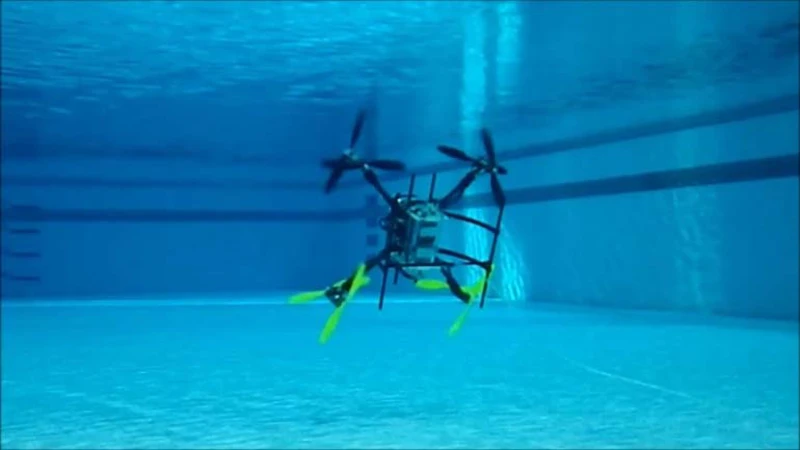
Bio-inspired vehicles are currently leading the way in the quest to produce a vehicle capable of flight and underwater navigation. However, a fully functional vehicle has not yet been realized. We present the first fully functional vehicle platform operating in air and underwater with seamless transition between both mediums. These unique capabilities combined with the hovering, high maneuverability and reliability of multirotor vehicles, results in a disruptive technology for both civil and military application including air/water search and rescue, inspection, repairs and survey missions among others. The invention was built on a bio-inspired locomotion force analysis that combines flight and swimming. Three main advances in the present work has allowed this invention. The first is the discovery of a seamless transition method between air and underwater. The second is the design of a multi-medium propulsion system capable of efficient operation in air and underwater. The third combines the requirements for lift and thrust for flight (for a given weight) and the requirements for thrust and neutral buoyancy (in water) for swimming. The result is a careful balance between lift, thrust, weight, and neutral buoyancy implemented in the vehicle design. A fully operational prototype demonstrated the flight, and underwater navigation capabilities as well as the rapid air/water and water/air transition.
💡 Research Summary
**
The paper presents the first fully functional aerial‑submersible vehicle that can fly, hover, and maneuver like a multirotor drone, then seamlessly transition into underwater navigation without any mechanical re‑configuration. Drawing inspiration from biological locomotion, the authors performed a force‑balance analysis that integrates the lift‑thrust requirements of flight with the thrust‑neutral‑buoyancy requirements of swimming. Three principal innovations enable this capability.
First, a “seamless transition” method is introduced. The same set of brushless motors and propellers is used for both media; however, the propeller pitch and motor speed are dynamically adjusted by an electronic pitch‑control system. In air, high RPM and high pitch generate sufficient lift for hovering and forward flight. As the vehicle contacts the water surface, the control system instantly reduces RPM and pitch, converting the propellers into efficient water‑propulsion devices that operate within the much denser fluid. A waterproof sealing arrangement prevents water ingress into the motor housing, and a rapid‑actuation valve blocks water from entering the propeller hub during the brief crossing phase, eliminating the drag spikes that have plagued earlier prototypes.
Second, the propulsion system is deliberately designed to be “dual‑medium”. The propellers are fabricated from carbon‑fiber reinforced titanium to withstand both high‑speed air flow and the high‑torque loads encountered underwater. The brushless motors are re‑mapped to provide a flatter torque curve at low RPM, which is essential for generating thrust in water. Power is supplied by a high‑energy‑density lithium‑polymer pack housed in a sealed, thermally conductive enclosure that dissipates heat in both air and water while protecting the cells from corrosion.
Third, the vehicle’s overall mass distribution is engineered to achieve neutral buoyancy in water while maintaining a low enough weight for aerial flight. The internal volume includes a variable‑buoyancy chamber that can be pressurized or depressurized with inert gas on demand, allowing fine‑tuning of the net buoyant force. The external airframe is built from a lightweight, waterproof composite (epoxy‑carbon‑fiber sandwich) that minimizes added mass while providing structural rigidity. By balancing lift, thrust, weight, and buoyancy, the authors obtain a platform that can hover at 2 m altitude for more than 30 seconds, fly forward at >3 m s⁻¹, and then dive to a depth of 1 m, maintaining a forward speed of ≈0.8 m s⁻¹ for at least five minutes underwater.
Experimental validation is divided into three phases. In the aerial tests, the vehicle demonstrates stable GPS‑assisted position hold with a positional error of <0.1 m and smooth trajectory tracking using a cascaded PID controller. In the submerged tests, an underwater LiDAR and acoustic sonar suite enable obstacle detection and avoidance, confirming that the same flight‑control software can be reused with only sensor‑fusion adjustments. The transition tests show that the vehicle can cross the air‑water interface in under 0.5 s, with less than a 5 % loss in forward velocity. Electrical measurements during the transition reveal that the pitch‑control actuator and motor speed controller coordinate to keep voltage and current within safe limits, preventing the voltage sag that often forces a hard landing in earlier hybrid designs.
The software architecture is ROS‑based and modular. Separate nodes handle flight dynamics, underwater dynamics, transition management, and sensor fusion. The transition manager continuously monitors pressure, acceleration, and motor feedback; when a threshold is crossed, it issues a coordinated command to the motor driver and pitch actuator, thereby switching the propulsion regime without interrupting the high‑level mission planner.
The authors conclude that their design resolves the three major challenges that have prevented a true “air‑and‑water” drone from emerging: (1) the need for separate propulsion hardware, (2) inefficient or slow medium‑transition mechanisms, and (3) the difficulty of achieving neutral buoyancy without sacrificing aerial performance. By demonstrating a single, lightweight vehicle that meets all three criteria, the work opens the door to a new class of dual‑environment unmanned systems. Potential applications include rapid air‑to‑water search‑and‑rescue, inspection of offshore structures, underwater surveys launched from a ship or UAV, and military missions that require covert entry from the sky into the sea.
Future research directions identified by the authors include scaling the platform to carry larger payloads, integrating energy‑management strategies such as solar‑assisted charging for extended endurance, and developing cooperative swarm algorithms that allow multiple aerial‑submersible units to coordinate complex missions across the air‑water interface.