A Survey and Classification of Controlled Natural Languages
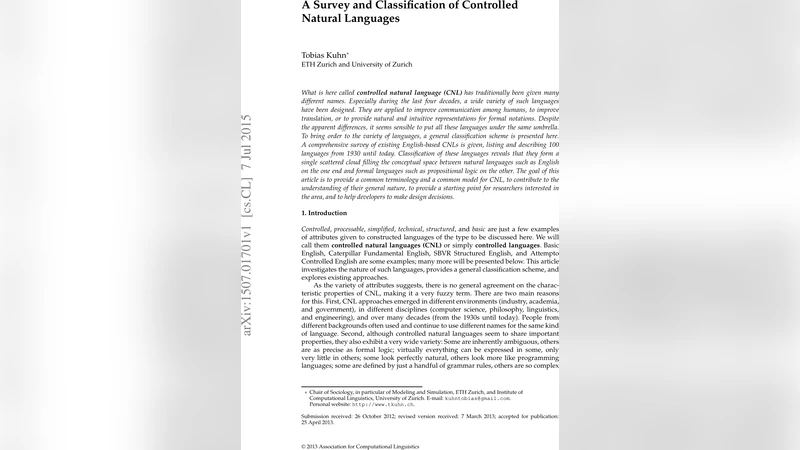
What is here called controlled natural language (CNL) has traditionally been given many different names. Especially during the last four decades, a wide variety of such languages have been designed. They are applied to improve communication among humans, to improve translation, or to provide natural and intuitive representations for formal notations. Despite the apparent differences, it seems sensible to put all these languages under the same umbrella. To bring order to the variety of languages, a general classification scheme is presented here. A comprehensive survey of existing English-based CNLs is given, listing and describing 100 languages from 1930 until today. Classification of these languages reveals that they form a single scattered cloud filling the conceptual space between natural languages such as English on the one end and formal languages such as propositional logic on the other. The goal of this article is to provide a common terminology and a common model for CNL, to contribute to the understanding of their general nature, to provide a starting point for researchers interested in the area, and to help developers to make design decisions.
💡 Research Summary
The paper “A Survey and Classification of Controlled Natural Languages” addresses the fragmented terminology and lack of a unified framework that have characterized the field of Controlled Natural Languages (CNLs) over the past four decades. The authors begin by proposing a precise definition: a CNL is a constructed language based on exactly one natural language, more restrictive in lexicon, syntax, and/or semantics, yet preserving enough of the base language’s natural properties to remain intuitively understandable to its speakers. This definition deliberately avoids the bias of earlier definitions that emphasized either human readability or machine processability alone.
To clarify the conceptual landscape, the authors differentiate CNLs from related notions such as sublanguages (naturally emerging restricted vocabularies), language fragments (identified subsets used for theoretical study), style guides (prescriptive writing advice that may or may not constitute a new language), phraseologies (collections of set phrases), controlled vocabularies (lexical restrictions without grammatical rules), and constructed languages in the broad sense (including Esperanto and programming languages). The key distinction is that CNLs are consciously engineered rather than emergent.
The core contribution is a nine‑letter code system that captures the most salient, orthogonal properties of any CNL:
- C (Comprehensibility): aimed at improving human‑to‑human communication;
- T (Translation): designed to facilitate manual, semi‑automatic, or automatic translation;
- F (Formal representation): intended to serve as a natural front‑end for formal logics or executable specifications;
- W (Written): primarily a written medium;
- S (Spoken): primarily a spoken medium;
- D (Domain‑specific): restricted to a narrow application domain;
- A (Academic origin), I (Industrial origin), G (Governmental/UN origin): indicating the institutional source of the language.
These codes are independent and combinable; for example, “CTW” denotes a written language that simultaneously targets human readability and translation support. The authors also discuss rule orientation (prescriptive vs. proscriptive) and introduce a life‑cycle model (conceptual, experimental, widespread adoption) to capture the evolutionary status of each CNL.
The empirical part surveys 100 English‑based CNLs spanning from 1930 to the present, ranging from early “Basic English” and “Caterpillar Fundamental English” to modern systems such as Attempto Controlled English, SBVR Structured English, and ACE. The survey is organized chronologically, by purpose (C, T, F), by origin (A, I, G), and by modality (W, S). Key findings include:
- Early CNLs (1930‑1970) were predominantly human‑oriented (type C) and focused on simplifying technical documentation.
- The 1980s‑1990s saw a surge in translation‑oriented CNLs (type T), driven by the rise of computer‑assisted translation and multinational industry.
- Since the early 2000s, formal‑representation CNLs (type F) have become prominent, reflecting increased interest in knowledge representation, semantic web, and executable specifications.
- Academic initiatives often seed CNL concepts that later migrate to industry, while government‑initiated CNLs tend to concentrate on safety, military, or standardization domains.
- Approximately 40 % of the surveyed languages are domain‑specific (D), while the remaining 60 % aim for broader applicability.
To provide a more quantitative assessment, the authors introduce the PENS framework—Precision, Expressiveness, Naturalness, and Simplicity. Each dimension maps onto previously identified fuzzy properties (e.g., ambiguity, predictability, formality) and allows designers to position a CNL on a four‑dimensional space, facilitating trade‑off analysis.
In conclusion, the paper delivers a comprehensive taxonomy, a clear definitional baseline, and an evaluative model that together promise to harmonize future research, development, and standardization efforts in the CNL community. By mapping the historical evolution and current landscape, it also highlights gaps—such as the relative scarcity of spoken CNLs and the need for more robust life‑cycle tracking—that suggest fruitful directions for subsequent work.
Comments & Academic Discussion
Loading comments...
Leave a Comment