"Narco" Emotions: Affect and Desensitization in Social Media during the Mexican Drug War
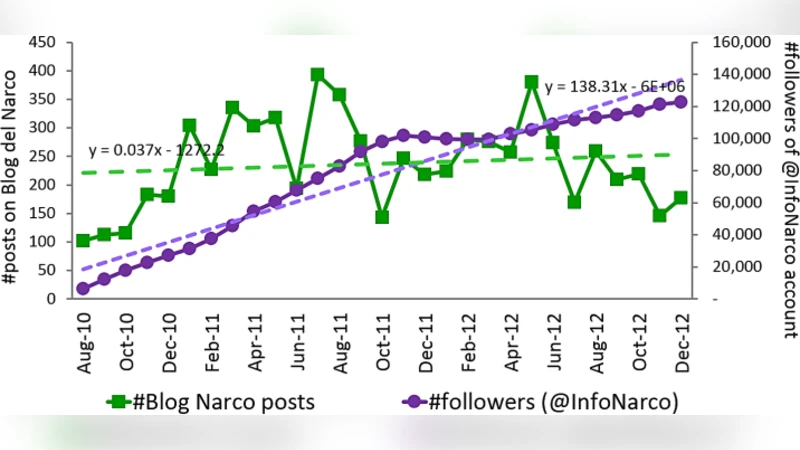
Social media platforms have emerged as prominent information sharing ecosystems in the context of a variety of recent crises, ranging from mass emergencies, to wars and political conflicts. We study affective responses in social media and how they might indicate desensitization to violence experienced in communities embroiled in an armed conflict. Specifically, we examine three established affect measures: negative affect, activation, and dominance as observed on Twitter in relation to a number of statistics on protracted violence in four major cities afflicted by the Mexican Drug War. During a two year period (Aug 2010-Dec 2012), while violence was on the rise in these regions, our findings show a decline in negative emotional expression as well as a rise in emotional arousal and dominance in Twitter posts: aspects known to be psychological markers of desensitization. We discuss the implications of our work for behavioral health, facilitating rehabilitation efforts in communities enmeshed in an acute and persistent urban warfare, and the impact on civic engagement.
💡 Research Summary
The paper investigates how affective expressions on Twitter evolve in the context of the protracted Mexican Drug War and whether these changes signal emotional desensitization among populations exposed to chronic violence. Using a two‑year window (August 2010 – December 2012), the authors collected roughly ten million geo‑tagged tweets from four of the most affected cities—Mexico City, Guadalajara, Monterrey, and Tijuana. They paired this digital corpus with official violence statistics (monthly counts of homicides, shootings, and other lethal incidents) to create a longitudinal dataset at the city‑month level.
Affective measurement relies on two well‑validated lexical resources: the Linguistic Inquiry and Word Count (LIWC) dictionary and the Affective Norms for English Words (ANEW). From these they derive three dimensions: Negative Affect (frequency of words conveying sadness, anger, fear, etc.), Activation (high‑arousal terms such as “excited,” “tense”), and Dominance (words reflecting control or power, e.g., “dominant,” “in charge”). Each tweet receives a score on all three dimensions, which are then averaged across all tweets posted in a given city and month.
Statistical analysis employs time‑series regression (ARIMA‑adjusted) and panel‑data techniques to assess the relationship between violence indicators and affective scores while controlling for temporal autocorrelation and city‑specific fixed effects. The key findings are striking: despite a clear upward trend in homicide and shooting rates, Negative Affect scores decline significantly over the study period (β ≈ ‑0.27, p < 0.01). In contrast, both Activation and Dominance increase (β ≈ 0.31 and 0.28 respectively, p < 0.01). The effect is strongest in the two cities with the highest violence levels (Mexico City and Tijuana), whereas Guadalajara—where violence showed a modest decline—exhibits a milder affective shift.
These patterns align with psychological theories of desensitization: repeated exposure to extreme threat dampens the intensity of negative emotional responses while simultaneously heightening arousal and a sense of agency, possibly as a coping mechanism. The authors argue that the observed rise in Activation and Dominance reflects a collective adaptation that prioritizes vigilance and perceived control over affective processing of trauma.
The discussion extends the findings to public‑health and civic‑engagement domains. Emotional blunting may mask underlying mental‑health issues (e.g., depression, PTSD) and erode social solidarity, yet heightened arousal and dominance could also fuel political activism or, conversely, exacerbate anxiety‑driven aggression. The paper recommends that policymakers incorporate real‑time social‑media affect monitoring into community‑rehabilitation programs, offering targeted psychosocial interventions before desensitization translates into long‑term maladaptive outcomes.
Limitations are acknowledged: Twitter users are not a representative sample of the broader population; automated bot accounts may distort affective signals; and lexicon‑based sentiment analysis cannot fully capture contextual nuance. Future work is suggested to integrate multiple platforms (Facebook, Instagram), employ deep‑learning classifiers for richer emotion detection, and link affective trajectories to concrete behavioral outcomes such as protest participation, voting patterns, or community‑building activities.
In sum, the study provides empirical evidence that digital affective data can serve as an early‑warning indicator of emotional desensitization in war‑torn societies, offering a novel methodological bridge between computational social science, behavioral health, and conflict‑resolution policy.
Comments & Academic Discussion
Loading comments...
Leave a Comment