Coherent analogues of matrix factorizations and relative singularity categories
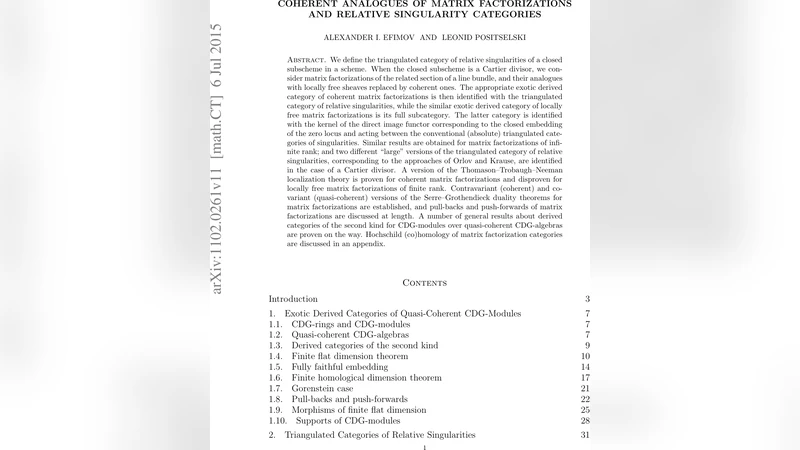
We define the triangulated category of relative singularities of a closed subscheme in a scheme. When the closed subscheme is a Cartier divisor, we consider matrix factorizations of the related section of a line bundle, and their analogues with locally free sheaves replaced by coherent ones. The appropriate exotic derived category of coherent matrix factorizations is then identified with the triangulated category of relative singularities, while the similar exotic derived category of locally free matrix factorizations is its full subcategory. The latter category is identified with the kernel of the direct image functor corresponding to the closed embedding of the zero locus and acting between the conventional (absolute) triangulated categories of singularities. Similar results are obtained for matrix factorizations of infinite rank; and two different “large” versions of the triangulated category of relative singularities, corresponding to the approaches of Orlov and Krause, are identified in the case of a Cartier divisor. A version of the Thomason-Trobaugh-Neeman localization theory is proven for coherent matrix factorizations and disproven for locally free matrix factorizations of finite rank. Contravariant (coherent) and covariant (quasi-coherent) versions of the Serre-Grothendieck duality theorems for matrix factorizations are established, and pull-backs and push-forwards of matrix factorizations are discussed at length. A number of general results about derived categories of the second kind for CDG-modules over quasi-coherent CDG-algebras are proven on the way. Hochschild (co)homology of matrix factorization categories are discussed in an appendix.
💡 Research Summary
The paper introduces a comprehensive framework that connects matrix factorizations, CDG‑modules, and triangulated categories of singularities. The authors begin by recalling the notion of a curved differential graded (CDG) ring and CDG‑algebra, and then develop the theory of “derived categories of the second kind” for CDG‑modules. Two variants of these derived categories are distinguished: the co‑derived category (appropriate for flat or locally free objects) and the absolute derived category (appropriate for coherent objects). A key technical result (Theorem 1.4) shows that under a finite flat dimension hypothesis the co‑derived and absolute derived categories coincide, which later underpins the main equivalences.
Next, for a closed subscheme (Z\subset X) the authors define a relative singularity category (D_{\mathrm{Sg}}^{\mathrm{rel}}(Z\subset X)) as the kernel of the direct‑image functor (i_*: D_{\mathrm{Sg}}(Z)\to D_{\mathrm{Sg}}(X)). When (Z) is a Cartier divisor given by a section (w) of a line bundle (L) on (X), one can form the category of matrix factorizations (\operatorname{MF}(w)). The paper treats both locally free matrix factorizations (\operatorname{MF}^{\mathrm{free}}(w)) and coherent matrix factorizations (\operatorname{MF}^{\mathrm{coh}}(w)).
The central theorem (Theorem 2.7) establishes a triangulated equivalence \
Comments & Academic Discussion
Loading comments...
Leave a Comment