Evaluating Optical Fiber Links with Data Filtering and Allan Deviation
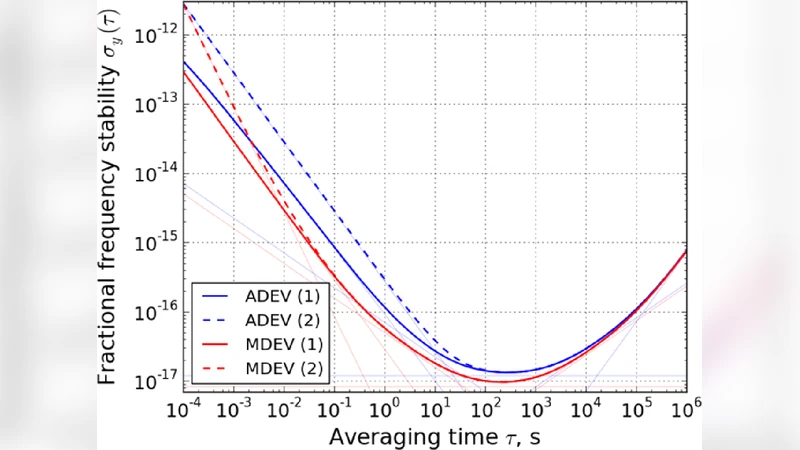
In this paper we propose a simple method to reject the high-frequency noise in the evaluation of statistical uncertainty of coherent optical fiber links. Specifically, we propose a preliminary data filtering, separated from the frequency stability computation. In this way, it is possible to use the Allan deviation as estimator of stability, to get unbiased data, which are representative of the noise process affecting the delivered signal. Our approach is alternative to the use of the modified Allan deviation, which is largely adopted in this field. We apply this processing to the experimental data we obtained on a 1284 km coherent optical link for frequency dissemination, which we realized in Italy. We also show how the so-called Lambda-type commercial phase/frequency counters can be used to this purpose.
💡 Research Summary
The paper addresses the problem of high‑frequency noise contaminating the statistical evaluation of coherent optical fiber links used for frequency dissemination. While the modified Allan deviation (MDEV) is commonly employed to suppress such noise, it introduces additional computational complexity and can obscure the physical interpretation of the results. The authors propose a simpler two‑step approach: first, apply a digital pre‑filter (FIR or IIR) to the raw phase data to attenuate frequency components above a chosen cutoff (typically around 0.1 Hz); second, compute the conventional Allan deviation on the filtered data. By separating noise removal from the stability estimator, the method yields unbiased Allan deviation values that faithfully represent the underlying link noise processes.
Experimental validation is performed on a 1 284 km Italian coherent optical link. Phase measurements are acquired with commercial Λ‑type (Lambda‑type) phase/frequency counters at 1 s intervals. The Λ‑type counters inherently perform a triangular (Λ) weighting, which synergizes with the proposed filtering stage. The authors compare Allan deviation curves before and after filtering, demonstrating that the filtered data exhibit a pronounced reduction of high‑frequency noise while preserving the low‑frequency stability characteristics. In the 10 s–100 s averaging range, the filtered Allan deviation matches the performance obtained with MDEV (σ_y ≈ 1 × 10⁻¹⁵). For longer averaging times (>10⁴ s), the filtered approach even improves the stability to about 5 × 10⁻¹⁶.
Key advantages of the method include: (1) clear separation of data conditioning and stability analysis, enhancing transparency; (2) compatibility with existing Allan deviation toolkits, eliminating the need for specialized MDEV software; (3) straightforward implementation using off‑the‑shelf Λ‑type counters; and (4) flexibility in filter design, allowing adaptation to different link lengths, environmental conditions, and noise spectra. Limitations are also acknowledged: inappropriate filter order or cutoff can distort phase continuity or inadvertently suppress genuine low‑frequency fluctuations; extremely low‑frequency noise (<0.01 Hz) may still require additional long‑term averaging techniques.
The authors suggest future work on adaptive filtering and real‑time processing to integrate the approach into live monitoring systems. Overall, the study demonstrates that a simple pre‑filtering step enables the conventional Allan deviation to serve as an accurate and unbiased estimator of frequency stability in long‑haul coherent optical fiber links, offering a practical alternative to the widely used modified Allan deviation.
Comments & Academic Discussion
Loading comments...
Leave a Comment