A note on the metrizability of spaces
With the blessing of hind sight we consider the problem of metrizability and show that the classical Bing-Nagata-Smirnov Theorem and a more recent result of Flagg give complementary answers to the metrization problem, that are in a sense dual to each other.
💡 Research Summary
The paper revisits the classical metrization problem from a categorical perspective and demonstrates that two seemingly different approaches—restricting the codomain of the standard functor from metric spaces to topological spaces, and enlarging its domain via value‑quantale continuity spaces—are in fact complementary and dual to each other.
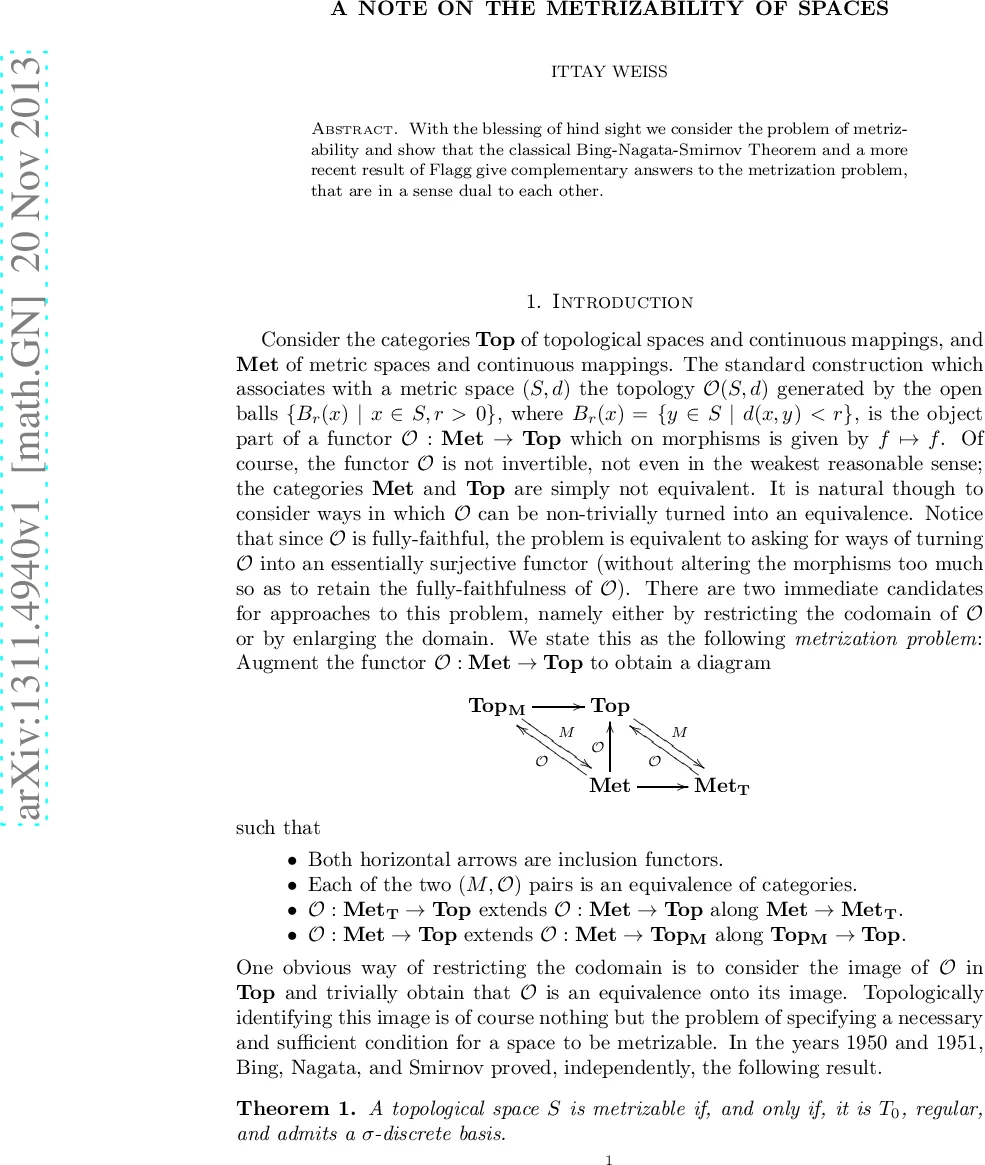
The standard construction associates to each metric space ((S,d)) the topology generated by its open balls, yielding a functor (O:\mathbf{Met}\to\mathbf{Top}). This functor is fully faithful but not essentially surjective on the whole of (\mathbf{Top}). The first line of attack therefore restricts the codomain to a subcategory (\mathbf{Top}_M) consisting of regular (T_0) spaces that admit a (\sigma)-discrete basis. The Bing‑Nagata‑Smirnov theorem (independently proved in 1950‑51) states that a topological space is metrizable iff it is (T_0), regular, and has a (\sigma)-discrete basis. Consequently, the inclusion (\mathbf{Top}_M\hookrightarrow\mathbf{Top}) makes (O) factor through (\mathbf{Top}_M) as an equivalence (\mathbf{Met}\simeq\mathbf{Top}_M). An explicit quasi‑inverse (M:\mathbf{Top}_M\to\mathbf{Met}) sends each space (S) to any metric guaranteed by the theorem, thereby solving the left‑hand triangle of the “metrization problem” diagram.
The second approach draws on R.C. Flagg’s work on value quantales. A value quantale (V) is a complete lattice equipped with a commutative, associative addition that distributes over arbitrary joins and satisfies (x+0=x) and (x+\bigvee S=\bigvee{x+s:s\in S}). A (V)-continuity space ((X,d)) is a set (X) together with a distance map (d:X\times X\to V) satisfying (d(x,x)=0) and the triangle inequality (d(x,z)\le d(x,y)+d(y,z)). When (V=
Comments & Academic Discussion
Loading comments...
Leave a Comment