Random field sampling for a simplified model of melt-blowing considering turbulent velocity fluctuations
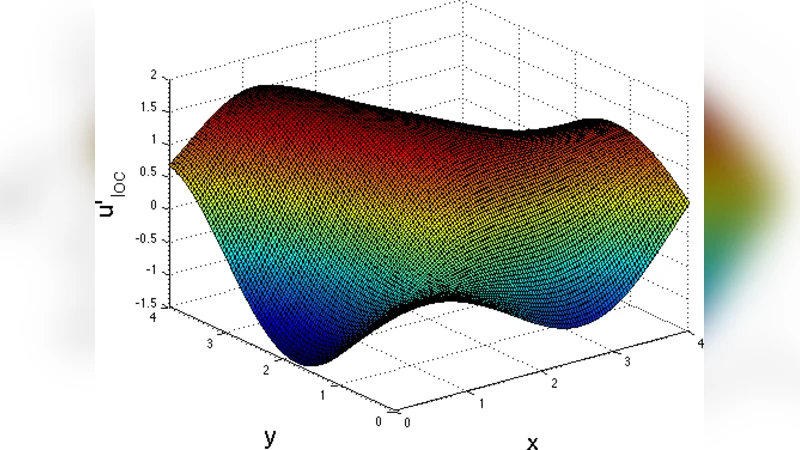
In melt-blowing very thin liquid fiber jets are spun due to high-velocity air streams. In literature there is a clear, unsolved discrepancy between the measured and computed jet attenuation. In this paper we will verify numerically that the turbulent velocity fluctuations causing a random aerodynamic drag on the fiber jets – that has been neglected so far – are the crucial effect to close this gap. For this purpose, we model the velocity fluctuations as vector Gaussian random fields on top of a k-epsilon turbulence description and develop an efficient sampling procedure. Taking advantage of the special covariance structure the effort of the sampling is linear in the discretization and makes the realization possible.
💡 Research Summary
Melt‑blowing is a high‑speed air‑assisted process that produces ultra‑fine polymer fibers by stretching a molten jet in a turbulent airstream. Despite extensive research, a persistent discrepancy has been observed between experimentally measured fiber attenuation (both in diameter reduction and length stretch) and the predictions of conventional numerical models. Existing simulations typically rely on Reynolds‑averaged Navier‑Stokes (RANS) turbulence closures, most commonly the k‑ε model, and compute aerodynamic drag using only the mean velocity field. This deterministic treatment neglects the instantaneous fluctuations of the turbulent flow, which can exert random, high‑frequency forces on the fibers. Consequently, the predicted attenuation is substantially lower than what is measured in practice, especially for fibers with diameters in the sub‑micron range.
The present paper addresses this “attenuation gap” by explicitly incorporating turbulent velocity fluctuations as a three‑dimensional vector Gaussian random field superimposed on the mean flow obtained from a k‑ε simulation. The authors first derive a covariance structure that reflects the statistical properties of high‑Reynolds‑number turbulence. The covariance is isotropic and homogeneous, depending only on spatial separation (r) and temporal lag (\tau):
\
Comments & Academic Discussion
Loading comments...
Leave a Comment