City Data Fusion: Sensor Data Fusion in the Internet of Things
Internet of Things (IoT) has gained substantial attention recently and play a significant role in smart city application deployments. A number of such smart city applications depend on sensor fusion c
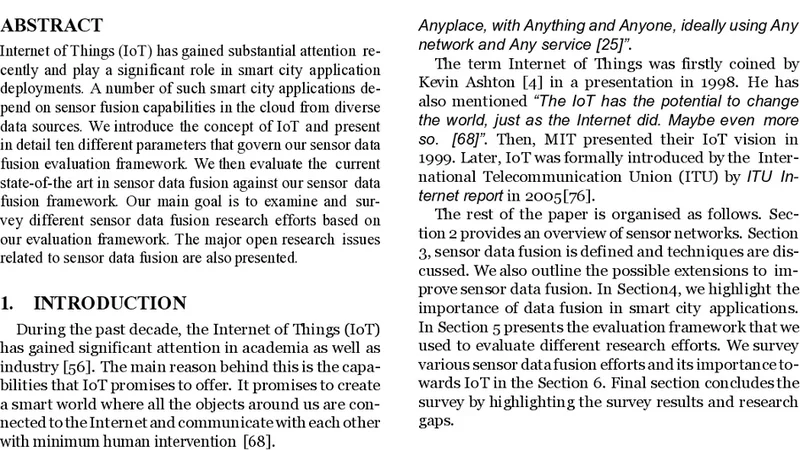
Internet of Things (IoT) has gained substantial attention recently and play a significant role in smart city application deployments. A number of such smart city applications depend on sensor fusion capabilities in the cloud from diverse data sources. We introduce the concept of IoT and present in detail ten different parameters that govern our sensor data fusion evaluation framework. We then evaluate the current state-of-the art in sensor data fusion against our sensor data fusion framework. Our main goal is to examine and survey different sensor data fusion research efforts based on our evaluation framework. The major open research issues related to sensor data fusion are also presented.
💡 Research Summary
The paper “City Data Fusion: Sensor Data Fusion in the Internet of Things” addresses the critical role of sensor data fusion for smart‑city applications built on the Internet of Things (IoT). Recognizing that many urban services—traffic management, environmental monitoring, emergency response—rely on heterogeneous sensor streams, the authors first provide a concise overview of IoT concepts and the challenges posed by massive, diverse, and often noisy data. They argue that existing research tends to focus narrowly on improving accuracy while overlooking other operational dimensions such as timing, scalability, energy consumption, security, and interoperability.
To fill this gap, the authors propose a comprehensive evaluation framework consisting of ten parameters that together capture the full spectrum of requirements for practical sensor fusion in smart cities: (1) Data Accuracy, (2) Temporal Synchronization, (3) Spatial Consistency, (4) Scalability, (5) Computational Complexity, (6) Energy Efficiency, (7) Security & Privacy, (8) Real‑time Responsiveness, (9) Adaptivity & Learning Capability, and (10) Standardization & Interoperability. Each parameter is defined with measurable criteria, and the framework includes a two‑stage assessment process. First, a mapping step assigns quantitative scores to a given fusion technique for each parameter. Second, application‑specific weight vectors (e.g., traffic control vs. air‑quality monitoring) are applied to produce a composite score that reflects the relative importance of the parameters for that domain.
The paper then surveys the state‑of‑the‑art sensor fusion approaches, classifying them into three architectural levels: sensor‑level, feature‑level, and decision‑level fusion. Representative methods are evaluated against the ten‑parameter framework:
- Sensor‑level fusion (e.g., Kalman filters, particle filters) excels in temporal synchronization and low computational overhead but scores poorly on security, privacy, and energy consumption because many implementations assume trusted, power‑rich environments.
- Feature‑level fusion (e.g., deep neural networks, ensemble learning) achieves high accuracy and strong adaptivity, yet its heavy computational and memory demands hinder real‑time deployment on edge devices and increase power usage.
- Decision‑level fusion (e.g., majority voting, Bayesian networks, fuzzy logic) offers simplicity, ease of integration, and the possibility of encrypted decision making, but it often sacrifices accuracy and may introduce latency when aggregating multiple high‑level decisions.
The comparative analysis reveals that no single technique dominates across all ten dimensions; instead, each method exhibits a distinct trade‑off profile. This insight underscores the necessity of multi‑criteria evaluation when selecting or designing fusion solutions for specific smart‑city services.
Beyond the comparative study, the authors identify several open research challenges. First, lightweight, real‑time fusion algorithms suitable for edge computing are needed to meet strict latency and power budgets. Second, privacy‑preserving fusion mechanisms—such as homomorphic encryption, differential privacy, or secure multi‑party computation—must be integrated without crippling performance. Third, the lack of standardized data models, metadata schemas, and APIs hampers interoperability among devices from different vendors, suggesting a need for industry‑wide consensus. Fourth, dynamic adaptivity—leveraging reinforcement learning or meta‑learning to automatically re‑configure fusion strategies in response to sensor failures, network congestion, or changing environmental conditions—remains largely unexplored. Finally, the authors call for cross‑domain fusion platforms that can simultaneously process traffic, environmental, and energy data to generate richer, synergistic insights for city planners.
In the concluding remarks, the paper emphasizes that the proposed ten‑parameter framework provides a practical, repeatable tool for both researchers and practitioners to benchmark fusion techniques against real‑world smart‑city requirements. The authors advocate for iterative refinement of the framework through pilot deployments in actual urban environments, which would generate empirical data to validate and adjust the parameter definitions and weighting schemes. By aligning technical evaluation with the multifaceted operational demands of smart cities, the work aims to bridge the gap between theoretical sensor‑fusion advances and their practical, large‑scale adoption.
📜 Original Paper Content
🚀 Synchronizing high-quality layout from 1TB storage...