Testing Order Constraints: Qualitative Differences Between Bayes Factors and Normalized Maximum Likelihood
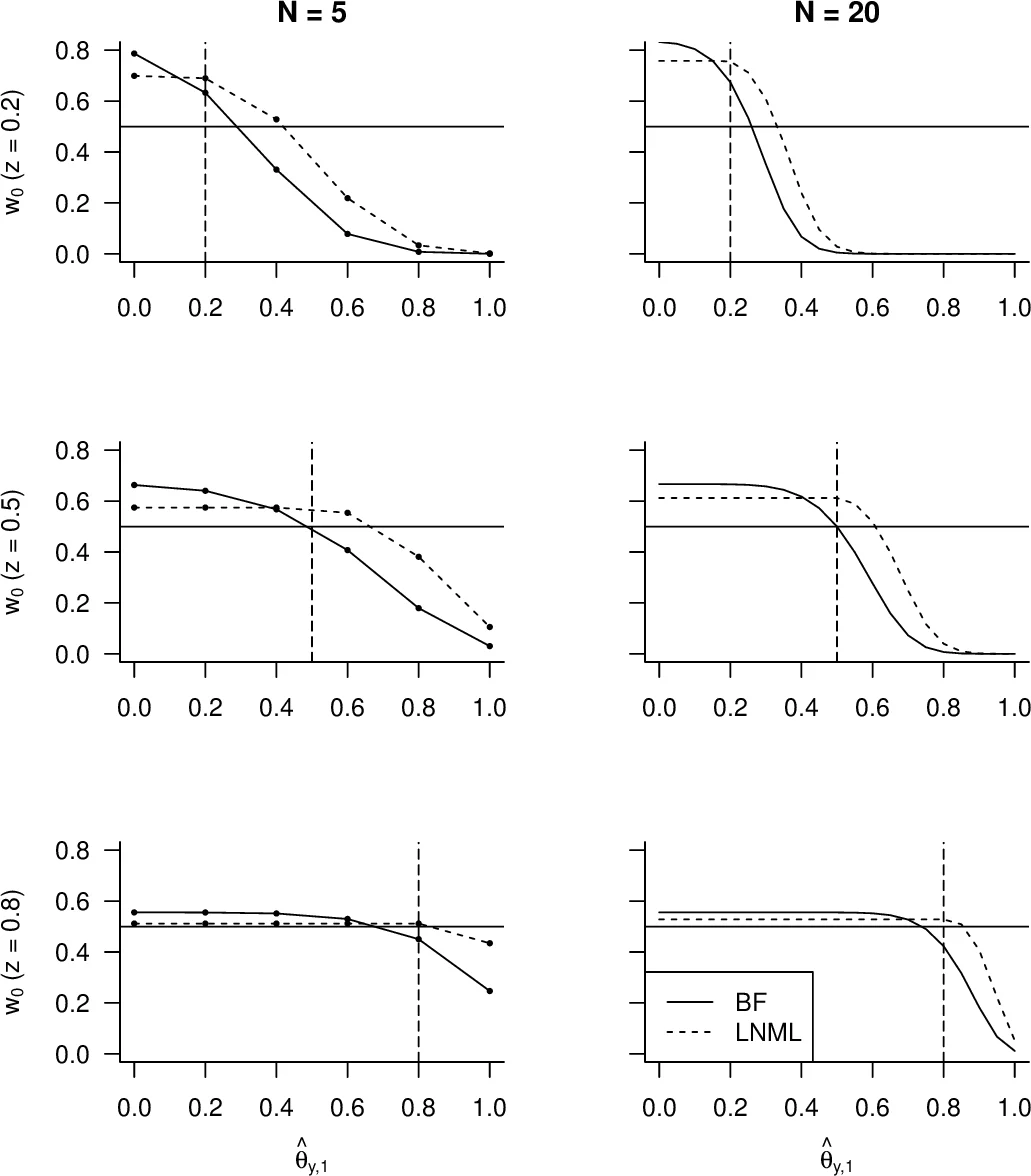
We compared Bayes factors to normalized maximum likelihood for the simple case of selecting between an order-constrained versus a full binomial model. This comparison revealed two qualitative differences in testing order constraints regarding data dependence and model preference.
💡 Research Summary
The paper investigates qualitative differences between Bayes factors and normalized maximum likelihood (NML), including its luckiness‑adjusted variant (LNML), when testing order constraints. The authors focus on a simple binomial setting: a full model M₁ assumes N binary observations y ∼ Bin(N, θ), while a constrained model M₀ adds the inequality θ ≤ z for a fixed bound z∈(0, 1). Both models have a single free parameter, so model‑complexity measures that rely solely on parameter count (e.g., AIC, BIC) are insufficient; the comparison therefore highlights how each method incorporates the order constraint.
Bayes factor approach.
A uniform prior on θ is placed under both models. Because the priors are proportional on the constrained region, the Bayes factor B₀₁ reduces to the ratio of posterior to prior mass of the full model over
Comments & Academic Discussion
Loading comments...
Leave a Comment