First steps in synthetic guarded domain theory: step-indexing in the topos of trees
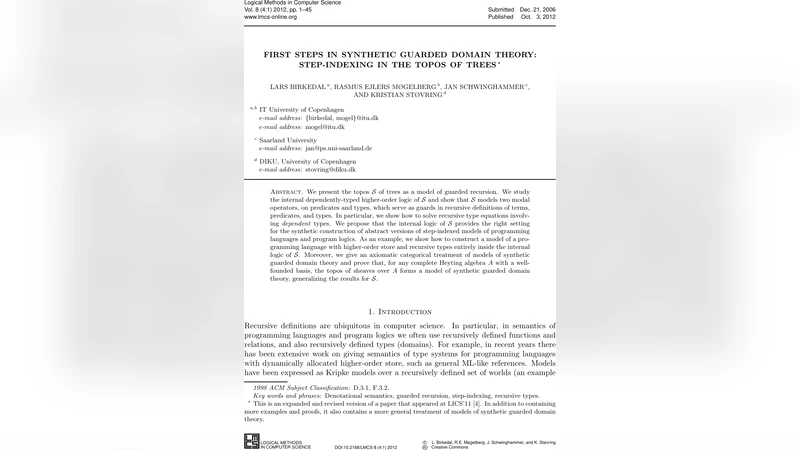
We present the topos S of trees as a model of guarded recursion. We study the internal dependently-typed higher-order logic of S and show that S models two modal operators, on predicates and types, which serve as guards in recursive definitions of terms, predicates, and types. In particular, we show how to solve recursive type equations involving dependent types. We propose that the internal logic of S provides the right setting for the synthetic construction of abstract versions of step-indexed models of programming languages and program logics. As an example, we show how to construct a model of a programming language with higher-order store and recursive types entirely inside the internal logic of S. Moreover, we give an axiomatic categorical treatment of models of synthetic guarded domain theory and prove that, for any complete Heyting algebra A with a well-founded basis, the topos of sheaves over A forms a model of synthetic guarded domain theory, generalizing the results for S.
💡 Research Summary
The paper introduces the topos S of trees as a natural setting for guarded recursion and develops its internal dependently‑typed higher‑order logic. The construction of S starts from the presheaf category on the preorder of natural numbers equipped with the “next” functor ▹, which shifts objects one time step forward. Within this topos, two modal operators are defined: □ on predicates and ◯ on types. □ corresponds to a one‑step delay of propositions, while ◯ is essentially the internal interpretation of the functor ▹ on types. These modalities act as guards, allowing recursive definitions to be expressed safely: a recursive type equation X ≅ F X can be solved by forming the guarded fixed point μX.F where the recursion is wrapped by ◯. Crucially, the framework supports dependent types, so that even type families depending on values can be defined recursively under the guard.
Using this internal logic, the authors construct a model of a programming language L that features higher‑order store and recursive types. The store is modeled as a ◯‑guarded mapping from locations to values, and program semantics are given by continuous functions with respect to the ▹ structure. Type safety, logical relations, and other meta‑theoretic properties are proved entirely inside the logic of S, eliminating the need for an external step‑indexing apparatus.
The second major contribution is an axiomatic categorical treatment of Synthetic Guarded Domain Theory (SGDT). The authors identify a set of axioms that any category must satisfy to support guarded recursion via the two modalities. They then prove that for any complete Heyting algebra A with a well‑founded basis, the topos of sheaves Sh(A) satisfies these axioms. This result generalizes the earlier model based on S, showing that a wide class of sheaf topoi—beyond the specific tree topos—can serve as models of SGDT. The proof constructs the □ and ◯ operators internally in Sh(A) and verifies the required continuity and completeness conditions.
The paper situates its contributions within the broader literature on step‑indexed models, guarded type theory, and categorical semantics. By internalizing the step‑indexing mechanism as a logical modality, the work offers a “synthetic” approach: one can reason about recursive types, higher‑order effects, and logical relations without ever leaving the internal language of the topos. The authors outline future directions, including extending SGDT to handle additional computational effects such as concurrency or probabilistic choice, and applying the framework to the design of practical programming languages with built‑in guarded recursion. Overall, the work establishes a robust theoretical foundation for synthetic guarded domain theory and demonstrates its applicability to realistic language models.
Comments & Academic Discussion
Loading comments...
Leave a Comment