Strongly Complete Logics for Coalgebras
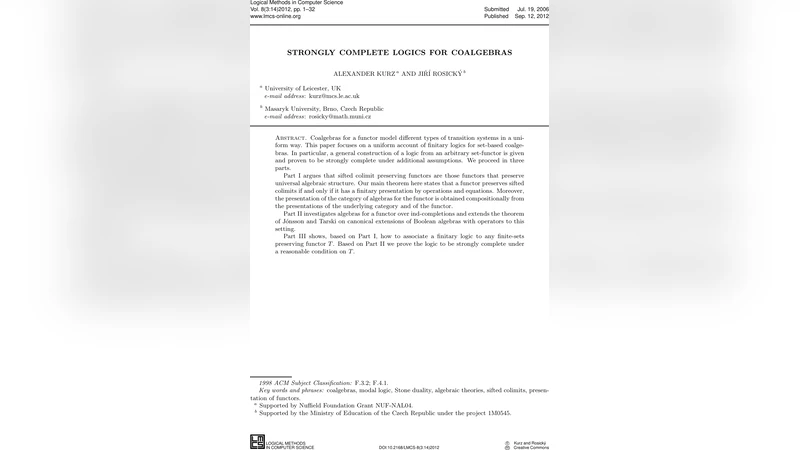
Coalgebras for a functor model different types of transition systems in a uniform way. This paper focuses on a uniform account of finitary logics for set-based coalgebras. In particular, a general construction of a logic from an arbitrary set-functor is given and proven to be strongly complete under additional assumptions. We proceed in three parts. Part I argues that sifted colimit preserving functors are those functors that preserve universal algebraic structure. Our main theorem here states that a functor preserves sifted colimits if and only if it has a finitary presentation by operations and equations. Moreover, the presentation of the category of algebras for the functor is obtained compositionally from the presentations of the underlying category and of the functor. Part II investigates algebras for a functor over ind-completions and extends the theorem of J{'o}nsson and Tarski on canonical extensions of Boolean algebras with operators to this setting. Part III shows, based on Part I, how to associate a finitary logic to any finite-sets preserving functor T. Based on Part II we prove the logic to be strongly complete under a reasonable condition on T.
💡 Research Summary
The paper presents a unified and highly systematic treatment of finitary logics for set‑based coalgebras, culminating in a strong completeness result for a broad class of functors. It is organized into three parts, each building on the previous one.
Part I – Sifted‑colimit preservation and algebraic presentations
The authors begin by analysing functors (F\colon\mathbf{Set}\to\mathbf{Set}) that preserve sifted colimits. A sifted colimit is a colimit over a diagram that is “connected enough” to make finite products commute with it; typical examples are filtered colimits and reflexive coequalisers. The main theorem of this section states that a functor preserves sifted colimits if and only if it admits a finitary presentation by operations and equations. In concrete terms, there exists a signature (\Sigma) with finitely many operation symbols and a set of finitary equations (E) such that the category of (F)-algebras is isomorphic to the variety presented by ((\Sigma,E)). The proof proceeds by constructing the free (F)-algebra on a set, showing that the underlying set functor reflects sifted colimits, and then extracting the operations from the action of (F) on finite sets. Moreover, the presentation of the algebraic category for (F) can be obtained compositionally: one combines the presentation of the base variety (e.g., Boolean algebras, semilattices) with the presentation of the functor itself. This compositionality is crucial for the later construction of logics, because it allows the logical syntax to be built directly from the algebraic data of the functor.
Part II – Algebras over ind‑completions and a Jónsson‑Tarski extension
The second part lifts the discussion from ordinary varieties to their ind‑completions, i.e. categories obtained by freely adding filtered colimits. The authors generalise the classical Jónsson‑Tarski theorem, which guarantees the existence of a canonical (or “perfect”) extension for Boolean algebras with operators, to this broader setting. They show that if a functor (F) preserves sifted colimits, then the induced functor on the ind‑completion also admits a canonical extension that preserves all existing limits and colimits. The construction uses the fact that ind‑completions are reflective subcategories of presheaf categories, together with a careful analysis of how operations extend to the completion. The result provides a powerful tool: any algebra for a sifted‑colimit‑preserving functor can be embedded into a complete, atomic algebra that respects the original operations. This embedding is essential for proving strong completeness later, because it supplies a “canonical model” that validates every consistent set of formulas.
Part III – From functors to finitary logics and strong completeness
Armed with the algebraic and categorical machinery of the first two parts, the authors now associate a finitary modal‑style logic to any functor (T\colon\mathbf{Set}\to\mathbf{Set}) that preserves finite sets. The syntax consists of propositional variables, Boolean connectives, and a family of modal operators whose arities are dictated by the finitary presentation of (T). The semantics interprets each modal operator as the action of (T) on the underlying coalgebraic state space, exactly as in standard coalgebraic modal logic. The key technical condition required for strong completeness is that (T) not only preserves finite sets but also preserves sifted colimits (or, equivalently, admits a finitary presentation). Under this assumption, the canonical extension from Part II can be applied to the algebra of formulas, yielding a complete atomic Boolean algebra with operators that validates precisely the (T)-coalgebraic semantics. The authors then prove a Henkin‑style completeness theorem: every formula that is semantically valid in all (T)-coalgebras is provable from the axioms derived from the equations of the functor’s presentation. Moreover, the proof is strong: if a set of formulas is consistent (i.e., has no derivable contradiction), then there exists a (T)-coalgebra model satisfying all of them.
Significance and outlook
The work unifies several strands of research: categorical algebra (sifted‑colimit preservation), universal algebra (presentations by operations and equations), and coalgebraic modal logic (logics for state‑based systems). By showing that sifted‑colimit preservation is exactly the condition needed for a finitary logical presentation, the authors provide a clean and general criterion for when a coalgebraic system admits a strongly complete logic. The extension of the Jónsson‑Tarski theorem to ind‑completions broadens the applicability of canonical model constructions beyond Boolean algebras, opening the door to logics for richer algebraic bases (e.g., distributive lattices, Heyting algebras). Finally, the construction of a logic for any finite‑set‑preserving functor gives a systematic method for deriving sound and strongly complete specification languages for a wide variety of transition systems, including deterministic, nondeterministic, probabilistic, and weighted systems.
In summary, the paper delivers a comprehensive categorical framework that turns structural properties of functors into concrete logical systems with strong completeness guarantees, thereby advancing both the theory of coalgebras and the practice of formal specification for state‑based computational models.
Comments & Academic Discussion
Loading comments...
Leave a Comment