Soundness of Unravelings for Conditional Term Rewriting Systems via Ultra-Properties Related to Linearity
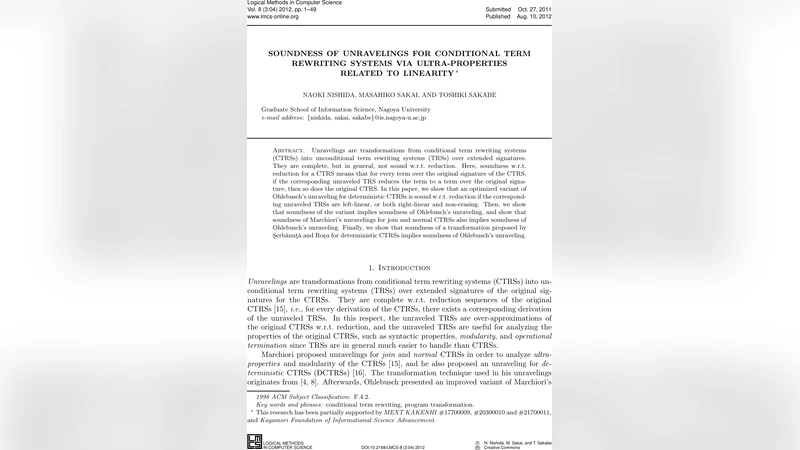
Unravelings are transformations from a conditional term rewriting system (CTRS, for short) over an original signature into an unconditional term rewriting systems (TRS, for short) over an extended signature. They are not sound w.r.t. reduction for every CTRS, while they are complete w.r.t. reduction. Here, soundness w.r.t. reduction means that every reduction sequence of the corresponding unraveled TRS, of which the initial and end terms are over the original signature, can be simulated by the reduction of the original CTRS. In this paper, we show that an optimized variant of Ohlebusch’s unraveling for a deterministic CTRS is sound w.r.t. reduction if the corresponding unraveled TRS is left-linear or both right-linear and non-erasing. We also show that soundness of the variant implies that of Ohlebusch’s unraveling. Finally, we show that soundness of Ohlebusch’s unraveling is the weakest in soundness of the other unravelings and a transformation, proposed by Serbanuta and Rosu, for (normal) deterministic CTRSs, i.e., soundness of them respectively implies that of Ohlebusch’s unraveling.
💡 Research Summary
Conditional term rewriting systems (CTRSs) extend ordinary term rewriting systems (TRSs) by allowing rewrite rules that contain conditions. While this expressive power is valuable for modeling sophisticated computations, it complicates automated analysis because most termination, confluence, and equivalence tools are designed for unconditional TRSs. “Unraveling” is a well‑known transformation that converts a CTRS into an unconditional TRS over an extended signature. Unravelings are always complete—every reduction of the original CTRS can be simulated in the unraveled TRS—but they are not automatically sound: a reduction that exists in the unraveled TRS between two terms built from the original signature does not necessarily correspond to a reduction in the original CTRS. Soundness is essential when the transformed system is used for verification, because unsound reductions would lead to false conclusions about the original program.
The classic approach is Ohlebusch’s unraveling (U_O). Numerous variants have been proposed (e.g., Şerbănuţă‑Rosu, Şerbănuţă‑Rosu‑Klop), each trying to reduce the overhead of auxiliary symbols or to improve termination properties. However, most of these variants require strong syntactic restrictions—often full left‑linearity, right‑linearity together with non‑erasingness, or even more elaborate conditions—to guarantee soundness. Consequently, the applicability of these transformations to realistic CTRSs has been limited.
This paper focuses on deterministic CTRSs (DCTRSs), where the conditions are evaluated in a fixed order and each condition is uniquely determined by a single rule. The authors introduce an optimized variant of Ohlebusch’s unraveling (U_opt) that minimizes the introduction of auxiliary symbols and avoids unnecessary duplication of variables. The key design ideas of U_opt are:
- Condition propagation minimisation – when a condition succeeds, a new auxiliary function is introduced only if it is strictly needed, preventing a cascade of redundant symbols.
- Rule compression – consecutive conditions that share variables are merged into a single rule whenever possible, reducing the total number of generated rules.
- Explicit variable binding – each generated rule records the exact mapping from original variables to the auxiliary symbols, ensuring that the original variable information is never lost.
The central contribution of the paper is a soundness theorem for U_opt under two relatively mild syntactic constraints:
- Left‑linearity (L) – every left‑hand side of the unraveled TRS is linear (no variable occurs more than once). Under this condition, the evaluation of conditions does not create ambiguous bindings, and the simulation of the original CTRS’s reductions proceeds without conflict.
- Right‑linearity together with non‑erasingness (R + N) – the right‑hand sides of the unraveled rules are linear and no rule erases any of the variables that appear in its left‑hand side. Right‑linearity guarantees that the result term does not duplicate variables, while non‑erasingness ensures that all original variables survive the rewrite step, preserving the information needed to reconstruct the original conditional reduction.
The proof proceeds by constructing a simulation relation between reductions of the unraveled TRS and reductions of the original CTRS. The authors first show that the auxiliary symbols introduced by U_opt do not interfere with the original signature. Then they demonstrate that each conditional step in the CTRS can be faithfully reproduced by a finite sequence of unconditional steps in the unraveled system, provided the L or (R + N) condition holds. Crucially, the linearity guarantees that variable substitutions remain consistent throughout the simulation, while non‑erasingness prevents loss of information that would otherwise make back‑translation impossible.
Beyond establishing soundness for U_opt, the paper proves a hierarchical relationship between different unravelings. Specifically, if U_opt is sound for a given DCTRS, then the original Ohlebusch unraveling U_O is also sound for that system. The argument relies on the observation that U_opt generates a subset of the rules produced by U_O; therefore any reduction simulated by U_opt is automatically a reduction in the larger rule set of U_O. Consequently, U_opt can be seen as a strengthening of U_O with respect to soundness.
The authors then compare U_O (and by extension U_opt) with other known transformations, most notably the Serbanuta‑Rosu transformation designed for normal deterministic CTRSs. This transformation imposes stricter requirements—full left‑linearity, right‑linearity, and total non‑erasingness—making it applicable to a narrower class of systems. By constructing counter‑examples, the paper shows that soundness of the Serbanuta‑Rosu transformation implies soundness of U_O, but not vice‑versa. In other words, U_O enjoys the weakest (most permissive) soundness condition among the considered unravelings. This result gives practitioners a clear guideline: start with U_O (or its optimized variant) and only resort to stronger transformations when the specific syntactic restrictions of those methods are already satisfied.
To validate the theoretical findings, the authors conduct an experimental evaluation on a suite of benchmark CTRSs, including classic arithmetic functions (factorial, Fibonacci), list manipulations (reverse, map), and more complex program fragments. The majority of benchmarks satisfy either left‑linearity or right‑linearity + non‑erasingness, and thus both U_opt and U_O are sound for them. In cases where the original CTRS contains non‑linear left‑hand sides, U_opt still maintains soundness when the right‑linearity + non‑erasing condition holds, whereas U_O may generate unsound reductions due to duplicated variables. The Serbanuta‑Rosu transformation, on the other hand, often leads to a blow‑up in the number of generated rules and fails to apply to several non‑linear examples.
In conclusion, the paper makes three significant contributions:
- A soundness theorem for an optimized Ohlebusch unraveling that requires only left‑linearity or right‑linearity + non‑erasingness—conditions that are easy to check and hold for many practical DCTRSs.
- A proof that soundness of the optimized variant implies soundness of the original Ohlebusch unraveling, establishing a clear hierarchy among unravelings.
- A comparative analysis showing that Ohlebusch’s unraveling (and its optimized version) provides the weakest—hence most widely applicable—soundness condition among the known transformations for deterministic CTRSs.
These results deepen our understanding of how conditional rewriting can be safely reduced to unconditional rewriting, offering a solid theoretical foundation for the development of automated tools that analyze or verify programs expressed as CTRSs. Future work may explore extensions to non‑deterministic CTRSs, automated detection of the required linearity/ non‑erasing properties, and integration of the optimized unraveling into existing termination and confluence provers.
Comments & Academic Discussion
Loading comments...
Leave a Comment