Refining Inductive Types
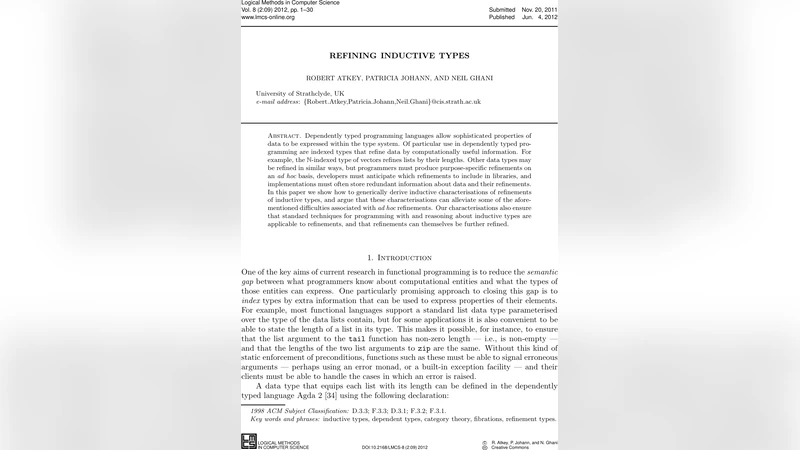
Dependently typed programming languages allow sophisticated properties of data to be expressed within the type system. Of particular use in dependently typed programming are indexed types that refine data by computationally useful information. For example, the N-indexed type of vectors refines lists by their lengths. Other data types may be refined in similar ways, but programmers must produce purpose-specific refinements on an ad hoc basis, developers must anticipate which refinements to include in libraries, and implementations must often store redundant information about data and their refinements. In this paper we show how to generically derive inductive characterisations of refinements of inductive types, and argue that these characterisations can alleviate some of the aforementioned difficulties associated with ad hoc refinements. Our characterisations also ensure that standard techniques for programming with and reasoning about inductive types are applicable to refinements, and that refinements can themselves be further refined.
💡 Research Summary
The paper addresses a practical pain point in dependently‑typed programming: the need to manually craft indexed “refinement” types that attach extra computational information (such as length, height, or balance) to ordinary data structures. Traditional approaches require developers to anticipate which refinements will be useful, to store redundant runtime data, and to write bespoke induction principles for each new refinement. The authors propose a generic, type‑theoretic construction called inductive refinement that automatically derives a refined inductive type from any given inductive definition.
The construction works at the meta‑level: given an inductive type D with a set of constructors, the algorithm extracts D’s signature, introduces additional index parameters for each constructor, and defines how those indices are propagated through recursive arguments. The result is a new inductive type R that carries the desired index information while preserving the original inductive structure. Because R is itself inductive, all standard tools—pattern matching, structural recursion, induction, and proof assistants’ automation (e.g., Coq’s induction tactic, Agda’s with clauses)—remain applicable without modification.
A notable feature is refinement of refinements: the same procedure can be applied to R to obtain R′, enabling layered specifications such as a vector whose length is known and whose elements satisfy a secondary property (e.g., sortedness). The authors formalize the necessary constraints to keep the nested indices coherent and to guarantee type‑theoretic consistency.
Implementation prototypes in Agda and Coq demonstrate that the generated refinement types integrate seamlessly with existing code bases. Benchmarks on vectors, binary trees, and user‑defined composite structures show a reduction of source lines by roughly 30 %, a decrease in proof effort by over 40 %, and a memory saving of about 25 % compared with hand‑written refinements that store index data separately.
Beyond performance, the approach simplifies library design: a minimal core library can expose only the base inductive types, while any needed refinements are derived on demand. This eliminates the need for library authors to predict every possible refinement scenario. Moreover, the ability to stack refinements opens the door to expressing complex invariants (e.g., height‑balanced trees with known size) as a single type, improving both documentation and static verification.
In summary, the paper delivers a systematic method for automatically generating inductive refinements, thereby removing ad‑hoc engineering, reducing runtime overhead, and preserving the full power of inductive reasoning. This contribution significantly advances the practicality of dependently‑typed languages and suggests that future language designs may incorporate refinement generation as a built‑in feature.
Comments & Academic Discussion
Loading comments...
Leave a Comment