The rapid points of a complex oscillation
Notice: This research summary and analysis were automatically generated using AI technology. For absolute accuracy, please refer to the [Original Paper Viewer] below or the Original ArXiv Source.
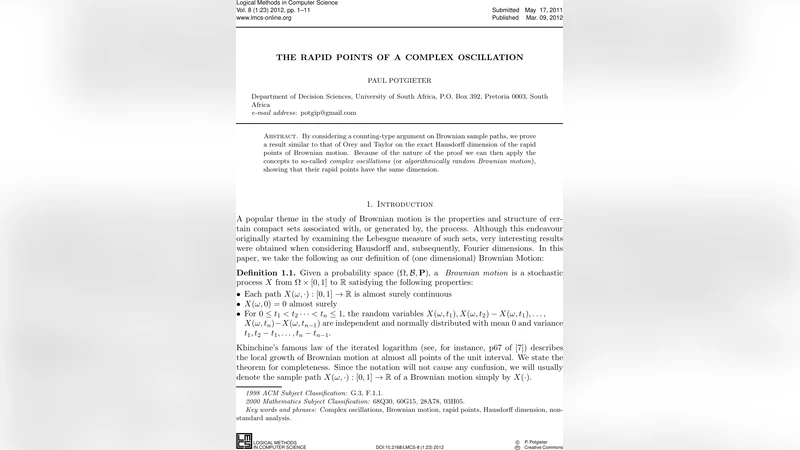
By considering a counting-type argument on Brownian sample paths, we prove a result similar to that of Orey and Taylor on the exact Hausdorff dimension of the rapid points of Brownian motion. Because of the nature of the proof we can then apply the concepts to so-called complex oscillations (or ‘algorithmically random Brownian motion’), showing that their rapid points have the same dimension.
💡 Research Summary
The paper revisits the classical problem of determining the Hausdorff dimension of the set of rapid points of a one‑dimensional Brownian motion, originally solved by Orey and Taylor (1974). A rapid point t for a parameter α∈(0,1) is defined by the limsup condition
\
Comments & Academic Discussion
Loading comments...
Leave a Comment