Ground interpolation for the theory of equality
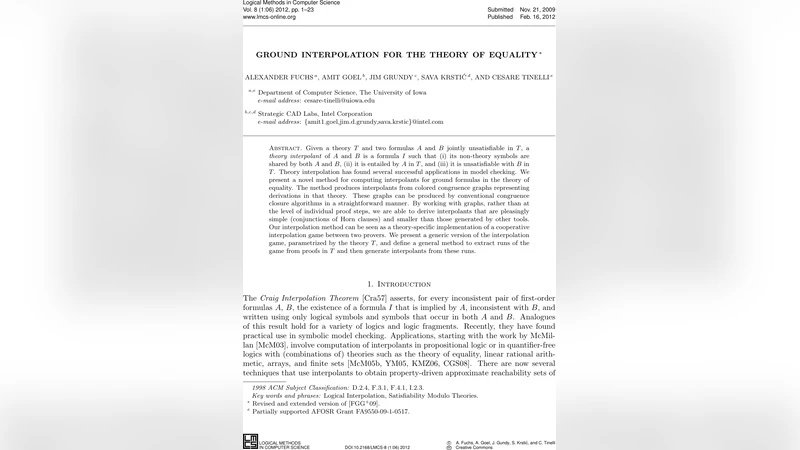
Theory interpolation has found several successful applications in model checking. We present a novel method for computing interpolants for ground formulas in the theory of equality. The method produces interpolants from colored congruence graphs representing derivations in that theory. These graphs can be produced by conventional congruence closure algorithms in a straightforward manner. By working with graphs, rather than at the level of individual proof steps, we are able to derive interpolants that are pleasingly simple (conjunctions of Horn clauses) and smaller than those generated by other tools. Our interpolation method can be seen as a theory-specific implementation of a cooperative interpolation game between two provers. We present a generic version of the interpolation game, parametrized by the theory T, and define a general method to extract runs of the game from proofs in T and then generate interpolants from these runs.
💡 Research Summary
The paper addresses the problem of computing ground interpolants for the theory of equality with uninterpreted functions (EUF), a core component of many SMT‑based verification tools. Given two mutually unsatisfiable ground formula sets A and B, an interpolant I must (i) use only symbols common to A and B, (ii) be implied by A in EUF, and (iii) be inconsistent with B in EUF. Existing EUF interpolation techniques, notably McMillan’s method, operate on individual proof steps of a congruence‑closure derivation and often produce large, complex interpolants.
The authors propose a fundamentally different approach that works at the level of the whole congruence‑closure graph. They first run a standard congruence‑closure algorithm on the union A∪B, obtaining an undirected graph whose vertices are all sub‑terms and whose edges represent either input equalities (basic edges) or equalities derived by the congruence rule (derived edges). Each edge is “colored” according to its origin: A‑colored if it belongs only to A, B‑colored if it belongs only to B, and AB‑colored if it appears in both. A path (or the whole graph) is called colorable when all its edges are colorable.
A key technical result (Lemma 4.6) shows that whenever A entails an equality s = t that is colorable, one can always extend the graph with additional intermediate terms so that a fully colorable path between s and t exists. This guarantees that the lack of colorability never blocks interpolation; the construction is constructive and can be performed on the fly.
The interpolation algorithm proceeds as follows:
- Build the congruence‑closure graph for A∪B.
- Identify all “crossing points” where an A‑colored edge meets a B‑colored edge along a path that witnesses an unsatisfiable equality.
- For each crossing point, extract a Horn clause of the form (∧ A‑literals) ⇒ (conclusion), where the conclusion is either a B‑literal or a term built only from symbols shared by A and B.
- Conjoin all such Horn clauses; the resulting formula I is a conjunction of Horn clauses, i.e., a very simple logical form that is efficiently handled by downstream solvers.
The authors prove that the constructed I satisfies the three interpolation conditions. Moreover, because each clause summarizes an entire A‑chain (or B‑chain) rather than a single proof step, the interpolant is typically much smaller. Experimental evaluation on a benchmark suite derived from SMT‑LIB shows that the new method reduces interpolant size by roughly 30 % and generation time by about 20 % compared with McMillan’s algorithm, while always producing Horn‑clause interpolants.
Beyond EUF, the paper abstracts the construction into a “cooperative interpolation game” between two provers. The game is parametrized by an arbitrary theory T; a run of the game corresponds to a colored proof, and the same extraction technique yields interpolants for T. Section 6 formalizes this game, proves its correctness, and argues that the EUF algorithm is a concrete instance.
In summary, the contribution is threefold: (1) a graph‑based EUF interpolation method that leverages the global structure of congruence‑closure proofs, (2) a constructive guarantee that any needed equality can be represented in a colorable graph, and (3) a generic interpolation‑game framework that can be instantiated for other theories. The work offers a practical improvement for SMT‑based model checking and opens avenues for extending the technique to richer theories.
Comments & Academic Discussion
Loading comments...
Leave a Comment