Extended Initiality for Typed Abstract Syntax
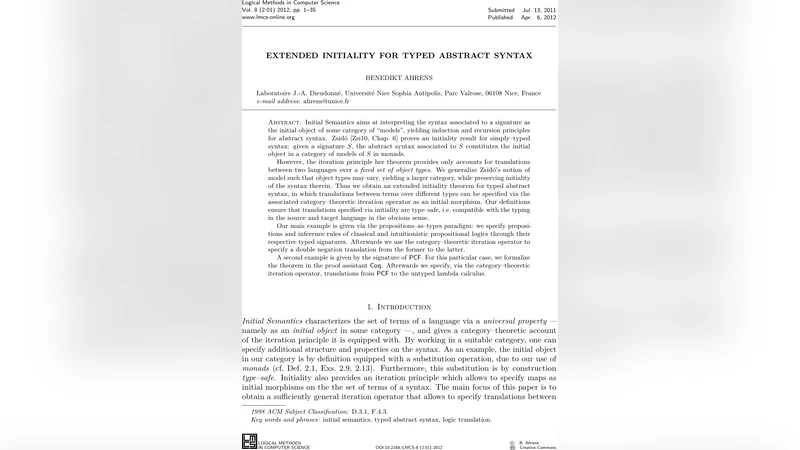
Initial Semantics aims at interpreting the syntax associated to a signature as the initial object of some category of ‘models’, yielding induction and recursion principles for abstract syntax. Zsid'o proves an initiality result for simply-typed syntax: given a signature S, the abstract syntax associated to S constitutes the initial object in a category of models of S in monads. However, the iteration principle her theorem provides only accounts for translations between two languages over a fixed set of object types. We generalize Zsid'o’s notion of model such that object types may vary, yielding a larger category, while preserving initiality of the syntax therein. Thus we obtain an extended initiality theorem for typed abstract syntax, in which translations between terms over different types can be specified via the associated category-theoretic iteration operator as an initial morphism. Our definitions ensure that translations specified via initiality are type-safe, i.e. compatible with the typing in the source and target language in the obvious sense. Our main example is given via the propositions-as-types paradigm: we specify propositions and inference rules of classical and intuitionistic propositional logics through their respective typed signatures. Afterwards we use the category–theoretic iteration operator to specify a double negation translation from the former to the latter. A second example is given by the signature of PCF. For this particular case, we formalize the theorem in the proof assistant Coq. Afterwards we specify, via the category-theoretic iteration operator, translations from PCF to the untyped lambda calculus.
💡 Research Summary
The paper investigates an extension of initial semantics for typed abstract syntax, building on Zsidó’s initiality result for simply‑typed languages. Initial semantics treats the syntax generated by a signature as the initial object in a category of “models”, thereby providing canonical induction and recursion principles. Zsidó’s theorem guarantees the existence of such an initial object for a given simply‑typed signature, but the associated iteration principle only supports translations between languages that share the same fixed set of object types (sorts). The authors’ main contribution is to remove this restriction: they define a broader notion of model in which object types may vary, and they prove that the initial object still exists in this enlarged category. Consequently, the iteration operator derived from initiality can now be used to specify type‑safe translations between languages whose type sets differ.
The technical development proceeds as follows. First, the authors formalize typed signatures: each operation is equipped with an arity that records the input and output object types, and the signature is interpreted over families of sets indexed by a set of object types. This leads naturally to monads (capturing substitution) and modules over monads (capturing the action of operations) parameterized by the object‑type set. A model of a typed signature is then a pair consisting of a monad and a compatible module satisfying the equations prescribed by the signature.
To allow varying object types, the authors introduce colax monad morphisms whose underlying functor maps one object‑type set to another. Such a morphism consists of a functor between the underlying categories of families of sets together with a natural transformation that respects the monad structure in a lax sense. This machinery enables the definition of morphisms between models that may live over different type sets.
The central theorem—the extended initiality theorem—states that for any simply‑typed signature, the category of its models (with colax morphisms) possesses an initial object. The proof constructs a free monad and a free module generated by the signature, then shows that any other model admits a unique colax morphism from this free construction. The uniqueness of the morphism guarantees the universal property of the initial object and yields an iteration operator that works uniformly across varying type sets.
With the theorem in place, the authors demonstrate its utility through two substantial examples.
-
Logical translation (classical → intuitionistic propositional logic). Both logics are presented as typed signatures: propositions become object types, and inference rules become operations with appropriate arities. The well‑known double‑negation translation is encoded as the unique initial morphism from the classical logic model to the intuitionistic one. Because the translation is obtained via initiality, it automatically respects typing: each classical proposition is mapped to an intuitionistic proposition of the correct type, and each proof term is translated to a well‑typed intuitionistic proof term.
-
Programming‑language translation (PCF → untyped lambda calculus). The authors formalize the simply‑typed language PCF as a typed signature, then instantiate the extended initiality theorem for this signature inside the Coq proof assistant. They provide two distinct models of the untyped lambda calculus (different ways of encoding PCF constructs) and obtain, by initiality, two concrete Coq functions that translate PCF terms into untyped lambda terms. The Coq development not only proves the existence of the initial object but also yields executable translation functions, illustrating the practical side of the theory.
The paper also discusses related work, situating the contribution among earlier approaches to initial semantics (Birkhoff, Fiore‑Plotkin‑Turi, Hirschowitz‑Maggesi) and their extensions to binding, monads, and reduction semantics. The authors note that while their framework handles syntactic translation cleanly, it does not yet address semantic preservation (i.e., ensuring that the operational behavior of programs is preserved by the translation). They outline possible future directions, such as incorporating reduction relations, handling dependent types, and extending to richer type systems (polymorphism, effects).
In summary, the work delivers a robust categorical foundation for specifying type‑safe translations between languages with different type universes. By generalizing the notion of model to allow varying object types and proving an extended initiality theorem, the authors provide a powerful iteration operator that can be used to define translations in a uniform, provably correct manner. The Coq formalization for PCF demonstrates that the theory is not merely abstract but can be mechanized, yielding executable translation code. This advances the state of the art in the categorical semantics of programming languages and logics, opening avenues for further research on semantics‑preserving translations and more expressive type systems.
Comments & Academic Discussion
Loading comments...
Leave a Comment