On the mathematical synthesis of equational logics
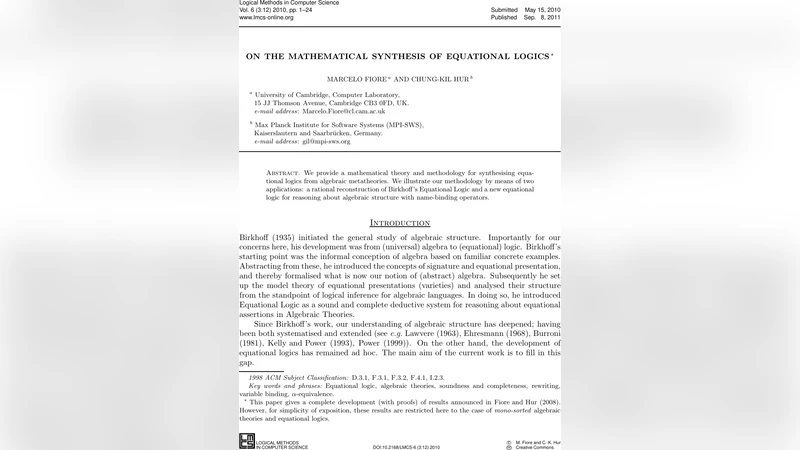
We provide a mathematical theory and methodology for synthesising equational logics from algebraic metatheories. We illustrate our methodology by means of two applications: a rational reconstruction of Birkhoff’s Equational Logic and a new equational logic for reasoning about algebraic structure with name-binding operators.
💡 Research Summary
The paper develops a general, mathematically rigorous methodology for synthesising equational logics directly from algebraic metatheories. The authors work in a symmetric monoidal closed category (\mathcal C) equipped with a strong monad (T). They introduce Monadic Equational Systems (MES), triples ((\mathcal C,T,A)) where (A) is a set of equations expressed as parallel Kleisli maps. Terms are Kleisli arrows, and models are (T)-algebras (Eilenberg‑Moore algebras) that satisfy all equations; the category of such models is denoted (S\text{-Alg}).
On top of an MES they define an Equational Metalogic (EML), a deductive system whose judgments have the form (A\vdash u\equiv v). The inference rules include reflexivity, symmetry, transitivity, substitution (via Kleisli composition), tensor extension, and a locality rule based on jointly epi families. They prove soundness: any derivable judgment holds in every (S)-algebra.
The central technical contribution is an internal completeness theorem. Assuming the MES admits free algebras (i.e., the forgetful functor (U_S:S\text{-Alg}\to\mathcal C) has a left adjoint), they construct a strong monad morphism (q_S:T\to T_S) (the quotient map). They show that an equation holds in all models iff it holds in the free (S)-algebra on its arity, which is equivalent to the two sides being identified by (q_S).
To guarantee the existence of free algebras they introduce finitary and inductive conditions on the MES: (\mathcal C) must be cocomplete, (T) (\omega)-continuous, arities compact, and (T) must preserve epimorphisms with projective arities. Under these hypotheses they give an explicit inductive construction of the quotient maps using pushouts and coequalisers, and they show how the construction simplifies when (T) arises from a left adjoint to a forgetful functor.
The second part of the paper translates this theory into a practical methodology: choose a suitable category and signature, encode signatures as strong monads, formulate equations as Kleisli pairs, derive the corresponding EML, and then use the inductive construction of free algebras to obtain completeness. The intermediate deductive system that arises during the construction often yields a rewriting‑style calculus that is both sound and complete.
Two applications illustrate the approach. First, the classic Birkhoff equational logic is recovered as the MES ((\textbf{Set},T_\Sigma,E)) where (T_\Sigma) is the term monad of a signature (\Sigma) and (E) the set of axioms; the resulting EML coincides with Birkhoff’s original system, and the internal completeness theorem reproduces the standard sound‑complete result. Second, the authors design a new equational logic for languages with name‑binding operators (e.g., λ‑calculus). By modelling binding via appropriate monads (such as the nominal or abstraction monad) and choosing projective arities, they obtain a MES that admits free algebras; the associated EML provides a clean, algebraic reasoning principle for α‑equivalence and substitution, and completeness follows from the internal theorem.
Overall, the paper offers a unifying categorical framework that turns algebraic metatheories into fully fledged equational logics with guaranteed soundness and completeness, opening the door to systematic logic design for a wide range of algebraic structures, including those with sophisticated binding mechanisms.
Comments & Academic Discussion
Loading comments...
Leave a Comment