Intuitionistic implication makes model checking hard
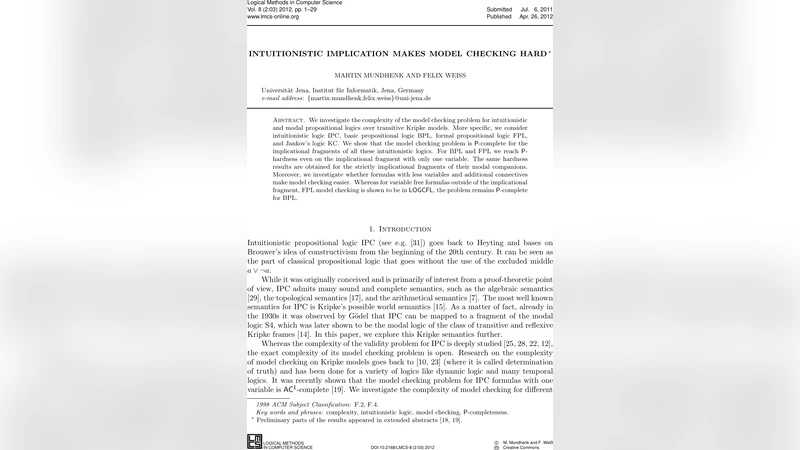
We investigate the complexity of the model checking problem for intuitionistic and modal propositional logics over transitive Kripke models. More specific, we consider intuitionistic logic IPC, basic propositional logic BPL, formal propositional logic FPL, and Jankov’s logic KC. We show that the model checking problem is P-complete for the implicational fragments of all these intuitionistic logics. For BPL and FPL we reach P-hardness even on the implicational fragment with only one variable. The same hardness results are obtained for the strictly implicational fragments of their modal companions. Moreover, we investigate whether formulas with less variables and additional connectives make model checking easier. Whereas for variable free formulas outside of the implicational fragment, FPL model checking is shown to be in LOGCFL, the problem remains P-complete for BPL.
💡 Research Summary
The paper investigates the computational complexity of the model‑checking problem for several intuitionistic propositional logics—IPC (intuitionistic propositional calculus), BPL (basic propositional logic), FPL (formal propositional logic), and KC (Jankov’s logic)—as well as for their modal companions (K4, S4, S4.2, and PrL). All these logics are interpreted over finite Kripke models whose underlying frames are transitive; additional frame properties (reflexivity, irreflexivity, directedness) distinguish the individual logics.
The model‑checking problem (denoted L‑KMc) asks, given a formula ϕ of a logic L, a Kripke model M = (U,R,ξ) for L, and a state s ∈ U, whether M,s ⊨ ϕ holds. The input is encoded straightforwardly (formula as text, the frame as an adjacency matrix), so the problem is well‑defined in the standard Turing‑machine model. An upper bound of P follows from earlier work on modal model checking (Fischer & Ladner, 1995).
The core contribution is to show that this upper bound is tight: for each of the four intuitionistic logics, model checking is P‑complete, even when restricted to the implicational fragment (formulas built only from → and ⊥). Moreover, for BPL and FPL the P‑hardness already holds with a single propositional variable; for IPC two variables are needed, reflecting the extra reflexivity constraint of its frames.
To establish P‑hardness the authors reduce the Alternating Graph Accessibility Problem (Agap), known to be P‑complete (Chandra, Kozen, Stockmeyer 1981). An Agap instance is a bipartite directed graph whose vertices are partitioned into existential (V∃) and universal (V∀) nodes, together with distinguished start and target nodes s and t. The question is whether there exists an alternating path from s to t respecting the existential/universal alternation. The reduction encodes the alternating choices as logical constraints using only → and ⊥, and uses the structure of the Kripke frame to simulate the graph’s reachability. For BPL and FPL the frame’s lack of reflexivity (or its directed preorder nature) allows the encoding with a single variable; for IPC the reflexive preorder forces the use of two variables to mark distances and selected states.
The paper also studies the effect of removing variables altogether. For the variable‑free fragment of FPL (i.e., formulas using only ⊥ and ∨), model checking drops to LOGCFL, a subclass of P that is log‑space reducible to context‑free languages. In contrast, the variable‑free fragment of BPL remains P‑complete, because the disjunction operator alone suffices to encode the alternating choices required by Agap.
A significant technical tool is the Gödel‑Tarski translation gt, which maps intuitionistic formulas into the language of the corresponding modal companion while preserving validity. The translation replaces each propositional variable p by p ∧ □p and translates implication α → β into □(gt(α) → gt(β)). Because gt does not introduce new propositional variables, it yields log‑space many‑one reductions between the model‑checking problems of an intuitionistic logic and its modal companion (e.g., BPL‑KMc ≤_logm K4‑KMc, IPC‑KMc ≤_logm S4‑KMc, etc.). A variant gt′ keeps variables unchanged (gt′(p)=p) and therefore translates implicational formulas into strictly implicational modal formulas, which is useful for preserving the fragment structure during reductions.
The authors also discuss the relationship between the number of variables needed for PSPACE‑hardness of the validity problem (known from earlier work) and the number of variables needed for P‑hardness of model checking. For the logics considered, the bounds coincide: IPC needs two variables for PSPACE‑hard validity and also for P‑hard model checking; BPL and FPL need only one variable for both. This suggests that the difficulty of model checking is already captured at the same variable level as the hardest validity instances.
The paper is organized as follows: Section 2 introduces the formal syntax and semantics of the logics, defines the model‑checking decision problems, and recalls the P‑completeness of Agap. Section 3 presents the main P‑completeness results for the intuitionistic logics, including the variable‑bounded hardness and the LOGCFL upper bound for variable‑free FPL. Section 4 transfers these results to the modal companions via the Gödel‑Tarski translations. Section 5 summarizes the findings, provides a visual overview (Figures 7 and 8), and discusses optimality of the variable bounds.
In conclusion, the paper establishes that even the very restricted implicational fragment of intuitionistic propositional logics already yields a P‑complete model‑checking problem, and that this hardness persists under very tight resource constraints (as few as one propositional variable). The results illuminate the intrinsic computational difficulty of reasoning in intuitionistic settings and clarify how frame properties and the presence of additional connectives influence the complexity landscape.
Comments & Academic Discussion
Loading comments...
Leave a Comment