Conway games, algebraically and coalgebraically
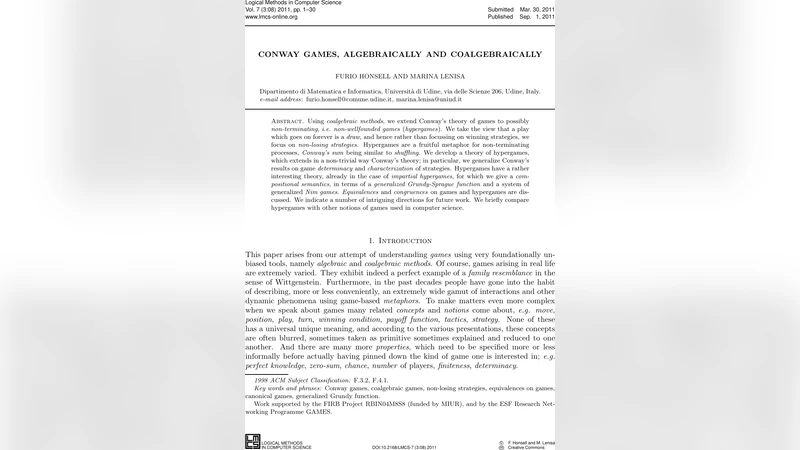
Using coalgebraic methods, we extend Conway’s theory of games to possibly non-terminating, i.e. non-wellfounded games (hypergames). We take the view that a play which goes on forever is a draw, and hence rather than focussing on winning strategies, we focus on non-losing strategies. Hypergames are a fruitful metaphor for non-terminating processes, Conway’s sum being similar to shuffling. We develop a theory of hypergames, which extends in a non-trivial way Conway’s theory; in particular, we generalize Conway’s results on game determinacy and characterization of strategies. Hypergames have a rather interesting theory, already in the case of impartial hypergames, for which we give a compositional semantics, in terms of a generalized Grundy-Sprague function and a system of generalized Nim games. Equivalences and congruences on games and hypergames are discussed. We indicate a number of intriguing directions for future work. We briefly compare hypergames with other notions of games used in computer science.
💡 Research Summary
The paper “Conway games, algebraically and coalgebraically” presents a systematic extension of John Conway’s combinatorial game theory to encompass non‑terminating, i.e., non‑well‑founded games, which the authors call hypergames. The central idea is to treat an infinite play as a draw; consequently the traditional notion of a winning strategy is replaced by a non‑losing strategy. By adopting both algebraic (initial algebra) and coalgebraic (final coalgebra) perspectives on the same functor F(A)=P(A)×P(A) (the product of two power‑set functors), the authors obtain a clean categorical framework that simultaneously captures Conway’s original well‑founded games (as the initial algebra) and the new hypergames (as the final coalgebra of the same functor).
The paper is organized into six sections.
-
Introduction motivates the need for a theory of infinite games, pointing out that many computational processes (operating systems, communication protocols, reactive systems) are naturally modeled as never‑terminating interactions. The authors argue that treating infinite plays as draws yields a more faithful abstraction for such systems.
-
From Conway’s Games to Hypergames formally defines Conway games as the carrier G of the initial F‑algebra, using the familiar notation x=(X_L,X_R) where X_L and X_R are the sets of left and right options. Hypergames are then introduced as the carrier H of the final F‑coalgebra, i.e., the class of all (possibly non‑well‑founded) sets satisfying an anti‑foundation axiom. The paper proves a determinacy theorem for hypergames: every hypergame admits either a left non‑losing strategy or a right non‑losing strategy (or both), extending Conway’s classic determinacy result to the infinite setting.
-
Algebraic Operations on Hypergames lifts Conway’s disjunctive sum and negation to the coalgebraic world. The sum ⊕ is defined as the unique coalgebra morphism that combines two hypergames by interleaving their moves, preserving the draw‑as‑infinite‑play convention. Negation swaps left and right options. Both operations are shown to be compatible with the contextual equivalence introduced later, and they respect the coalgebraic structure (they are homomorphisms).
-
Equivalences and Congruences introduces several notions of equivalence: bisimulation, the partial order ≤ induced by Conway’s “greater‑or‑equal” relation, and a new contextual equivalence that requires two games to remain indistinguishable when placed in any surrounding game context. The authors prove that contextual equivalence coincides with the equivalence induced by the partial order on ordinary Conway games, and that it is the greatest congruence compatible with the sum operation. This result provides a robust algebraic notion of when two (hyper)games can be substituted for each other without affecting overall behavior.
-
Impartial Hypergames and a Generalized Grundy Theory focuses on the subclass of impartial hypergames, where left and right have identical option sets at every position. The classic Sprague‑Grundy theory, which assigns a Grundy number to each impartial finite game, is extended to the infinite realm. The authors define a generalized Grundy function g that maps any impartial hypergame to an element of a canonical family of infinite Nim‑type games (called ∞‑hypergames). They prove that every impartial hypergame is contextually equivalent to a unique canonical ∞‑hypergame, and that the sum of two impartial hypergames corresponds to the Nim‑xor of their Grundy values, exactly as in the finite case. This provides a compositional semantics that is fully abstract with respect to the contextual equivalence.
-
Related Work and Future Directions compares the coalgebraic hypergame approach with earlier graph‑based or pointed‑graph models of infinite games, highlighting the advantages of a set‑theoretic (or class‑theoretic) representation: bisimulation coincides with game equivalence, and the categorical machinery yields clean proofs of determinacy and congruence properties. The paper concludes with several open problems, such as exploring algorithmic aspects of the generalized Grundy function, extending the framework to mixed or fixed infinite games (where some infinite plays are declared wins for a player), and applying hypergame semantics to verification of reactive systems and infinite-state automata.
Overall, the contribution is twofold: (i) a mathematically elegant, category‑theoretic unification of Conway’s finite game theory with a theory of infinite, non‑terminating games; and (ii) a concrete, compositional semantics for impartial hypergames via a generalized Grundy‑Nim construction. By replacing winning strategies with non‑losing strategies and treating infinite plays as draws, the authors open a pathway for applying combinatorial game ideas to a broad class of computational processes that never halt, offering new tools for reasoning about equivalence, strategy synthesis, and modular composition in infinite‑state systems.
Comments & Academic Discussion
Loading comments...
Leave a Comment