Decidable Expansions of Labelled Linear Orderings
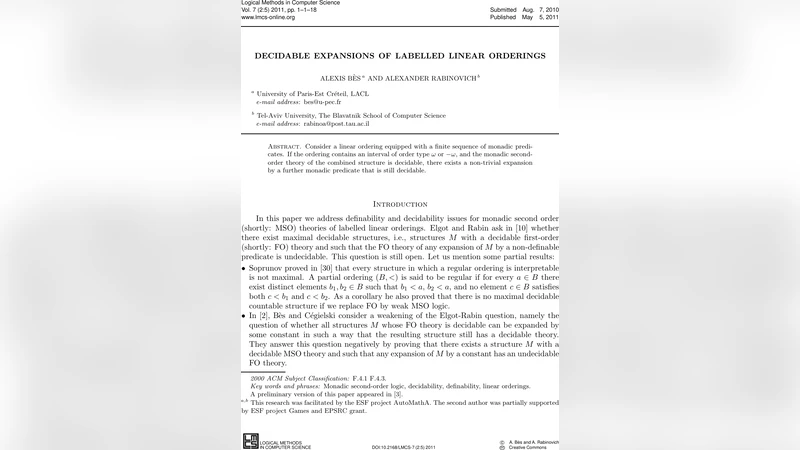
Consider a linear ordering equipped with a finite sequence of monadic predicates. If the ordering contains an interval of order type \omega or -\omega, and the monadic second-order theory of the combined structure is decidable, there exists a non-trivial expansion by a further monadic predicate that is still decidable.
💡 Research Summary
The paper investigates decidability and maximality issues for monadic second‑order (MSO) theories of labelled linear orderings, i.e., structures of the form M = (A, <, P₁,…,Pₙ) where < is a total order on A and each Pᵢ is a unary predicate (a “label”). The central question, motivated by the classic Elgot‑Rabin problem, asks whether there exist structures whose MSO theory is decidable but becomes undecidable after any non‑definable expansion. The authors show that for a very broad class of labelled linear orderings this never happens: if the underlying order (A, <) contains an interval isomorphic to ω (the natural numbers) or to –ω (the reverse of ω) and the MSO theory of M is decidable, then one can add a new unary predicate Q, not definable in M, such that the expanded structure M′ = (A, <, P₁,…,Pₙ, Q) still has a decidable MSO theory. Consequently, no such M is maximal with respect to MSO decidability.
The proof proceeds in two stages. First, the authors treat the canonical cases of the natural numbers (ω) and the integers (ζ). Using Büchi’s theorem that MSO over ω coincides with ω‑regular languages, they construct a uniform method to colour intervals of the order with a new predicate Q while preserving decidability. The construction relies on the notion of k‑type (the set of all MSO sentences of quantifier depth ≤ k true in a structure). By ensuring that all intervals used in the construction share the same k‑type, the MSO theory of the expanded structure can be computed from the k‑types of the original structure.
For the general case, the authors introduce a convex equivalence relation ∼ on A that is definable in M and partitions A into convex blocks. Each block is either finite, of type –ω, ω, or ζ. The structure M can then be viewed as an ordered sum of the substructures induced on these blocks, together with the quotient order M/∼. The crucial tool is Shelah’s composition theorem for ordered sums: the k‑type of a sum is effectively determined by the k‑types of its summands. Applying the construction from the first stage to each block yields a predicate Q that is defined block‑wise but globally non‑definable in M. Because the k‑type of each block’s expansion is computable from its original k‑type, the overall MSO theory of M′ reduces to the MSO theories of the blocks and of the quotient, all of which are decidable by hypothesis. Hence MSO(M′) is decidable.
The paper also discusses why this result does not follow from earlier criteria based on Gaifman graphs (as in
Comments & Academic Discussion
Loading comments...
Leave a Comment