The degree structure of Weihrauch-reducibility
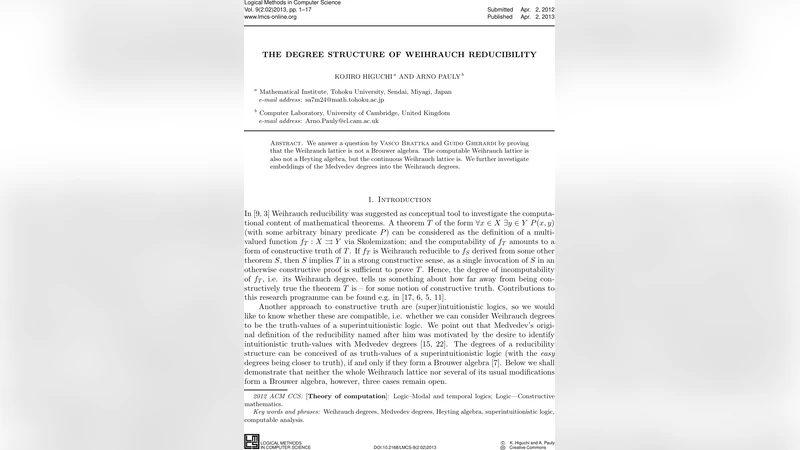
We answer a question by Vasco Brattka and Guido Gherardi by proving that the Weihrauch-lattice is not a Brouwer algebra. The computable Weihrauch-lattice is also not a Heyting algebra, but the continuous Weihrauch-lattice is. We further investigate the existence of infinite infima and suprema, as well as embeddings of the Medvedev-degrees into the Weihrauch-degrees.
💡 Research Summary
The paper investigates the algebraic structure of the Weihrauch degrees, a lattice that orders multivalued computational problems according to Weihrauch reducibility. The authors address a question raised by Brattka and Gherardi concerning whether this lattice forms a Brouwer algebra. By constructing specific counterexamples, they show that the full Weihrauch lattice does not admit a well‑defined implication operation for all pairs of degrees, and therefore fails to be a Brouwer algebra.
The analysis then distinguishes between three related lattices: the general Weihrauch lattice, its computable sublattice (where every problem is realized by a Turing machine), and the continuous sublattice (where problems are represented by continuous functions on Baire space). For the computable Weihrauch lattice the authors demonstrate that the Heyting algebra law (a\to a = 1) (the self‑implication must be the top element) is violated. They provide a concrete computable problem whose self‑implication does not yield the top degree, establishing that this sublattice is not a Heyting algebra.
In contrast, the continuous Weihrauch lattice does support a well‑behaved implication operation. Using the continuity of the underlying realizers, the authors define an implication (P\to Q) that satisfies all Heyting algebra axioms, thereby proving that the continuous lattice is indeed a Heyting algebra. This result highlights how the additional topological restriction restores logical completeness that is absent in the unrestricted setting.
The paper also examines the existence of infinite meets and joins. It is shown that the unrestricted Weihrauch lattice does not contain arbitrary countable infima or suprema: for example, the countable family of choice principles ({C_n}_{n\in\mathbb{N}}) has no supremum in the lattice. The authors prove that the lack of such infinite joins is another source of the failure of Brouwer‑algebraic properties. By contrast, under the continuity constraint, certain countable joins do exist, indicating a richer completeness profile for the continuous sublattice.
Finally, the authors explore embeddings of Medvedev degrees into the Weihrauch degrees. They construct an order‑preserving embedding that maps each Medvedev degree to a “constant problem” (a problem with no input and a fixed output set). This embedding respects the ordering but does not preserve the lattice operations: joins and meets in the Medvedev structure do not correspond to joins and meets in the Weihrauch lattice. Consequently, while the Medvedev degrees sit inside the Weihrauch degrees as an ordered substructure, they do not form a sub‑lattice.
Overall, the paper provides a thorough characterization of the Weihrauch lattice’s algebraic limitations, clarifies the role of computability versus continuity in shaping its logical properties, and situates the Weihrauch degrees relative to the classical Medvedev hierarchy. These contributions deepen our understanding of the interplay between computable analysis, constructive logic, and degree theory, and open avenues for further investigation of logical algebras arising from computational reducibilities.
Comments & Academic Discussion
Loading comments...
Leave a Comment