Functional Interpretations of Intuitionistic Linear Logic
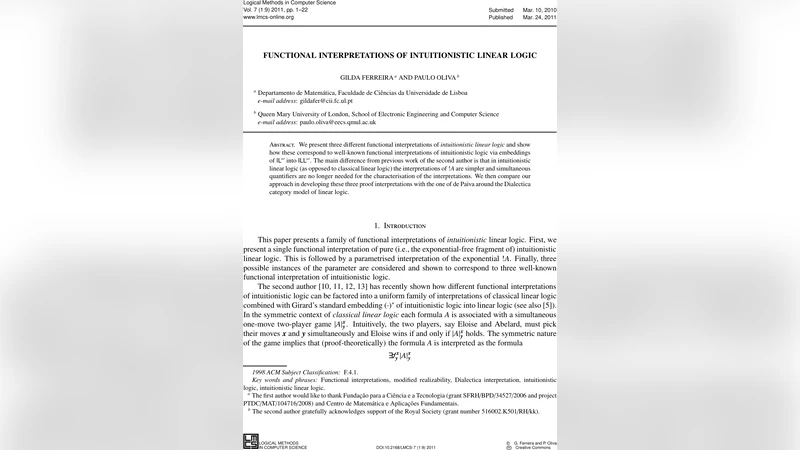
We present three different functional interpretations of intuitionistic linear logic ILL and show how these correspond to well-known functional interpretations of intuitionistic logic IL via embeddings of IL into ILL. The main difference from previous work of the second author is that in intuitionistic linear logic (as opposed to classical linear logic) the interpretations of !A are simpler and simultaneous quantifiers are no longer needed for the characterisation of the interpretations. We then compare our approach in developing these three proof interpretations with the one of de Paiva around the Dialectica category model of linear logic.
💡 Research Summary
The paper “Functional Interpretations of Intuitionistic Linear Logic” develops a unified framework for interpreting intuitionistic linear logic (ILL) functionally and shows how three well‑known functional interpretations of intuitionistic logic (IL) – Gödel’s Dialectica, Diller‑Nahm, and Kreisel’s modified realizability – arise as special cases. The authors proceed in several stages.
First, they give a basic functional interpretation for the pure fragment of ILL, i.e., the fragment without the exponential modality !. Every ILL formula A is translated into a formula |A| x y of a verifying system ILLωᵇ, where x is a tuple of “witnesses” and y a tuple of “challenges”. Atomic formulas are left unchanged. The logical connectives are interpreted as follows: implication A⊸B becomes |A| x (f x w) ⊸ |B| g x w, where f and g are functional witnesses; tensor A⊗B becomes |A| x y ⊗ |B| v w; additive conjunction A&B is rendered as a guarded disjunction |A| x y ^ z |B| v w, where the Boolean variable z indicates which component is chosen; similarly for additive disjunction A⊕B. Quantifiers are handled by λ‑abstraction (∀) and existential pairing (∃). This interpretation can be read as a one‑move two‑player sequential game: Eloise (the prover) first supplies a witness x, then Abelard (the refuter) supplies a challenge y; Eloise wins iff |A| x y holds. Crucially, unlike the classical linear logic setting, no simultaneous quantifiers are needed: the asymmetry is already built into ILL, so the interpretation is simpler.
The second major contribution is a parametrised treatment of the exponential !A. They define |!A| x a ≡ ∀y∈a |A| x y, where a is a set of moves that Abelard may choose from. By varying the allowed shape of a they obtain three distinct functional interpretations:
- Singleton sets (a contains exactly one element) give the Dialectica interpretation. Here Abelard’s “set of moves” collapses to a single function, matching Gödel’s original formulation.
- Finite sets correspond to the Diller‑Nahm interpretation. Abelard may choose from a finite collection of possible responses, reflecting the bounded quantifier structure of Diller‑Nahm.
- All possible moves (a is the whole type of moves) yields Kreisel’s modified realizability. Abelard is unrestricted, which aligns with the classical realizability viewpoint.
Thus the exponential modality alone supplies the “non‑canonical” ingredient that distinguishes the three interpretations; the pure fragment of ILL is interpreted identically across them.
The third component of the paper concerns embeddings of intuitionistic logic into ILL. Two translations are defined: the familiar Girard embedding * (A ↦ !A*) and a second translation ◦ that maps A to !A* while also translating additive connectives via exponentials. Using these embeddings, the authors show that the basic interpretation of pure ILL coincides exactly with Gödel’s Dialectica interpretation of IL when the linear connectives ⊸, ⊗, ⊕ are read as →, ∧, ∨ respectively. Consequently, any proof in IL can be carried over to ILL, interpreted, and then projected back, preserving the functional content.
To formalise the soundness proofs, the authors introduce a verifying system ILLωᵇ that extends ILLω with a Boolean base type, constants true/false, an equality predicate, and a conditional term λz(t,q). They give a minimal set of equality axioms and Boolean axioms sufficient to verify the basic interpretation and the three exponential variants. The system also includes a restricted version ILLωʳ, where the &‑right rule is limited to contexts consisting solely of formulas of the form !A; this restriction is needed for the soundness of the additive conjunction in the presence of exponentials.
The final section compares the present proof‑theoretic approach with de Paiva’s categorical Dialectica model of linear logic. De Paiva’s work builds a category of “Dialectica objects” that models classical linear logic and yields the Dialectica interpretation. The authors argue that their parametrised exponential treatment reproduces de Paiva’s model for the singleton case, while simultaneously extending it to capture Diller‑Nahm and modified realizability. In this sense, the paper provides a proof‑theoretic counterpart to the categorical construction and clarifies how the exponential modality in ILL generates the spectrum of functional interpretations.
Overall, the paper achieves a clean unification: the pure fragment of ILL admits a single, symmetric game‑theoretic interpretation; the exponential !A supplies the asymmetry needed for different realizability‑style interpretations; and the embeddings of IL into ILL ensure that the three classic functional interpretations of intuitionistic logic are recovered as special cases. This work deepens the understanding of the relationship between linear logic, intuitionistic logic, and functional interpretations, and it offers a flexible framework for further exploration of computational content in proofs.
Comments & Academic Discussion
Loading comments...
Leave a Comment